
If you’re looking for serious AI and machine learning talent in Latin America, one market stands above the rest.
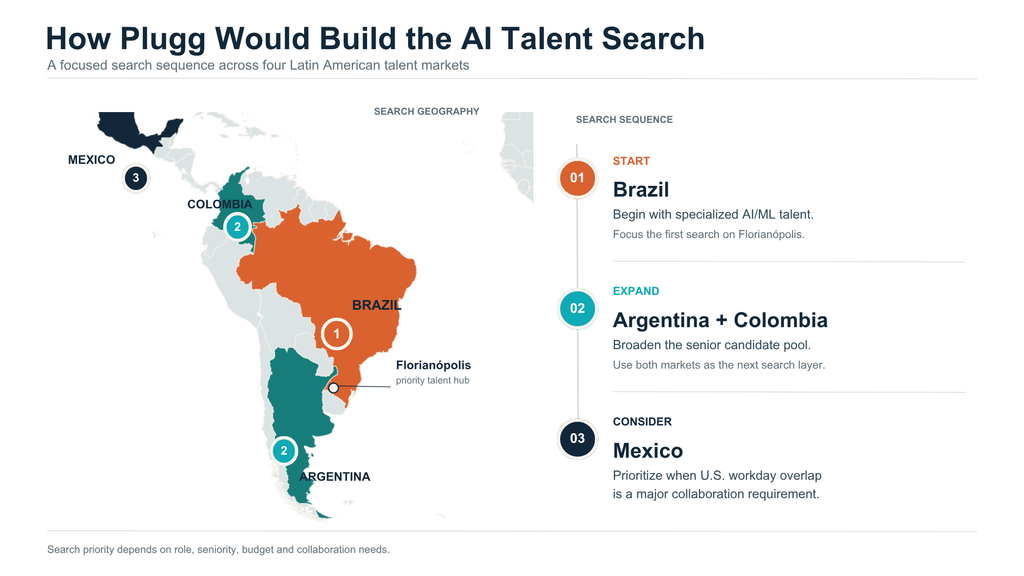
Short answer: We’d start in Brazil, particularly Florianópolis. Plugg founder Brian Samson calls Brazil the “undisputed leader” in LATAM AI/ML talent, with Argentina and Colombia behind it.
That doesn’t mean every AI search should end in Brazil.
An ML engineer, LLM engineer, data scientist and MLOps engineer can require very different experience. Budget, seniority and collaboration needs can also change where we’d look.
But if a U.S. CTO asked us where to begin a specialized AI/ML search today, Brazil would be our first answer.
Our recommendation: start in Brazil for specialized AI/ML talent, then widen the search to Argentina and Colombia based on the role, budget and candidate pool.
This guide compares the markets we’d consider based on talent depth, cost, collaboration and specialization.
Who is this for?
This guide is for U.S. CTOs, founders and engineering leaders deciding where to recruit AI and machine learning talent in Latin America.
It’s most useful if you’re hiring machine learning engineers, AI developers, data scientists, LLM engineers, MLOps engineers or other specialized AI talent.
If you need a software engineer who can integrate an LLM API or add AI functionality to an existing product, you may not need a dedicated AI/ML specialist.
What does it cost to hire AI and machine learning engineers in LATAM?
For planning purposes, AI/ML talent in Latin America starts around $45 per hour and can reach into the $60s, based on Plugg’s internal data.
Where a hire lands in that range depends heavily on the role.
A software engineer integrating existing AI models into a product has a different hiring profile from an ML engineer developing models, an LLM specialist working on retrieval and evaluation, or an MLOps engineer responsible for deploying and maintaining AI systems in production.
Seniority matters too. The more architecture, production ownership and specialized model experience you need, the more likely the hire is to move toward the upper end of the range.
Our recommendation: use $45 per hour as an initial floor for specialized AI/ML planning, with room into the $60s for more senior or specialized talent.
What are the advantages of hiring AI and ML engineers in LATAM?
Brazil is Plugg’s first choice for AI/ML talent
For a specialized AI or machine learning search, we’d start in Brazil.
Plugg founder Brian Samson describes Brazil as the “undisputed leader” in LATAM AI/ML talent, with Florianópolis standing out in particular.
There’s broader market evidence behind that firsthand assessment. Brazil recorded approximately 494,000 formal IT employment relationships in 2025, including about 291,000 in systems development, according to Brasscom. Those aren’t AI-engineer counts, but they demonstrate the scale of the country’s broader technology workforce.
Brazil is also investing directly in its AI pipeline. In 2026, the Ministry of Science, Technology and Innovation announced R$129 million for an AI-focused technology residency program expected to train 1,800 AI developers and another 4,000 users of AI tools.
Brazil Ministry of Science, Technology and Innovation
Plugg has heard the same shift firsthand. On the Nearshore Cafe Podcast, Tony Teshara discusses Brazil’s growing AI talent market, including machine learning and LLM roles and the country’s increasing relevance as a sourcing market for U.S. companies.
Nearshore Cafe Podcast: AI Talent, Nearshoring & Brazil’s Tech Boom
For a difficult ML, LLM or specialized AI search, Brazil wouldn’t simply make our shortlist. It’s where we’d start.
Why Florianópolis?
Within Brazil, Plugg sees particularly strong AI/ML talent in Florianópolis.
That’s based on Brian Samson’s firsthand market experience. We don’t currently have a neutral Florianópolis-specific data point in the source set that quantifies its AI/ML talent pool, so we wouldn’t manufacture one.
For buyers, the practical takeaway is simple: don’t treat Brazil as one enormous interchangeable talent market. Where you search within the country can matter too.
Argentina is a strong second market
After Brazil, Argentina would be one of the next markets we’d add to a specialized AI/ML search.
Plugg’s view of Argentina also comes with substantial firsthand technical-market experience. Founder Brian Samson previously built an 85-person software development operation in Buenos Aires, giving him direct experience building engineering teams in the country.
Argentina is also expanding technical training in areas including artificial intelligence, data and cloud technologies. That doesn’t tell us exactly how many production-ready AI engineers are available today, but it provides another signal of continued investment in these skills.
Argentina government technology training programs
We’d add Argentina when the Brazil search needs to widen, particularly for experienced technical talent.
Colombia belongs in the next wave of the search
Alongside Argentina, we’d look to Colombia after Brazil for specialized AI/ML talent.
That Plugg market view is reinforced by Colombia’s 2025 national digital-talent study, which identified increasing employer demand for artificial intelligence, Big Data and analytics, cloud computing, cybersecurity and DevOps. The study analyzed 16 datasets and more than 3.5 million data points.
Colombia’s 2025–2030 digital talent study
Colombia also brings substantial U.S. workday overlap and has historically shown more competitive pricing than Brazil in Plugg’s broader hiring history.
That combination makes Colombia particularly interesting when AI skills, collaboration and economics all matter.
Where does Mexico fit?
Mexico remains worth considering when U.S. collaboration is a major priority, but it wouldn’t be our first market for a specialized AI/ML search.
Mexico is the center of Plugg’s broader 2021–2026 hiring history, giving Plugg substantially more firsthand recruiting experience there than in any other LATAM market in the dataset. That’s evidence of Plugg’s experience recruiting technical talent in Mexico, rather than a measure of its AI-specific talent pool.
There are also signs of continued investment in AI skills. The government-backed MEXIA initiative reported 12,400 registrations in its first generation, with 17 partner companies and six specialization tracks.
Mexico’s workday overlap can make it particularly attractive when an AI engineer needs to collaborate continuously with U.S.-based product, data and engineering teams.
For specialized AI/ML talent, however, we’d put Brazil ahead and add Argentina and Colombia before assuming Mexico is the strongest market for the role.
What are the disadvantages?
Specialized AI/ML talent can get expensive quickly.
With Plugg’s internal data putting AI/ML talent at around $45 per hour to start and into the $60s, the economics can look different from a general LATAM software-development search.
The talent is also harder to benchmark. There isn’t a directly comparable count of production-ready AI or ML engineers across Brazil, Argentina, Colombia and Mexico. Technology workforce and training data provide useful signals, but they don’t tell us exactly how many qualified engineers are available today.
Workday overlap varies too. Colombia and Mexico generally provide easier overlap for Pacific teams than Argentina or Brazil’s major technology hubs.
For specialized roles, you may need flexibility on geography or budget to get the experience you need.
What are the risks?
The biggest risk is hiring someone whose AI experience looks deeper on a résumé than it is in production.
Familiarity with LLMs, prompt engineering or AI frameworks isn’t the same as designing, deploying, evaluating and maintaining AI systems in production.
There’s also a risk of hiring the wrong specialist. A data scientist, ML engineer, MLOps engineer and software engineer with applied AI experience solve different problems.
For teams working with sensitive or proprietary data, security, privacy and IP controls matter too. Understand what data the engineer can access and how third-party models and services handle company information.
Finally, avoid key-person dependency. One engineer shouldn’t be the only person who understands your models, pipelines or production AI infrastructure.
What are the alternatives?
You may not need a dedicated AI engineer.
If you’re adding generative AI features to an existing product, an experienced software engineer with applied AI experience may be the better hire.
If data quality and pipelines are the bottleneck, consider a data engineer. If you’re developing predictive models, you may need a data scientist. If deployment and reliability are the problem, MLOps or DevOps expertise may be the missing piece.
And if the technical requirements are right but the candidate pool is too narrow, expanding the geographic search may make more sense than lowering the hiring bar.
What common mistakes should you avoid?
Don’t hire an “AI engineer” until you’ve defined what that person will own.
Start with the problem, the systems they’ll work with and what success should look like.
Don’t mistake familiarity with AI tools for engineering depth. Ask what candidates have shipped, what they personally owned, how they evaluated it and what happened in production.
Don’t benchmark specialized AI talent against the cheapest generic LATAM developer rate you can find.
And don’t assume the largest or most familiar LATAM hiring market is automatically the best market for AI. For this particular specialization, Plugg would start in Brazil.
FAQ
Which LATAM country is best for hiring AI engineers?
Brazil. Plugg founder Brian Samson considers Brazil, and Florianópolis in particular, the strongest LATAM market for AI/ML talent.
We’d typically add Argentina and Colombia next, then widen the search further if the role or candidate pool requires it.
Which LATAM country is best for machine learning engineers?
We’d start in Brazil, particularly for a specialized ML search.
Brazil’s large broader technology workforce, current investment in AI training and Plugg’s firsthand market experience make it our first choice. Argentina and Colombia would be the next markets we’d add.
How much does an AI or machine learning engineer cost in LATAM?
For planning purposes, start around $45 per hour, with more specialized or senior AI/ML talent reaching into the $60s, based on Plugg’s internal data.
The final rate depends on specialization, production experience, seniority, responsibilities and country.
Is it cheaper to hire AI engineers in LATAM than in the U.S.?
LATAM can offer lower technical hiring costs than the U.S., but the size of that advantage depends on the role.
Specialized AI talent shouldn’t be benchmarked against a generic software developer. Seniority, production experience, technical specialization and the country you’re recruiting in can all affect the final cost.
For buyers, the more useful comparison is between qualified candidates who can actually do the job rather than relying on a generic U.S.-versus-LATAM percentage.
Should I hire an AI engineer, machine learning engineer or data scientist?
It depends on the work.
AI engineers generally build AI-powered applications. Machine learning engineers build and deploy ML systems. Data scientists focus more heavily on analysis, experimentation and model development.
If deployment, infrastructure and reliability are the problem, you may need an MLOps engineer instead.
Should I search one country or all of LATAM?
Start in Brazil, then widen the search as needed.
For specialized AI/ML roles, Plugg would generally look to Argentina and Colombia next. Mexico or another LATAM market may still produce the strongest individual candidate depending on the technical requirements, seniority, budget and collaboration needs.
Why hire AI and machine learning engineers through Plugg?
AI hiring is exactly where firsthand market knowledge matters.
Plugg recruits across specialized AI roles, including machine learning engineers, AI developers, data scientists, NLP specialists, computer vision engineers, deep learning specialists and generative AI engineers.
Explore Plugg’s AI talent services
Plugg’s internal hiring data gives buyers a more concrete starting point for cost: around $45 per hour at the lower end for AI/ML talent, extending into the $60s for more specialized or senior hires.
The market view is also clear. For specialized AI/ML talent, we’d start in Brazil, particularly Florianópolis, with Argentina and Colombia next. From there, we’d let the requirements and candidate quality determine how far the search needs to expand.
Across Plugg searches more broadly, clients receive a vetted, interview-ready shortlist in an average of three days.
Learn more about Plugg’s LATAM hiring model
The goal isn’t to find the cheapest country. It’s to know where the right talent is most likely to be and build the search from there.