
Search for LATAM data engineer salaries and you’ll find plenty of numbers.
But those numbers don’t necessarily tell you what it costs to build a data engineering team.
A team of highly specialized senior engineers has a very different price tag from one that blends senior and mid-level talent. Where you hire matters too, as do the costs of employment, compliance, equipment, and onboarding.
So what should you actually budget for a LATAM data engineering team in 2026?
Let’s start with the numbers.
One senior specialist or a full team? It changes the math
Based on Plugg founder Brian Samson’s experience building technical teams across Latin America, Brazil stands out for highly specialized senior talent.
Samson has seen a concentration of experienced AI and data engineers in cities such as Florianópolis, where exceptional candidates can command more than $100,000 USD annually.
If you need one or two senior engineers to make consequential decisions about data architecture, pipelines, or AI infrastructure, Plugg often recommends looking to Brazil. If you’re building an entire data engineering team, however, the economics change.
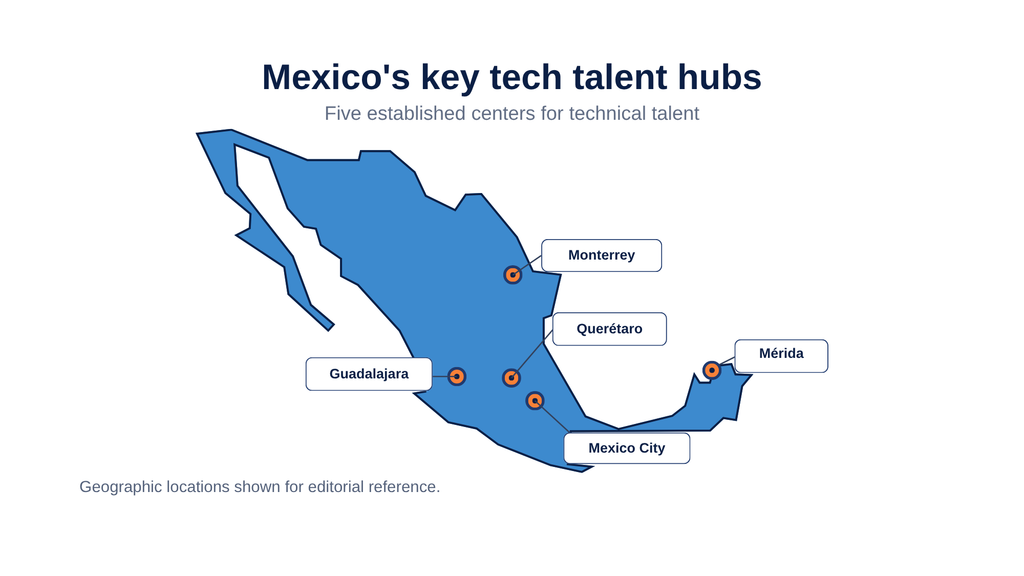
Mexico can offer more flexibility to combine senior and mid-level talent at different rates. Instead of paying a senior-level rate for every seat, you can build the team around the work that actually requires that level of expertise.
That’s why team composition matters as much as headcount. A four-person team with one senior engineer and three mid-level engineers can have a very different budget from four highly specialized senior hires.
So what does the team actually cost?
For high-quality LATAM engineering talent, Samson recommends budgeting roughly $6,000 to $9,000 USD per engineer per month when hiring through a recruiting or staffing partner.
Here’s what that looks like as a team budget:
| Team size | Estimated monthly cost | Estimated annual cost |
| 1 data engineer | $6,000–$9,000 | $72,000–$108,000 |
| 2 data engineers | $12,000–$18,000 | $144,000–$216,000 |
| 3 data engineers | $18,000–$27,000 | $216,000–$324,000 |
| 4 data engineers | $24,000–$36,000 | $288,000–$432,000 |
These are budgeting ranges, not salary benchmarks. Samson describes the $6,000–$9,000 monthly range as an all-inclusive cost when working with a recruiting or staffing partner. With a provider such as Plugg, that means the company handles costs such as benefits and taxes rather than simply passing through the engineer’s salary.
You can find engineers in Latin America for less. Samson notes that $3,000-per-month engineers are available, but cautions against assuming that price will buy the strongest talent in the market. For data engineering, AI, and other complex or scarce skill sets, supply and demand can push costs higher.
The table also assumes the same $6,000–$9,000 range for every seat. In practice, a well-designed team may cost less than simply multiplying a senior engineer’s rate by four. A mix of senior and mid-level talent can shift the total considerably.
What else belongs in the budget?
The $6,000–$9,000 monthly range gives you a useful starting point. But how that number is structured depends on how you hire.
And even an all-inclusive staffing rate doesn’t capture every internal cost of adding someone to your team.
Compliance
A local entity, employer of record, contractor arrangement, and staffing partner handle payroll, taxes, benefits, and employment obligations differently.
With an all-inclusive provider such as Plugg, many of those employment costs are built into the rate. Hire directly or through another model, and your company may need to budget for them separately.
The important thing is to compare total cost with total cost. A $70,000 salary and a $70,000 all-inclusive staffing rate aren’t necessarily equivalent.
Worker classification matters too. The IRS distinguishes employees from independent contractors based on the actual working relationship, not simply the label in a contract. Companies hiring in Latin America also need to account for the employment and classification rules in the country where the worker is based.
Onboarding and equipment
A new data engineer doesn’t become productive the moment the laptop arrives.
They need hardware, system access, security permissions, documentation, and time to understand the infrastructure they’re joining. For data teams, that can mean getting up to speed on existing pipelines, schemas, dependencies, data-quality requirements, and years of architecture decisions.
Some providers include equipment and onboarding support in their fees. But the internal ramp-up time still has a cost, even if it never appears on an invoice.
Turnover and knowledge continuity
Replacing a data engineer isn’t just another recruiting fee.
When someone leaves, they can take detailed knowledge of pipelines, integrations, architecture decisions, and dependencies with them.
Good documentation and clear handoffs reduce that risk, but critical systems shouldn’t depend on knowledge held by one person. That’s why retention belongs in the cost calculation, even if it never appears as a neat line item in the hiring budget.
Before you start adding up salaries
A per-engineer rate is a useful starting point. Before turning it into a team budget, make sure you’re comparing the same things and hiring the team you actually need.
- Who actually needs to be senior? Identify the work that requires deep expertise and the work that can be owned by mid-level talent. Paying senior rates for every seat can inflate the budget unnecessarily.
- What does the quoted rate include? Salary, benefits, taxes, recruiting, equipment, and provider fees may be bundled together or charged separately depending on the hiring model.
- How will you hire? A local entity, EOR, contractor arrangement, and staffing partner come with different costs and responsibilities.
- How long will ramp-up take? Account for system access, security, documentation, and the time it takes to understand your existing data environment.
- What happens if someone leaves? Plan how critical knowledge will be documented and transferred before you need the handoff.
The goal isn’t to find the lowest per-engineer number. It’s to understand what you’re paying for and build the right team around the work.
Build the team, then build the budget
So, what does a LATAM data engineering team really cost?
For high-quality data engineering talent hired through a recruiting or staffing partner, $6,000–$9,000 per engineer per month is a reasonable starting range.
That puts a four-person team at roughly $288,000–$432,000 per year.
But the final number depends on the team you build. One highly specialized senior hire may lead you to Brazil and a six-figure price tag, while a larger team may benefit from a market like Mexico and a mix of seniority levels.
Start with the work the team needs to own, then decide which roles require senior expertise. That’s how you build a realistic budget without overpaying for every seat or compromising on the talent that matters most. See how Plugg approaches technical hiring.