Hiring a full stack developer in Argentina involves more than comparing salaries. What a U.S. company ultimately pays depends on the developer’s experience, technical stack, English proficiency, and hiring model.
According to Plugg’s 2027 Latin America Tech Hiring Report, observed client-billed rates for software development talent across Latin America typically range from $34 to $52 per hour, with senior and lead technical professionals generally commanding $44 to $52 per hour.
These figures come from Plugg’s proprietary contractor data and represent observed regional pricing ranges, not Argentina-specific full stack developer averages. Plugg’s historical Argentina hiring experience provides additional context for what U.S. companies can expect when recruiting experienced developers in this market.
The cost depends on seniority, technical stack, English proficiency and hiring arrangement. It’s also important to distinguish developer compensation from client-billed staffing rates.
The cost of hiring full stack developers depends on seniority, technical specialization, and hiring arrangement. It’s also important to distinguish what developers earn from what U.S. companies pay a staffing provider.
Plugg’s 2027 Latin America Tech Hiring Report analyzes proprietary contractor records to illustrate how technical hiring costs vary across the region.
Technical talent category | Contractor pay (USD/hour) | Client bill rate (USD/hour) |
Junior technical roles | $11-$18 | $27-$32 |
Mid-level technical roles | $21-$23 | $30-$34 |
Senior/lead technical roles | $30-$38 | $44-$52 |
Software development roles | $22-$38 | $34-$52 |
Source: Plugg Technologies, 2027 Latin America Tech Hiring Report, Figure 8. Figures represent the 25th–75th percentile of observed contractor rates within each category. Seniority figures cover technical roles with an explicit level in the job title, while the software development category includes multiple seniority levels. These are LATAM-wide observations, not Argentina-specific full stack salary averages.
For U.S. companies evaluating Argentina, these benchmarks provide a useful starting point for budgeting. However, the actual rate will depend on the developer’s technical capabilities, experience, and responsibilities.
A senior full stack developer responsible for application architecture, complex integrations, and technical decisions will typically require a different budget than a mid-level developer maintaining an established application.
Companies should also distinguish between contractor compensation and client-billed rates, which may include recruiting, administration, and ongoing staffing support.
Plugg’s historical contractor data and Brian Samson’s earlier Argentina hiring experience provide additional context.
Historical benchmark | Cost (USD) | What it represents |
Technical contractors in Argentina | Average above $35/hour | Historical client-billed rates across multiple technical roles |
Senior React developers | Approximately $40-$44/hour | Brian’s pre-Plugg hiring experience in Argentina |
These historical figures provide Argentina-specific context alongside the broader pricing benchmarks in Plugg’s 2027 report.
The contractor data includes engagements associated with Brian Samson’s previous company, while the senior React benchmark reflects his firsthand experience building engineering teams in Buenos Aires before founding Plugg.
The historical senior React rate of approximately 40–44 per hour is broadly consistent with the regional senior/lead pricing ranges reported in Plugg’s newer research. However, the datasets cover different periods, roles, and engagements, so they should not be treated as directly comparable.
Neither historical figure represents a current Argentina-wide full stack developer rate. Together, the historical examples and newer proprietary research illustrate why companies should evaluate seniority, specialization, and hiring model when estimating nearshore development costs.
A developer earning $4,500 per month doesn’t necessarily cost a U.S. company $4,500 per month.
The total budget may also include recruiting, contractor or employment administration, payroll services, equipment, benefits where applicable and ongoing support.
Plugg’s nearshore technical staffing services include sourcing, vetting, onboarding and operational support.
When comparing staffing quotes, ask what’s included in the monthly rate, whether recruiting and administrative fees are separate, and how many billable hours the estimate assumes.
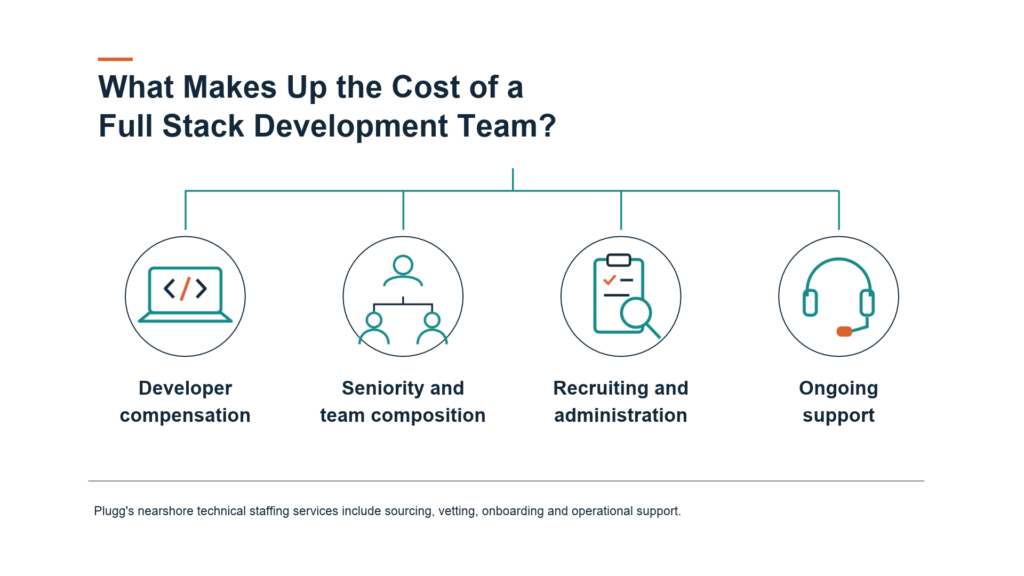
A full stack developer works across frontend and backend development, but that doesn’t mean every candidate has equal depth in both. Four factors have a particularly important influence on cost.
A mid-level developer may be well suited to maintaining an established application, building features and working within an existing architecture.
Senior developers generally command higher rates because they can work independently, handle complex integrations and make technical decisions affecting the broader application.
Your development need | Recommended hire |
Bug fixes and routine enhancements | Junior or mid-level developer with appropriate supervision |
Ongoing frontend and backend features | Mid-level full stack developer |
Complex integrations and major application features | Senior full stack developer |
Architecture, technical standards and team oversight | Technical lead |
Plugg’s proprietary hiring data reflects growing demand for experienced technical professionals. In 2024, senior-level roles accounted for 26% of technical job openings handled through Plugg’s LATAM recruiting operations. That figure increased to 45% in 2025 and 72% in 2026 year-to-date, through September 30.
These figures reflect Plugg’s own client demand rather than the entire LATAM hiring market. Nevertheless, they illustrate how strongly the company’s recent recruiting activity has shifted toward experienced technical talent.
For companies building full stack development teams, the implication is worth considering: technical judgment, architectural experience, and the ability to work independently can be as important as the number of developers hired.
A senior developer can be an expensive choice for routine maintenance. But assigning complex architectural work to an inexperienced developer can create far greater costs later.
Argentina has been a particularly productive market for React hiring in Brian’s experience. But React primarily addresses the frontend.
A company using React and Node.js needs a different combination of skills than one using React with Python, Java or .NET.
The official React documentation covers building user interfaces, while the Node.js documentation explains JavaScript development on the server.
When evaluating full stack candidates, we’d look for production experience across the technologies your application actually uses, including backend services, APIs, databases, authentication, testing and deployment.
A long list of technologies on a résumé isn’t a substitute for relevant experience.
Maintaining an established application is different from designing a new platform or modernizing a legacy system.
Projects involving complex integrations, scalability, security or significant architectural changes require more experienced developers. The more technical decisions someone must make independently, the stronger the case for senior expertise.
For nearshore development roles, communication is part of the job. Full stack developers need to discuss requirements, participate in technical reviews, and explain decisions to U.S. colleagues.
Argentina offers a potentially attractive environment for this collaboration. The 2027 Latin America Tech Hiring Report cites the EF English Proficiency Index 2025, which ranked Argentina 26th out of 123 countries, ahead of several other major Latin American technical markets.
However, national English proficiency rankings don’t establish the communication abilities of individual developers.
For U.S. companies, it’s important to assess a candidate’s ability to communicate technical concepts, participate in collaborative problem-solving, and work effectively within an English-speaking engineering team.
Previous experience working with U.S. companies can also be valuable, particularly for developers expected to contribute directly to planning, architecture, and product decisions.
Hiring one developer is relatively straightforward to budget. Building an effective team requires more thought.
Brian’s previous experience in Buenos Aires included a representative four-person Agile development team.
Role | Responsibility |
Technical lead | Architecture, technical direction and code quality |
Senior developer | Complex features, integrations and technical decisions |
Mid-level developer | Feature development across established systems |
Junior developer | Defined tasks, testing and routine enhancements |
The historical team model had a weighted average rate of approximately $33/hour, with a monthly budget of around $22,000.
At approximately 167 billable hours per developer per month, the illustrative calculation is:
4 developers × 167 hours × $33/hour ≈ $22,000/month
This is a historical planning illustration, not a current staffing quote. Whether the original model included staffing fees has not been established.
A company building a new product may need senior technical leadership, but not every developer needs to be senior.
Once architecture and development standards are established, mid-level and junior developers can handle appropriately scoped work under experienced supervision.
Plugg’s recommendation: Invest in the technical leadership your project requires, then build the rest of the team around the development workload.
For an established product with strong internal leadership, adding one or two capable mid-level developers may be more economical than hiring additional senior engineers.
Plugg has also described an Argentina engagement in which a U.S. technology company expanded its engineering capacity with a four-person senior full stack team. The developers participated in daily standups and collaborated with the client’s existing team through Slack, Zoom and Jira.
Read the full Argentina full stack development team case study.
Building a development team in Argentina?
Talk to Plugg about your technical requirements and budget. We’ll help you determine whether you need senior leadership, additional development capacity or a combination of both.
Argentina offers more than a potentially competitive hiring budget. Its appeal includes experienced technical talent, specialized development capabilities and overlapping working hours with U.S. teams.
Brian’s experience building an organization of more than 85 developers in Buenos Aires, many specializing in React, gives Plugg a practical perspective on the market.
Argentina is particularly worth investigating for React-heavy applications and experienced technical roles. Based on Plugg’s broader recruiting experience, it’s also a strong market for Cloud/DevOps and AI/ML talent.
Employers should still evaluate the specific frontend and backend capabilities their projects require.
Argentina operates on UTC−3 year-round, creating meaningful working-hour overlap with U.S. engineering teams.
This can make sprint planning, technical reviews and troubleshooting easier, particularly when developers need to collaborate directly with U.S. product and engineering teams.
Argentina has generally sat toward the higher-cost end of LATAM technical markets in Plugg’s historical experience.
That makes it particularly attractive when specialization, independence and senior experience matter more than finding the lowest hourly rate.
Country | Plugg’s historical market perspective | Particularly worth considering for |
Argentina | Higher-cost market with strong React experience | React-heavy applications and senior technical roles |
Mexico | Generally around the LATAM pricing midpoint | U.S. collaboration, proximity and general software development |
Colombia | Historically somewhat below the LATAM pricing midpoint | Cost-conscious technical hiring with U.S. workday overlap |
These are Plugg’s qualitative historical market observations, not a current standardized comparison of equivalent full stack developer rates.
For a React-heavy product requiring experienced developers, Argentina deserves serious consideration. For general application development, Mexico or Colombia may offer different cost and talent advantages.
The goal is to find the strongest market for the role, not choose a country before evaluating the available talent.
The hiring model affects total cost, administrative responsibilities and flexibility.
Hiring model | Best suited to |
Direct hire | Core, long-term roles when local employment infrastructure is available |
Contract-to-hire | Roles where longer-term requirements are uncertain and a future direct hire is being considered |
Contract staffing | Companies seeking flexible technical capacity through an appropriately structured engagement |
Staff augmentation | Established engineering teams that need additional development capacity |
Project outsourcing | Companies that want an external provider to take responsibility for a defined project |
For U.S. companies with existing technical leadership, Plugg generally recommends staff augmentation.
Developers work within your engineering team, follow your processes and contribute to your roadmap, while a staffing partner helps manage recruiting and administrative support.
If you want an external provider to take responsibility for delivering an entire application or project, outsourcing may be a better fit.
For more detail, see Plugg’s guides to contractors versus employees in Latin America and nearshore staff augmentation versus outsourcing.
The right structure also needs to comply with applicable employment and contractor-classification requirements in Argentina. Not having a local entity doesn’t eliminate those obligations.
According to Plugg's 2027 Latin America Tech Hiring Report, observed client-billed rates for software development professionals across Latin America typically range from $34 to $52 per hour, while senior/lead technical roles generally range from $44 to $52 per hour.
These are regional benchmarks, not Argentina-specific full stack developer averages.
Plugg's historical Argentina hiring experience provides additional context, with senior React developers previously costing approximately 40–44 per hour and technical contractor rates averaging above $35 per hour across multiple roles.
Actual hiring costs depend on seniority, technical stack, experience, and staffing arrangement.
Argentina can offer competitive hiring economics compared with U.S. technical staffing, particularly for experienced developers working within overlapping business hours.
Savings depend on the skills, responsibilities and hiring model being compared. Companies should account for staffing fees and administrative costs rather than comparing developer compensation with a U.S. employee's total employment cost.
A senior developer is valuable when the role requires independent technical decisions, complex integrations or architectural responsibility.
If your company already has strong technical leadership, multiple mid-level developers may provide more development capacity for the budget.
Not necessarily. Appropriately structured contractor arrangements or third-party employment services may allow companies to engage talent without establishing their own Argentine entity.
The correct arrangement depends on the working relationship, local legal requirements and services provided by the staffing or employment partner.
For a closer look at the options, see our guide to hiring LATAM developers without a local entity.
Argentina is a strong market for companies seeking experienced developers, particularly for React-heavy applications and technically demanding projects.
Plugg helps U.S. companies recruit technical talent across Latin America, evaluate candidates and choose hiring arrangements that fit their engineering requirements.
Whether you’re adding one developer or building a larger team, we’ll help you identify the right combination of technical expertise, seniority and cost.
Tell us what you’re building, which technologies you’re using and where your team needs support.
Talk to Plugg about hiring full stack developers in Argentina today!