Published Mexican salaries range from approximately MXN 25,000 to MXN 140,000 per month, depending on experience and specialization. However, these domestic benchmarks don’t necessarily reflect the cost of hiring developers with the English proficiency and U.S. experience needed for nearshore roles. That’s why the cost to hire Salesforce developers in Mexico is more dynamic than it might seem at first glance.
For U.S. companies looking to hire nearshore technical talent, Mexico offers competitive costs, strong workday alignment, and proximity that makes collaboration easier.
Plugg’s recommendation: Match the developer to the job. Routine Salesforce enhancements rarely require an expensive architect, while complex integrations and major implementations justify investing in senior expertise.
Published Mexican salary benchmarks vary considerably depending on the source and the type of employer.
Glassdoor’s September 2025 salary data places the typical monthly base salary range for Salesforce developers in Mexico at approximately MXN 25,000–50,000, with an average of MXN 35,000.
Meanwhile, LHH’s 2025 Mexico Salary Guide reports substantially higher gross monthly base salaries for Salesforce specialists.
Salesforce role | Gross monthly salary (MXN) |
Salesforce Developer | 70,000–140,000 |
Salesforce Administrator | 60,000–115,000 |
Salesforce Consultant | 60,000–130,000 |
Salesforce Architect | 85,000–160,000 |
Sources: Glassdoor Mexico Salesforce Developer Salaries and LHH Mexico Salary Guide 2025. LHH figures are reported gross monthly base salaries.
These figures reflect salaries in the Mexican employment market, rather than the cost of hiring Salesforce developers specifically qualified to work with U.S. companies.
Domestic salary benchmarks can include candidates who lack the advanced English proficiency, experience working with U.S. teams or specialized Salesforce expertise required for nearshore roles. For senior positions involving complex integrations, architecture or direct collaboration with American stakeholders, these averages may underestimate the compensation needed to attract qualified talent.
They also represent gross salaries, not the total cost of hiring through a staffing partner, which may include employment-related expenses and administrative services.
Plugg’s historical technical contractor data provides another useful reference. Across previous starts in Mexico, billed rates have been over USD 30 per hour.
These figures cover multiple technical roles rather than Salesforce developers specifically. They offer context for Mexico’s broader engineering market, while the actual cost of a Salesforce hire will reflect platform expertise, seniority and the hiring arrangement.
Salesforce development covers everything from maintaining an existing CRM to designing complex enterprise integrations.
The responsibilities should determine the level of experience you hire.
Your Salesforce challenge | Who to hire |
Backlog of Apex and Lightning Web Components work | Mid-level Salesforce developer |
Complex integrations with ERP or other business systems | Senior Salesforce developer with integration experience |
Major implementation or architecture overhaul | Salesforce technical architect |
Existing Salesforce team needs more development capacity | Developer through staff augmentation |
User permissions, reporting and routine configuration | Salesforce administrator |
The difference between these benchmarks is significant. Glassdoor’s figures reflect its salary estimates based on reported compensation, while LHH provides a separate set of market salary benchmarks. They use different data sources and methodologies, so the ranges should not be treated as interchangeable.
For U.S. companies, the more important question is what it costs to attract a Salesforce developer with the technical experience, English proficiency and ability to collaborate directly with American teams.
For companies maintaining or expanding an established Salesforce environment, Apex and Lightning Web Components are common development requirements.
A capable mid-level developer can often handle custom functionality, testing, bug fixes and ongoing enhancements when the architecture and development standards are already established.
If your company has an experienced Salesforce lead, adding mid-level capacity may be more economical than hiring another senior specialist.
Salesforce rarely operates in isolation.
Companies may need to connect it with ERP systems, customer databases, payment platforms, marketing tools or other business applications.
These projects introduce requirements around API design, authentication, data synchronization, error handling and system reliability.
For integration-heavy work, we’d prioritize a developer who has delivered comparable production integrations over someone whose experience is limited to Salesforce configuration.
A Salesforce architect brings broader technical oversight than a developer focused on individual features.
Architecture becomes particularly important when multiple teams share the same Salesforce environment, customizations have accumulated over time or new integrations could create performance and maintenance problems.
For a major implementation or redesign, an experienced technical lead can help establish the architecture before additional developers begin building on it.
Not sure what level of Salesforce expertise you need? Talk to Plugg about your development backlog, integrations or implementation plans. We’ll help you determine whether you need a developer, administrator or architect, and what to budget for the role.
Mexico is particularly attractive when Salesforce development requires regular collaboration with U.S. business and technical teams.
A Salesforce developer might troubleshoot an integration with IT in the morning, review requirements with sales operations at noon and test changes with customer service before a release.
These aren’t tasks that always fit neatly into an isolated development queue.
Mexico’s workday alignment with the U.S. makes it easier for developers to participate directly in those conversations, resolve issues and keep projects moving.
Based on Plugg’s recruiting experience, Mexico is particularly valuable when U.S. companies prioritize proximity, collaboration and operational coordination.
For Salesforce teams, those advantages can support closer working relationships with internal stakeholders and more responsive development cycles.
Mexico generally sits near the midpoint of LATAM technical pricing in Plugg’s experience.
That makes it a practical market to consider when building a Salesforce team in Mexico with a mix of senior and mid-level talent.
The goal is to reserve senior expertise for architecture, complex integrations and technical leadership while assigning routine enhancements to developers with the appropriate level of experience.
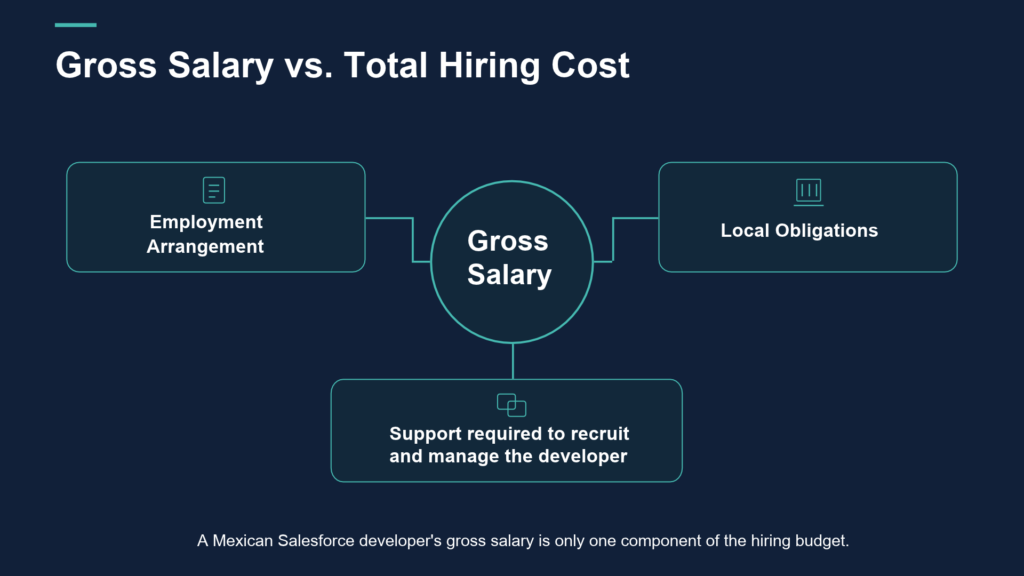
A Mexican Salesforce developer’s gross salary is only one component of the hiring budget.
The total cost depends on the employment arrangement, local obligations and the support required to recruit and manage the developer.
Direct hire: Appropriate when Salesforce development is a core, long-term function and your company already has a Mexican entity and payroll infrastructure. Employer obligations and recruiting costs need to be considered alongside salary.
Contract-to-hire: Useful when local employment infrastructure exists but the long-term need for the role is uncertain over the next 6–12 months.
Contract or staff augmentation: A practical option when your company needs additional Salesforce capacity without establishing a Mexican entity. Staff augmentation works particularly well when you already have Salesforce leadership and want developers integrated into your existing team.
Project outsourcing: Better suited to a defined implementation, migration or integration project where an external provider takes responsibility for delivery.
For companies that want to retain control of their Salesforce roadmap and technical decisions, staff augmentation can provide flexibility while keeping developers closely connected to the internal team.
Certifications can help demonstrate platform knowledge, but production experience is especially important.
We’d evaluate Mexican Salesforce developers on:
For senior roles, ask candidates to walk through a difficult Salesforce problem they’ve solved, including the decisions they made and the outcome.
That discussion can reveal more than a list of certifications.
Published salary benchmarks vary widely. Glassdoor's September 2025 data reports a typical monthly base salary range of approximately MXN 25,000–50,000, while LHH's 2025 Mexico Salary Guide lists gross monthly base salaries of MXN 70,000–140,000 for Salesforce developers.
These figures represent different salary datasets and are not equivalent to nearshore staffing rates.
Mexico is a strong market to consider when U.S. workday overlap, proximity and operational convenience are priorities.
Based on Plugg's recruiting experience, the country generally sits near the midpoint of LATAM technical pricing.
Certifications can influence compensation, particularly when combined with substantial production experience or specialized platform expertise.
However, a certification alone doesn't establish that a developer can handle complex architecture or integrations.
Not necessarily. Depending on the engagement arrangement, companies can work with contractors or staffing partners without establishing their own Mexican entity.
The appropriate structure should account for employment classification, compliance and the nature of the working relationship.
Hire an administrator when the work primarily involves user management, configuration, reporting, permissions and declarative automation.
Hire a developer when your requirements involve custom Apex code, Lightning Web Components, complex integrations or other work beyond standard configuration.
Mexico can be a strong market for U.S. companies that need Salesforce development capacity without sacrificing day-to-day collaboration.
Whether you’re hiring one experienced developer or expanding an established Salesforce team, Plugg’s nearshore technical staffing services can help you define the technical requirements, evaluate available talent and choose the right hiring arrangement.
Tell us about your Salesforce environment, the work you need completed and the experience you’re looking for. We’ll help you build a realistic hiring plan.
Talk to Plugg about hiring Salesforce developers in Mexico →