
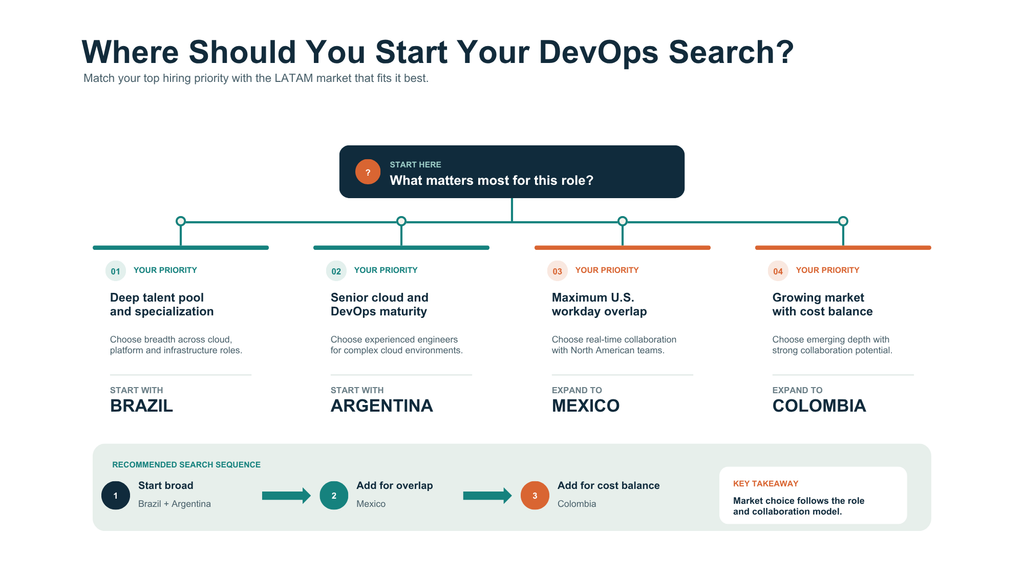
Short answer: For DevOps and cloud engineers in Latin America, we’d start with Brazil and Argentina. Based on Plugg’s own recruiting team’s experience, those are the two strongest markets for these roles.
Brazil gives us a large technical market for specialized cloud and infrastructure searches, while Plugg has firsthand evidence of senior DevOps talent succeeding in Argentina. When Cloud Cath needed a senior DevOps engineer for a complex med-tech environment, Plugg helped the company hire one in Buenos Aires in less than a week.
Our recommendation: start with Brazil and Argentina, then widen the search to Mexico, Colombia or elsewhere in LATAM if the role, budget or candidate pool requires it.
Who is this for?
This guide is for U.S. CTOs, founders and engineering leaders deciding where to hire DevOps, cloud, platform or infrastructure engineers in Latin America.
It’s particularly relevant if you need someone working with AWS, Azure or Google Cloud; infrastructure as code; Kubernetes and containers; CI/CD; observability; security; or production reliability.
“DevOps engineer” can describe very different jobs. Maintaining an established CI/CD pipeline is one role. Owning cloud architecture, security, reliability and production systems is another.
Those searches shouldn’t have the same requirements or the same budget.
What does it cost to hire DevOps and cloud engineers in LATAM?
Based on Plugg’s internal data, Cloud/DevOps talent in Latin America typically falls around $38–$45 per hour.
Where a hire lands within or beyond that range depends on seniority, specialization and ownership. An engineer maintaining an established CI/CD pipeline has a different hiring profile from a senior DevOps engineer responsible for cloud architecture, security, reliability and production systems.
For planning purposes, we’d use $38–$45 per hour as the starting range, then adjust for the infrastructure and level of ownership the role requires.
What are the advantages of hiring DevOps and cloud engineers in LATAM?
Brazil is one of Plugg’s top markets for DevOps and cloud talent
Based on Plugg’s recruiting team’s experience, Brazil is one of the two LATAM markets we’d start with for DevOps and cloud roles.
Brazil has one of LATAM’s largest broader technology workforces. In 2025, the country recorded approximately 494,000 formal IT employment relationships, including about 291,000 in systems development, according to Brasscom.
Those aren’t DevOps-engineer counts. But they demonstrate the size of the broader technical market available when you’re searching for a narrower combination of cloud, infrastructure and engineering experience.
See the Brasscom 2025 sector report
For a search requiring a particular combination of cloud platform, containers, infrastructure as code and production experience, that wider technical market can be useful.
For a specialized DevOps or cloud search, Brazil would be one of our first markets.
Argentina combines strong DevOps talent with firsthand Plugg proof
Alongside Brazil, Argentina is one of the markets Plugg’s recruiting team considers strongest for DevOps and cloud roles.
Plugg also has direct evidence from a difficult senior DevOps search there.
Cloud Cath, a Series A medical technology company, needed a senior DevOps engineer for a complex environment spanning hardware, software and firmware. Plugg helped the company interview and hire a senior DevOps engineer from Buenos Aires in less than a week. He became a key member of the engineering team.
Read the Cloud Cath DevOps case study
One placement doesn’t establish the depth of an entire country’s DevOps market. But combined with Plugg’s recruiting team’s broader experience, it gives us both a market-level reason and a concrete hiring example for putting Argentina near the top of the list.
For senior DevOps and cloud roles, we’d search Argentina alongside Brazil from the start.
Mexico is a strong alternative when U.S. collaboration matters
We’d consider Mexico when extensive real-time collaboration with a U.S. engineering organization is a major priority.
Mexico represents the largest share of Plugg’s broader 2021–2026 contractor history, giving us substantial firsthand experience recruiting technical talent there. That isn’t a measure of Mexico’s DevOps talent pool, but it does give Plugg deep experience hiring in the market.
Mexico is also investing in cloud and infrastructure skills. The government-backed MEXIA program includes training in cloud and networks/infrastructure, including a Google Cloud Engineer certification track.
See MEXIA’s technical training programs
The time-zone advantage can matter particularly for DevOps. Engineers responsible for deployments, production incidents and infrastructure changes often need to collaborate with U.S. engineering teams in real time.
Mexico wouldn’t replace Brazil or Argentina as our first recommendation for these roles, but we’d include it when close U.S. collaboration is particularly important.
Colombia is worth considering when cost and overlap matter
We’d consider Colombia when U.S. workday overlap and cost carry significant weight.
The country’s 2025 national digital-talent study identifies both cloud computing and DevOps among areas of increasing employer demand.
See Colombia’s 2025–2030 digital talent study
Colombia also operates on UTC-5 year-round, giving U.S. teams substantial real-time overlap.
Plugg’s broader hiring history has shown competitive pricing there compared with some other LATAM markets, although that data spans different technical roles and shouldn’t be treated as a DevOps-specific rate.
We’d include Colombia when economics and collaboration matter, particularly when widening the search beyond Brazil and Argentina.
What are the disadvantages?
DevOps and cloud engineering become specialized quickly.
An engineer with deep AWS experience isn’t automatically the right fit for an Azure environment. Kubernetes experience doesn’t guarantee Terraform depth, and someone who has built CI/CD pipelines may never have owned cloud architecture or production reliability.
That makes country-level salary and workforce statistics less useful than they are for broader software-development roles.
The candidate pool can also narrow quickly when several requirements stack up. If you need a senior engineer with AWS, Kubernetes, Terraform, security, observability and experience operating a high-availability SaaS platform, you may need flexibility on geography.
What are the risks?
A weak DevOps hire doesn’t just slow development. They can introduce production risk.
Infrastructure engineers may control cloud accounts, deployment systems, credentials, databases and production environments. Poor access controls or configuration decisions can create security and reliability problems.
There’s also an important difference between knowing cloud tools and having operated production systems. Candidates should be able to explain what they’ve deployed, what failed, how they responded and what they changed afterward.
Key-person dependency is another risk. Cloud architecture, deployment processes and incident-response knowledge shouldn’t live entirely inside one engineer’s head.
And if the role includes on-call responsibilities, define the coverage model before hiring. Nearshore time-zone alignment helps with collaboration, but it doesn’t automatically provide 24/7 coverage.
What are the alternatives?
You may not actually need a DevOps engineer.
If the main challenge is building application code, a strong backend or full-stack engineer with cloud experience may be enough.
If the problem is data pipelines and warehouses, you may need a data engineer.
If you’re building internal developer platforms and tooling at scale, a platform engineer may describe the role more accurately.
If uptime, observability and reliability are the central concerns, you may need a site reliability engineer (SRE).
For an early-stage company with relatively straightforward infrastructure, managed cloud services may also reduce how much dedicated DevOps capacity you need.
What common mistakes should you avoid?
Don’t write “AWS + Kubernetes + Terraform” and assume you’ve defined the role.
Specify what the engineer will actually own. Will they design infrastructure? Maintain CI/CD? Handle incidents? Improve observability? Manage cloud costs? Own security controls?
Don’t treat certifications as proof of production experience. Ask candidates to walk through systems they’ve actually operated and failures they’ve personally handled.
Don’t make every tool mandatory. A strong infrastructure engineer can often move between related technologies, while an excessively narrow checklist can eliminate good candidates.
And don’t optimize exclusively for rate. A cheaper infrastructure hire can become expensive quickly if poor decisions create downtime, security issues or an architecture that has to be rebuilt.
FAQ
Which LATAM country is best for hiring DevOps engineers?
We’d start with Brazil and Argentina. Based on Plugg’s recruiting team’s experience, those are the strongest LATAM markets for DevOps and cloud roles.
Brazil gives us a large technical market for specialized searches, while Plugg has direct experience successfully placing senior DevOps talent in Argentina. Mexico and Colombia can still be useful markets depending on collaboration requirements, budget and the specific cloud stack.
What does a DevOps engineer cost in LATAM?
Based on Plugg’s internal data, Cloud/DevOps talent in Latin America typically falls around $38–$45 per hour.
Actual rates will depend on seniority, specialization, cloud environment and the amount of production ownership the engineer takes on.
Is Brazil or Argentina better for DevOps engineers?
We’d search both rather than choosing one upfront. Brazil gives us a larger technical market for specialized searches, while Argentina has produced strong senior DevOps talent in Plugg’s own recruiting experience. The better market for a specific search will depend on the cloud environment, seniority and production experience required.
What skills should I look for in a LATAM DevOps engineer?
That depends on your environment. Common requirements include AWS, Azure or GCP; infrastructure as code; Docker and Kubernetes; CI/CD; monitoring and observability; security; and scripting or programming ability.
For senior hires, we’d put significant weight on what the candidate has actually operated in production.
Should I hire a DevOps engineer or an SRE?
DevOps roles often focus broadly on infrastructure, automation and deployment. SRE roles tend to put more explicit emphasis on reliability, availability, monitoring and incident response.
In practice, titles overlap. The responsibilities matter more than the label.
Should I search one country or all of LATAM?
For a relatively common cloud stack, start with the markets most likely to fit the role.
For a highly specialized senior search, we’d recruit across LATAM rather than unnecessarily restricting the candidate pool.
Why hire DevOps and cloud engineers through Plugg?
Plugg has firsthand experience filling complex DevOps roles in Latin America.
When Cloud Cath needed a senior DevOps engineer for a Series A medical technology environment, Plugg helped the company interview and hire an engineer from Buenos Aires in less than a week.
Read the Cloud Cath DevOps case study
Plugg recruits cloud, infrastructure, platform and SRE talent across Latin America. We start with the infrastructure, technical requirements, seniority, budget and collaboration model, then search the markets most likely to produce that experience.
Plugg can also support interview coordination, contracts, payroll and ongoing contractor support.
For infrastructure roles, we’d rather find someone who has already operated systems like yours than steer the search toward a country because its average rate looks attractive.