
If you’re hiring both QA and DevOps talent in Latin America, don’t expect the salaries to be anywhere close.
Based on Plugg’s internal hiring data, QA professionals typically earn around $17–$25 per hour. Cloud/DevOps professionals are more likely to fall around $38–$45 per hour.
Why such a big difference?
Because “technical talent” is a pretty useless category when it comes to setting a budget. A manual QA tester following an established test plan and a senior DevOps engineer responsible for keeping production infrastructure running may work on the same product, but they’re doing very different jobs.
And even within QA or DevOps, the title only tells you so much.
Our advice: figure out what you actually need someone to own before you decide what the role should cost.
Based on Plugg’s internal data, expect roughly $17–$25 per hour for QA talent in Latin America.
But here’s where it gets more complicated: QA isn’t one job.
Someone manually testing features against an established test plan has a very different skill set from an automation engineer writing tests and building testing infrastructure. Add responsibility for the overall testing strategy or a QA team, and you’re looking at a different hire again.
Plugg has seen this firsthand.
In one Mexico engagement, a client was moving work from the Philippines to a nearshore model and needed front-end developers, Salesforce developers and QA professionals at team-lead, mid-level and junior levels. Plugg ultimately built a large QA team in Mexico alongside the client’s other technical teams.
Read the Mexico staffing case study
So before you start comparing QA salaries, ask a more basic question: Do we need manual testing, automation or someone to own QA?
The answer can change the budget considerably.
Plugg’s internal data puts Cloud/DevOps talent at roughly $38–$45 per hour.
Why is that so much higher than QA?
Look at what you’re asking the person to own.
A senior DevOps engineer might be responsible for cloud architecture, deployment pipelines, security, reliability and production systems. If something goes wrong with the infrastructure, this may be the person everyone turns to.
That’s a very different hiring profile from many QA roles.
Plugg saw this with Cloud Cath, a Series A medical technology company building a product that combined hardware, software and firmware. The company needed a senior DevOps engineer who could handle that complexity.
Plugg introduced the company to a senior engineer in Buenos Aires in less than a week. Within several months, he had become a key member of the engineering team.
Read the Cloud Cath DevOps case study
That’s a good example of why the title alone isn’t enough. The more infrastructure and production responsibility you’re handing someone, the more we’d expect experience and specialization to affect the rate.
At the risk of oversimplifying it: you’re paying for different skills and different levels of responsibility.
QA professionals make sure software works as intended. That can mean manual testing, automated testing, regression testing, finding defects and validating releases.
DevOps professionals may be responsible for cloud infrastructure, CI/CD pipelines, deployment automation, monitoring, reliability, security and keeping production environments running.
There’s also a huge amount of variation inside those categories.
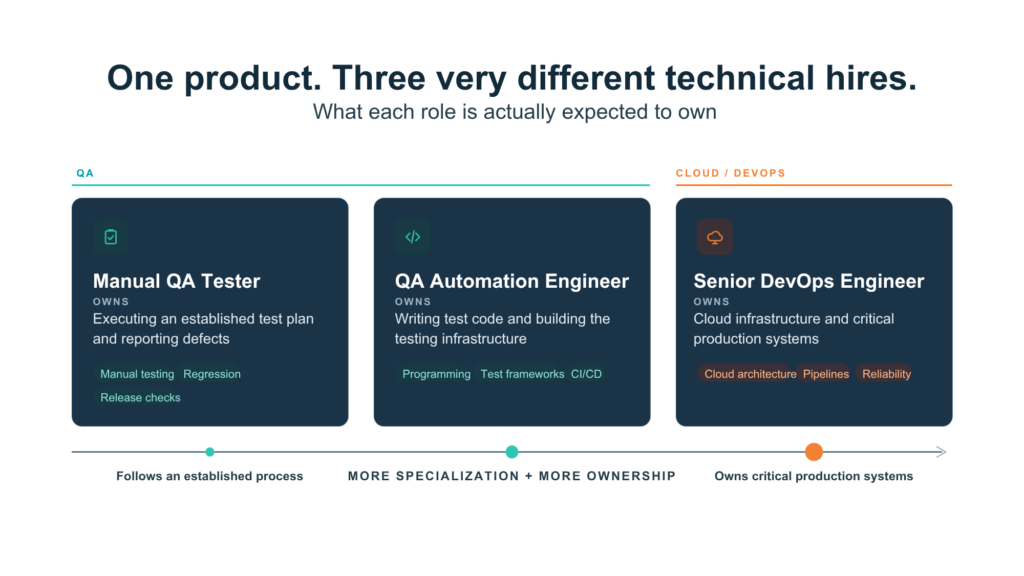
Take three people:
All three are technical hires. That doesn’t make them interchangeable from a salary perspective.
That’s why we’d use Plugg’s $17–$25 QA range and $38–$45 Cloud/DevOps range as planning benchmarks, not rate cards.
For QA, start with one question: manual or automation?
Automation roles may require programming skills, experience with testing frameworks and knowledge of CI/CD. If you’re hiring someone to lead QA, you’re also paying for strategy, processes and responsibility for the wider testing function.
For DevOps, look closely at the stack and the infrastructure.
AWS, Azure or Google Cloud experience may matter. So might Kubernetes, Terraform, CI/CD, observability, security and infrastructure as code.
Then think about the environment.
Testing a straightforward web application isn’t the same as testing a regulated healthcare or financial product. Maintaining an internal application isn’t the same as being responsible for production infrastructure serving thousands of customers.
And don’t overlook autonomy. If you need someone who can join a U.S. engineering team and take ownership without a lot of supervision, that affects the hiring profile too.
More specialization + more ownership usually means moving toward the top of the range, or beyond it.
Yes. Just not as much as the role itself.
It’s tempting to start a LATAM search by asking, “Which country is cheapest?”
We’d start somewhere else: What does this person actually need to be able to do?
Plugg’s broader hiring history shows differences in rates across Latin American markets. But country averages lump together junior and senior hires, common and specialized skills, and very different levels of responsibility.
A senior DevOps engineer in a lower-cost market can still cost more than a less experienced technical hire somewhere else. An automation engineer can cost considerably more than a manual QA professional sitting in the same country.
Define the role first. Then look for the best markets in which to find it.
For an initial LATAM hiring budget, we’d start here:
Then start asking questions.
For QA: Manual or automation? Individual contributor or lead? How technical does the person need to be?
For DevOps: What cloud environment? How complicated is the infrastructure? Will they own production? How independently do they need to work?
Those questions matter because your team composition can change the budget dramatically.
Four developers plus a manual QA professional is one thing. Four developers, an automation engineer and a senior DevOps engineer responsible for production infrastructure is something else entirely.
Don’t budget for five or six generic “technical hires.” Budget for the capabilities you’re actually buying.
If you just need a number to get started, use $17–$25 per hour for QA and $38–$45 per hour for Cloud/DevOps, based on Plugg’s internal hiring data.
Then stop looking at the numbers for a minute.
Figure out what you need each person to own, how specialized the work is and how much experience they’ll need to do it independently. That’s what should drive your budget.
Learn more about hiring technical talent across LATAM with Plugg.