
Short answer: Hiring a developer in Latin America? Don’t decide they’re a contractor just because it’s easier.
If you want flexibility and the relationship genuinely works as independent contracting, a contractor can be a good fit. If you’re building a formal employment relationship with local benefits and protections, an employee makes more sense.
Start with how you want the person to work with your company. Then figure out the right structure.
This guide is for U.S. founders, CTOs and engineering leaders deciding whether LATAM hires should be contractors or employees.
You may be hiring one developer in Argentina, adding engineers across several countries or building a longer-term nearshore team.
The decision affects cost, flexibility, benefits, employment obligations and the infrastructure required to support the hire. But there isn’t one LATAM-wide rule for making it.
At a high level, an employee works within an employment relationship, while an independent contractor provides services under a commercial agreement.
The legal tests distinguishing the two vary by country, so there isn’t one contractor-versus-employee checklist that applies across Latin America.
For a U.S. company making the hiring decision, this framework is more useful:
Contractor | Employee | |
Often considered when | Flexibility is important and the engagement can appropriately be structured as independent contracting | The company wants a formal local employment relationship |
Employment benefits | Not generally provided through an employment relationship | Subject to applicable local employment requirements |
Administration | Can be lighter, but classification and compliance still matter | Requires local employment infrastructure |
Company’s own local entity required? | Not necessarily | Not necessarily if a third party provides local employment infrastructure |
Best question to ask | Can this engagement appropriately operate as a contractor relationship in this country? | Do we want this person employed locally? |
This is a commercial decision framework, not a legal classification test. The applicable rules depend on the country and facts of the relationship.
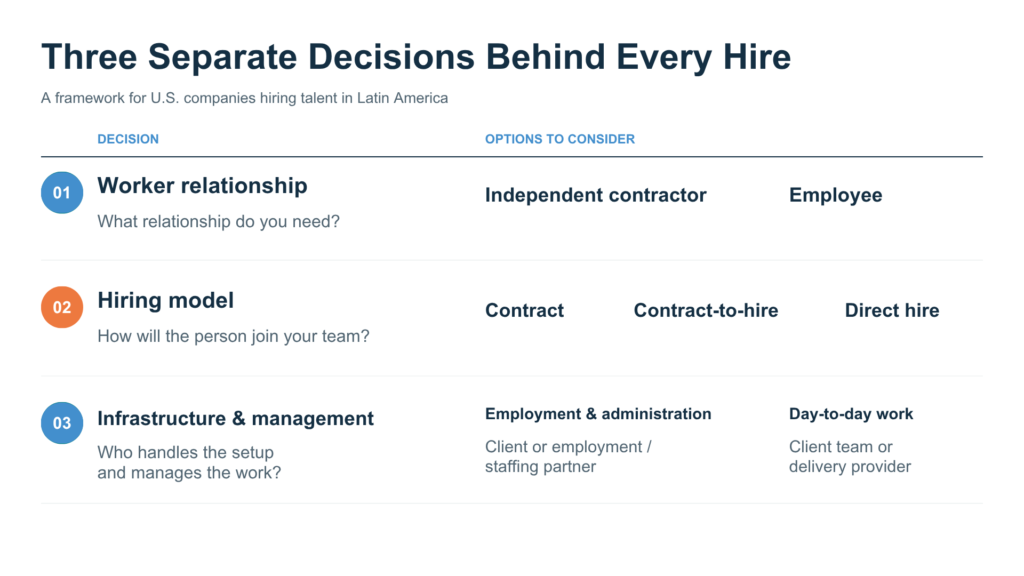
Here’s where the terminology gets confusing: contractor vs. employee and contract vs. contract-to-hire vs. direct hire aren’t the same decision.
The first describes the type of worker relationship. The second describes how the person is brought onto the team.
Term | What it means in this article |
Independent contractor | Provides services under a contractor relationship rather than being employed by the client |
Employee | Works under a formal employment relationship |
Contract | The person works with the client through an ongoing staffing or contract arrangement |
Contract-to-hire | The person starts on contract with the possibility of becoming a direct hire later |
Direct hire | Plugg recruits the person and the client hires them through its chosen employment structure |
Employer of Record (EOR) | A third party legally employs someone locally when the client doesn’t have its own entity |
So a company might decide it wants to direct hire someone and then still need to determine how that person will be legally employed in their country.
Plugg generally looks at three things: whether the company already has local infrastructure, how core the role is to the business and how much flexibility the company needs.
The right model depends on both the role and the company’s existing infrastructure. A company building permanent headcount in an established LATAM operation has different needs from one making its first hire in the region.
See Plugg’s nearshore software engineering hiring models
Contractors can look less expensive on paper, but hourly rate versus salary isn’t a complete cost comparison.
With an independent contractor, the company typically pays an agreed contract rate. With an employee, costs can extend beyond salary to country-specific payroll obligations, statutory benefits and employment administration.
There is also the infrastructure around the hire.
Recruiting, contracts, payroll, equipment, onboarding and compliance all require resources regardless of where the developer lives.
Plugg’s model can include recruiting, onboarding, payroll management, equipment and ongoing support rather than leaving clients to assemble those functions separately.
Don’t decide between contractor and employee based on the compensation number alone. Compare the total cost of the relationship, then determine whether the structure fits how you intend to work with the person.
Contract arrangements can give companies more flexibility as hiring needs change.
That can be useful for a startup growing quickly, an engineering organization adding capacity or a U.S. company testing LATAM hiring before making a larger commitment.
But flexibility shouldn’t be confused with temporary work. A contractor relationship can continue long term when the engagement remains appropriately structured.
A U.S. company can potentially engage LATAM contractors without establishing its own corporate entity in every country where it hires.
That can be particularly useful when recruiting across several markets. The company can search for the right talent rather than limiting hiring to a country where it already has corporate infrastructure.
Plugg’s view is that external LATAM talent should have opportunities to understand the product and contribute ideas rather than simply receive tickets.
On the Nearshore Cafe Podcast, Plugg founder Brian Samson describes LATAM developers who had worked with the same U.S. company for nearly four years and participated in its sprints.
Nearshore Cafe Podcast: AI Talent, Nearshoring & Brazil’s Tech Boom
That level of integration doesn’t determine worker classification. The engagement still needs to be appropriate under the rules that apply where the person works.
A contractor agreement doesn’t automatically determine whether someone is appropriately classified.
The applicable country’s rules and the reality of the working relationship matter.
Employees may be entitled to statutory benefits and employment protections under local law.
Independent contractors operate under a different framework, which can affect both company costs and what candidates prefer.
Companies still need appropriate contracts, payments, IP protections, onboarding and other infrastructure.
A staffing or payroll partner can handle much of that work, but contractor doesn’t automatically mean administratively effortless.
If the company specifically wants someone employed locally, employee status provides that structure.
That can be appropriate when the company wants to build employee headcount in a country and provide the benefits and protections associated with local employment.
The specifics vary by country, but employment comes with applicable local payroll treatment, statutory benefits and worker protections.
For some candidates and companies, that’s an important part of the hiring proposition.
If you’re intentionally building a substantial, long-term operation in one country, local employment may fit the company’s broader strategy.
But employee doesn’t necessarily mean “set up your own entity.”
A third-party employment structure such as an Employer of Record (EOR) can potentially employ workers locally without requiring the U.S. company to establish its own entity.
Employment generally requires more local infrastructure.
Payroll, employment agreements, statutory benefits and other employment requirements have to be handled according to the rules of the country where the employee works.
Those requirements aren’t uniform across Latin America.
A company employing people in Brazil, Argentina and Mexico isn’t dealing with one generic LATAM employment system. Without its own entities, it may need third-party infrastructure to employ people locally.
For companies hiring across several countries or still testing LATAM expansion, that can add complexity.
This is the biggest reason not to make contractors the automatic choice for international hiring.
A company shouldn’t assume that calling someone a contractor in an agreement makes that classification appropriate. The actual relationship and applicable local rules matter.
Latin America isn’t one legal jurisdiction.
A structure appropriate for a hire in one country shouldn’t automatically be copied into another.
The way someone works with the company can evolve.
If the relationship materially changes over time, it’s worth reassessing whether the original structure still fits rather than treating classification as a one-time decision.
Both employees and contractors may work with source code, customer data and valuable intellectual property.
Whichever model you use, contracts should appropriately address confidentiality, IP ownership and security.
A staffing, payroll or employment provider can handle substantial operational complexity, but companies should still understand the structure being used.
Ask who contracts with the worker, who handles payments and local compliance, what’s included in the service and what remains the client’s responsibility.
Contractor versus employee isn’t the same decision as EOR versus staff augmentation versus outsourcing.
If you want an employee relationship but don’t have your own entity in the country, an EOR can provide the local employment infrastructure.
If you want external talent integrated into your engineering organization and also need help with recruiting, payroll and operational support, staff augmentation may be appropriate.
Plugg supports contract, contract-to-hire and direct-hire models, giving companies options as their hiring needs change.
Traditional project outsourcing is another option if you want a provider to take greater responsibility for delivering the work rather than adding individual contributors to your own team.
Separate the questions: Do you want a contractor or employee relationship? Who should handle the infrastructure? And who will manage the person’s work?
The biggest mistake is starting with the structure instead of the relationship.
Don’t choose contractor status because it looks cheaper, assume one country’s rules apply across LATAM or confuse worker classification with hiring models such as contract-to-hire.
Define how you actually want the person to work with your company, then choose the appropriate structure.
Contractors can make sense when flexibility matters and the engagement can appropriately operate as independent contracting. Employees make sense when the company wants a formal local employment relationship.
We wouldn’t choose contractor status solely because it’s administratively easier or appears less expensive.
They can look less expensive because the company isn’t necessarily paying the same statutory employment costs associated with an employee.
But that doesn’t automatically make contractors cheaper overall.
Compare compensation, employment costs, administration, provider fees and the infrastructure required for the relationship you actually want.
There isn’t a single LATAM-wide answer.
Whether an arrangement is appropriately classified depends on the relevant country’s rules and the facts of the relationship. Working a particular number of hours isn’t a universal classification test across Latin America.
If you’re considering a full-time contractor relationship, make sure the structure is appropriate in the country where the person works.
Not necessarily.
A third-party employment structure such as an EOR may allow a company to employ someone locally without establishing its own entity.
Contractors can also potentially be engaged without your own local entity when the relationship is appropriately structured.
Contract-to-hire means the person starts under a contract arrangement with the possibility of becoming a direct hire later.
Plugg generally considers this model when a company already has the entity and payroll infrastructure to hire directly, but the role isn’t core to the business or the company isn’t sure what its needs will look like six to 12 months from now.
It provides more flexibility while keeping open the possibility of moving to direct hire later.
Any change in structure still needs to follow the applicable requirements in the worker’s country.
Any change in structure still needs to follow the applicable requirements in the worker’s country.
Yes. Contractor doesn’t necessarily mean short-term or disconnected from the team.
On the Nearshore Cafe Podcast, Brian Samson describes LATAM developers who had worked with the same U.S. company for nearly four years and participated in its sprints.
That longevity and integration don’t by themselves determine worker classification. The engagement still needs to be appropriate under the applicable local rules.
Plugg doesn’t stop at recruiting.
The choice depends on factors such as whether the client has an existing LATAM entity and payroll infrastructure, whether the role is core to the business and how much workforce flexibility the company needs..
For contractor engagements, Plugg can also handle much of the infrastructure around the relationship, including payroll, compliance support, onboarding, hardware and ongoing engagement management.
Plugg’s view is also that successful nearshore talent should have opportunities to understand the product and contribute to the broader team rather than operate as anonymous ticket-takers.
Brian Samson has seen LATAM developers remain with the same U.S. company for nearly four years while participating in sprints, an experience he discussed on the Nearshore Cafe Podcast.
The goal isn’t to force every hire into contractor status. It’s to build the relationship the company actually needs and put the right infrastructure behind it.