Plugg’s short answer: For 2027 planning, budget approximately USD 38–45 per hour for Cloud/DevOps engineers in Latin America, based on Plugg’s internal data. For demanding senior searches, Brazil and Argentina are two markets we’d prioritize.
The cost to hire DevOps engineers in Latin America depends on what the developer needs to manage. Maintaining an established CI/CD pipeline is one thing. Taking responsibility for cloud architecture, security, production reliability and infrastructure decisions requires a different level of experience.
The more critical the infrastructure, the more important it is to hire a DevOps specialist who’s managed it before.
Plugg’s internal data puts Cloud/DevOps talent at approximately USD 38–45 per hour.
For a full-time engineer, that works out to approximately:
Planning benchmark | Approx. monthly equivalent* |
USD 38/hour | USD 6,587/month |
USD 45/hour | USD 7,800/month |
Monthly equivalents assume 40 hours per week and 52 weeks per year, divided by 12. They are planning calculations based on Plugg’s hourly benchmark, not separate Plugg rate data.
These are internal hourly planning benchmarks. The amount a company ultimately pays to hire a DevOps engineer will depend on the role’s scope and hiring arrangement.
A DevOps specialist maintaining an established cloud environment shouldn’t automatically be benchmarked against someone expected to design architecture, improve security, own production reliability and make infrastructure decisions independently.
The title tells you the function. The scope tells you what you’re actually hiring for.
A senior DevOps engineer can be responsible for systems the entire engineering organization depends on.
That can include:
If something goes wrong with production infrastructure, this may be the person everyone turns to.
The greater the responsibility, the more important seniority and proven production experience become.
A relatively straightforward cloud environment requires a different skill set from a product spread across multiple services, environments or infrastructure layers.
Complexity can increase further when the engineer needs to work across hardware, software, firmware, regulated environments or demanding uptime requirements.
The ability to execute DevOps tasks isn’t the same as the ability to own an infrastructure function.
A senior hire may be expected to make architecture decisions, identify risks, improve existing systems and work independently with engineering leadership.
That level of ownership calls for a more experienced profile.
Requirements around AWS, Azure or GCP can narrow the candidate pool further when combined with expertise in areas such as Kubernetes, Terraform, security, observability or regulated environments.
As the requirements become more specialized, finding someone who has already handled comparable infrastructure becomes increasingly important.
Plugg saw this with CloudCath, a Series A medical technology company building a product that combined hardware, software and firmware.
The company needed a senior DevOps engineer who could handle that complexity.
Plugg introduced CloudCath to a senior engineer in Buenos Aires in less than a week. Within several months, he had become a key member of the engineering team.
Read the CloudCath DevOps case study
Your cloud architecture and deployment processes already exist. The engineer will maintain infrastructure, support deployments, monitor systems and work within established practices.
A role with this scope may require a different level of experience from one with full production ownership.
The key is to define how much independent technical decision-making the engineer will actually need to provide.
The engineer will own meaningful parts of the cloud environment, improve CI/CD processes, make infrastructure decisions and take responsibility for production reliability.
Experience and independence become much more important here than if you hire a junior DevOps engineer in Latin America.
You’re hiring someone the engineering team can rely on to own the infrastructure, not simply execute DevOps tasks.
Now add requirements such as Kubernetes, multi-cloud infrastructure, security, regulated systems, significant scale or a product spanning hardware and software.
The qualified candidate pool gets smaller.
For this kind of search, we’d put more weight on whether the candidate has already handled comparable infrastructure than on staying within a generic rate band.
Based on Plugg’s recruiting experience, we’d put Brazil and Argentina high on the list for Cloud/DevOps talent.
Argentina has already produced successful senior DevOps placements for Plugg, including the CloudCath engineer in Buenos Aires.
Brazil is another market we’d prioritize when the search requires deeper or more specialized technical talent.
For a more standard DevOps search, we wouldn’t artificially restrict the candidate pool to those two countries. The complexity of the role should guide how narrowly you target the market.
Not every company needs 40 hours of DevOps every week.
Plugg President Brian Samson has noted that DevOps staffing can be handled on a fractional basis when a company needs senior infrastructure expertise but doesn’t have enough ongoing work to justify a full-time role.
That changes the budgeting question. In addition to the hourly rate, companies should consider how much DevOps capacity the team actually needs.
Fractional support can make sense when senior expertise is needed at specific points but infrastructure doesn’t require continuous ownership.
Hiring a dedicated DevOpsengineer in Latin America becomes easier to justify when cloud infrastructure, deployments, reliability and production systems require ongoing attention.
Hear Brian discuss LATAM tech talent costs on the Nearshore Cafe Podcast
A general software engineering benchmark doesn’t tell you much about what senior DevOps ownership should cost.
The same problem applies to broad domestic salary averages.
Local salary data may represent engineers working for domestic employers without the English fluency, U.S. company experience, cloud specialization or independent ownership a U.S. company expects from a nearshore senior DevOps hire.
Benchmark the engineer against the work you need them to own.
Based on Plugg’s internal data, Cloud/DevOps talent costs approximately USD 38–45 per hour.
At 40 hours per week, that’s approximately USD 6,600–7,800 per month.
Actual costs depend on seniority, cloud expertise, infrastructure complexity and the amount of production ownership attached to the role.
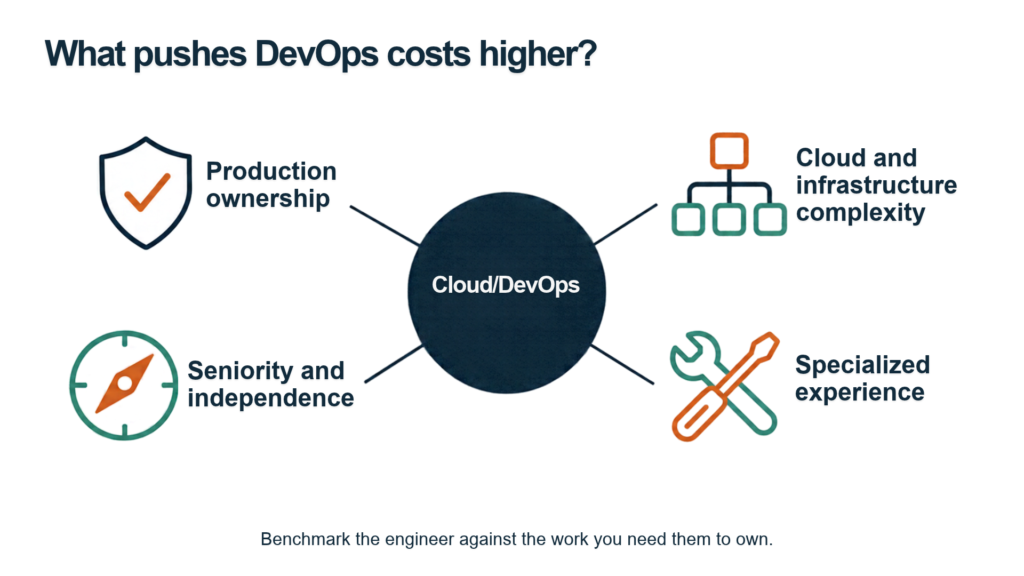
The biggest factors include seniority, infrastructure complexity, specialized technical requirements and the amount of production responsibility the engineer needs to carry.
Cloud architecture, security, reliability, incident response and independent technical decision-making can all increase the experience required for the role.
Based on Plugg’s recruiting experience, we’d put Brazil and Argentina high on the list for Cloud/DevOps talent.
For a more standard search, we’d still consider qualified candidates elsewhere in LATAM rather than restricting the search unnecessarily.
Yes.
Plugg considers Argentina one of the stronger LATAM markets for Cloud/DevOps talent and has successfully placed senior DevOps engineers there.
In one case, Plugg introduced Series A medical technology company CloudCath to a senior DevOps engineer in Buenos Aires in less than a week. He became a key member of the engineering team within several months.
Read the CloudCath DevOps case study
Not necessarily.
If the company needs senior infrastructure expertise but doesn’t have enough ongoing DevOps work to fill 40 hours every week, fractional support can be a more efficient option.
If infrastructure, deployments, reliability and production systems require continuous ownership, a full-time engineer is more likely to make sense.
LATAM can provide attractive economics compared with U.S. technical hiring, but a useful comparison needs to account for the level of infrastructure and production responsibility each engineer can handle.
The goal isn’t simply a lower hourly rate. It’s the right level of technical ownership at a cost that makes sense.
Your DevOps budget should reflect the infrastructure and production responsibility attached to the role, not just the job title. Our tech staffing services can help bridge that gap.
Tell us your cloud environment, technical requirements, current team and the responsibilities you need the engineer to carry. Plugg can benchmark the role against its LATAM hiring data and determine where we’d recommend searching.
For difficult Cloud/DevOps searches, that may put Brazil and Argentina high on the list. For a narrower role, keeping the LATAM search broader may produce a better fit.