Plugg’s short answer: QA talent in Latin America costs approximately USD 17–25 per hour, or USD 2,950–4,330 per month for a full-time hire, based on Plugg’s internal data and 2027 planning estimates.
But hiring QA engineers in Latin America isn’t as simple as filling a testing position. Need someone to find bugs and validate releases? That’s one skill set. Need someone to write automated tests, improve coverage or take charge of quality across your engineering team? That’s a different QA hire, with a different price tag.
Get the role right first. You’ll have a much better idea of what to budget and who to hire when looking for Latin America QA specialists.
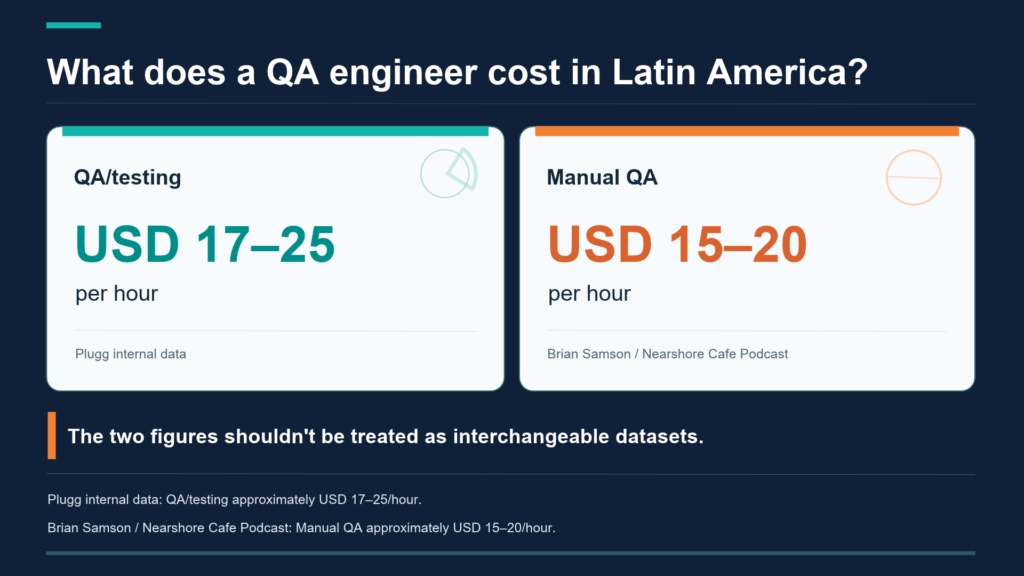
Plugg’s internal data puts QA talent at approximately USD 17–25 per hour.
For a full-time hire, that translates to approximately:
Planning benchmark | Approx. monthly equivalent |
USD 17/hour | USD 2,947/month |
USD 25/hour | USD 4,333/month |
Monthly equivalents assume 40 hours per week and 52 weeks per year, divided by 12. They are planning calculations based on Plugg’s hourly benchmark, not separate monthly rate data.
These figures are useful for initial planning, but they shouldn’t be treated as a fixed rate for every QA position.
The final budget depends on whether the role involves manual testing, test automation, QA strategy or leadership. Technical requirements, seniority and the amount of ownership also affect the cost.
This is one of the most important distinctions to make when pricing QA talent in Latin America.
Manual QA professionals execute test cases, explore features, reproduce bugs, document issues and validate releases.
On the Nearshore Cafe Podcast, Plugg President Brian Samson estimates manual QA at approximately USD 15–20 per hour.
This is a separate estimate from Plugg’s broader USD 17–25/hour internal QA benchmark. The two figures shouldn’t be treated as interchangeable datasets.
For a role focused primarily on executing an established testing process, manual QA may be the appropriate hiring profile.
Automation requires a more technical skill set.
A QA automation engineer may need to write and maintain test code, work with automation frameworks, integrate testing into CI/CD pipelines and collaborate closely with software developers.
In the same Nearshore Cafe discussion, Brian describes QA automation professionals as comparable to backend engineers in terms of the technical profile required.
That doesn’t establish a specific hourly rate for automation, but it does explain why a manual QA benchmark isn’t appropriate for every automation search.
A senior QA hire may be responsible for the testing function itself, including:
At this level, you’re hiring for judgment, strategy and ownership as well as testing capacity.
The budget needs to reflect those responsibilities rather than simply the number of testing hours required.
The right profile depends on what your existing team can already handle.
Your situation | Likely hiring profile |
You have an established testing process but need more capacity to execute tests and identify bugs. | Manual QA professional |
You need to automate repetitive tests, expand regression coverage or integrate testing into development pipelines. | QA automation engineer |
You need someone to design the testing approach, make automation decisions or lead a QA function. | Senior QA engineer or QA lead |
A company with established QA leadership may only need additional testing capacity. A growing engineering team without a clear testing strategy may benefit more from an experienced QA lead.
Define the work and the level of independence required before choosing the seniority of your nearshore hire.
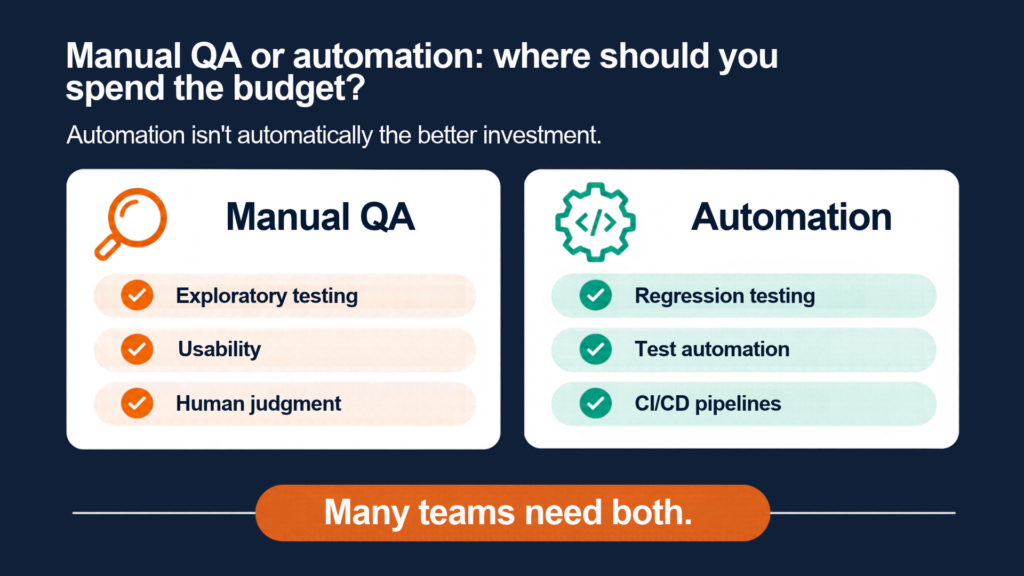
Automation isn’t automatically the better investment.
Manual QA remains valuable for exploratory testing, usability, rapidly changing features and situations where automating a test doesn’t provide enough return to justify the effort.
Automation is particularly useful when important tests need to run repeatedly and consistently, especially as a product and its regression-testing requirements grow.
Many teams need both.
The budget should reflect which testing problems are repetitive and worth automating, and which still benefit from human judgment.
A single QA professional may be enough for a smaller engineering organization with manageable testing requirements.
As the product and development team grow, QA may need to cover several functions:
At that point, team composition becomes just as important as individual hourly rates.
Plugg saw this in a Mexico engagement where a client was moving offshore work from the Philippines to a nearshore model.
The client needed front-end developers, Salesforce developers and QA professionals across team-lead, mid-level and junior levels. Plugg ultimately built a large QA team in Mexico alongside the client’s other technical teams.
Read the Mexico staffing case study
The engagement illustrates the value of hiring at different seniority levels.
For a larger QA function, we’d put senior talent where testing strategy, technical decisions and leadership are required, then build additional testing capacity at the appropriate levels.
You don’t need senior QA talent in every seat. You need the right mix of experience for the work.
Less than the role itself.
Plugg has successfully built a large QA team in Mexico, but we wouldn’t restrict every QA search to Mexico based on that experience alone.
Mexico can make particular sense when QA is part of a larger nearshore engineering team already operating there.
For other searches, we’d define the testing requirements, technical skills and seniority first, then compare qualified candidates across LATAM markets that fit the client’s broader team strategy.
Based on Plugg’s internal data, QA talent costs approximately USD 17–25 per hour.
At 40 hours per week, that’s approximately USD 2,950–4,330 per month.
Actual costs depend on the type of testing, technical requirements, seniority and level of ownership.
Brian Samson estimates manual QA at approximately USD 15–20 per hour, based on his discussion on the Nearshore Cafe Podcast.
This is separate from Plugg’s broader internal QA benchmark of USD 17–25 per hour.
Plugg doesn’t currently have a separately approved hourly benchmark specifically for QA automation.
Brian has described QA automation as comparable to backend engineering in terms of the technical profile required.
For that reason, we’d price an automation role based on its programming requirements, automation frameworks, technical complexity and level of ownership rather than automatically applying a manual QA rate.
Manual QA and automation require different skill sets.
Automation engineers typically need stronger programming skills and experience with automation frameworks and development pipelines. Those requirements can justify a higher rate than a role focused primarily on manual test execution.
The actual difference depends on the position and candidate.
Manual QA is particularly useful for exploratory testing, usability and work that benefits from human judgment.
Automation becomes more valuable when tests need to run repeatedly and consistently.
Many engineering teams benefit from a combination of both.
Yes, particularly when QA is part of a broader nearshore engineering team.
Plugg has built a large QA team in Mexico alongside front-end and Salesforce developers, hiring QA professionals across team-lead, mid-level and junior levels.
Read the Mexico staffing case study
Not necessarily.
U.S. companies may be able to hire through legitimate contractor arrangements, an Employer of Record or a nearshore staffing partner without establishing their own entity in every country.
The appropriate model depends on the employment relationship, local requirements and who will handle payroll, compliance, equipment, onboarding and ongoing administration.
USD 17–25 per hour is a useful starting benchmark for tech staffing in Latin America. The bigger decision is what kind of QA capacity you’re actually hiring.
Manual testing, automation and QA ownership require different skills and levels of experience.
Tell us what you’re testing, how much automation you already have, the seniority you need and whether the person will execute an established QA process or own it.
Plugg can benchmark the role against its LATAM hiring data and help determine the right profile and search strategy.