What could hiring operations talent in Nicaragua save your business? For one Plugg client, the answer was approximately 50% in monthly operating costs.
A Midwest FinTech company achieved those savings by moving its call center operations from Missouri to a six-person team in Managua. And it’s not an isolated opportunity. According to Plugg’s Brian Samson, Nicaragua offers some of LATAM’s biggest cost advantages for virtual assistants, customer support, and back-office operations.
Plugg’s take: Nicaragua is one of the first markets we’d consider for nontechnical operations roles. But low costs alone don’t build a strong team. English proficiency, relevant experience, and the ability to work independently matter just as much.
Nicaragua’s low labor costs make it an attractive market for U.S. companies expanding their operations teams.
The country’s official 2024 Investor’s Guide reported a base call center salary of approximately $550 per month.
However, that figure reflects historical local compensation. It doesn’t represent what a U.S. company would pay for a fully supported nearshore employee today.
The actual cost depends on the role, experience, language requirements, and hiring arrangement.
Third-party hiring platforms provide another perspective on the cost of recruiting operations professionals in Nicaragua.
For example, Upwork publishes the following hourly estimates for Nicaragua-based talent:
Role | Published hourly range (USD) |
Virtual assistant | $8-$12/hour |
Customer service representative | $8-$11/hour |
Sources: Upwork’s Nicaragua virtual assistant hiring guide and Nicaragua customer service representative hiring guide. These are third-party platform hiring estimates, not Plugg rates, local base salaries, or guaranteed all-in staffing quotes.
These ranges provide useful context for U.S. companies evaluating remote operations talent. However, they shouldn’t be compared directly with the government’s $550 monthly salary figure, which measures something different.
Companies also need to account for the additional costs associated with their chosen hiring model.
Cost component | What it covers |
Base compensation | Employee pay based on role, experience, and English proficiency |
Employer contributions | Applicable payroll taxes and statutory obligations |
Benefits and paid leave | Required benefits, leave, and additional employee benefits |
Recruitment | Sourcing, screening, and candidate interviews |
Equipment and software | Computers, headsets, licenses, and connectivity |
Staffing fees | Contracting, payroll, compliance, and ongoing support, depending on the provider |
Source for historical salary: Nicaragua’s 2024 Investor’s Guide. The $550 figure is a historical base salary reference for call center employees, not a current Plugg placement rate or all-in staffing quote.
A local salary benchmark or published hourly rate is only the starting point.
For example, a bilingual customer support representative handling live calls with U.S. customers may command higher compensation than an employee performing basic data entry.
Similarly, an experienced operations coordinator who can manage exceptions, troubleshoot problems, and work independently will generally cost more than an entry-level administrative assistant.
When comparing staffing quotes, ask what’s included in the monthly rate, whether recruiting and administrative fees are separate, and what working hours and coverage the estimate assumes.
Plugg’s recommendation: Compare complete staffing costs for candidates with equivalent experience and communication skills. The lowest advertised rate won’t necessarily produce the best value.
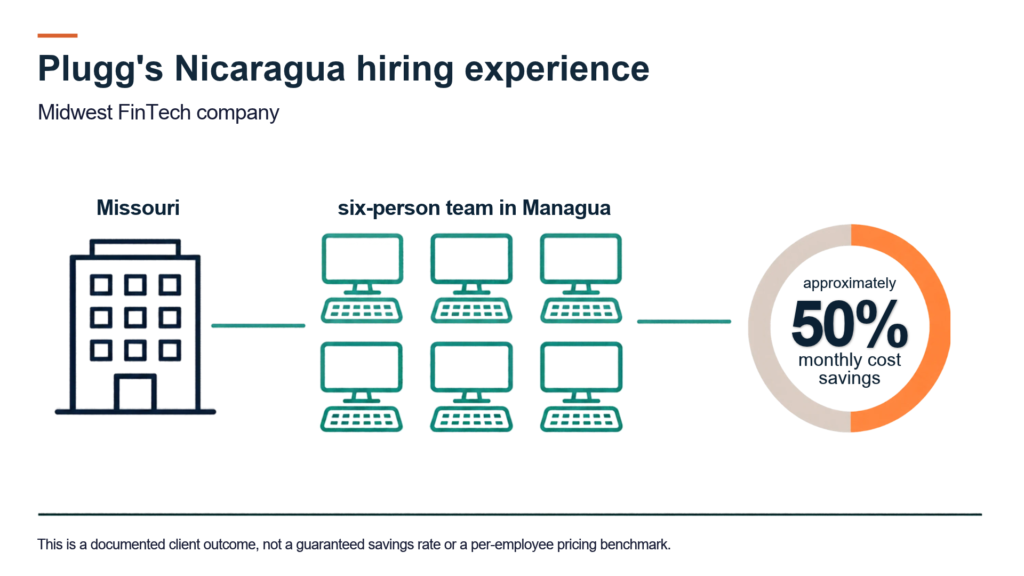
In one engagement, Plugg helped a Midwest FinTech company replace a high-cost, high-attrition Missouri call center operation with a six-person team in Managua.
The company achieved approximately 50% monthly cost savings. Plugg recruited and onboarded the team, sourced hardware, configured the working environment, and tested the setup against the client’s requirements.
This is a documented client outcome, not a guaranteed savings rate or a per-employee pricing benchmark. However, it demonstrates Nicaragua’s potential to deliver meaningful operating-cost savings for U.S. companies.
Read Plugg’s Nicaragua FinTech case study.
Nicaragua is particularly well suited to repeatable business processes that can be documented, trained, and measured.
Virtual assistants can handle scheduling, inbox management, CRM updates, document preparation, and other recurring administrative tasks.
These roles are attractive for U.S. companies that need consistent support without hiring another full-time employee domestically.
The strongest candidates can work directly with U.S. managers, follow established processes, and take ownership of routine responsibilities.
Nicaragua has an established business process outsourcing industry supporting international customers.
Customer support roles can include phone, email, and chat inquiries, appointment scheduling, order tracking, and basic troubleshooting.
For customer-facing positions, English proficiency and communication skills should be central to the hiring process.
Nicaragua-based operations professional Anna Rodriguez, who has worked with a Plugg client, discussed the country’s bilingual talent on the Nearshore Cafe Podcast. She highlighted the availability of professionals with strong English skills and BPO experience who understand how to work with U.S. businesses.
Her experience reinforces an important hiring principle: assess each candidate’s communication skills rather than relying on assumptions about English proficiency at the country level.
Watch Anna Rodriguez’s Nearshore Cafe conversation.
Companies handling large volumes of customer interactions can use Nicaragua to expand service capacity while controlling labor costs.
The country has an existing outsourcing workforce familiar with structured workflows, service metrics, and customer support processes.
For larger teams, employers should also budget for supervision, scheduling, and quality assurance.
For additional context, see Plugg’s article on building a nearshore call center in Central America.
Nicaragua is also worth considering for administrative work that happens behind the scenes.
Common responsibilities include:
These positions are especially suitable when work can be evaluated through accuracy, turnaround times, and completed tasks.
Nicaragua’s low compensation levels create an opportunity for savings, but several factors influence the final hiring cost.
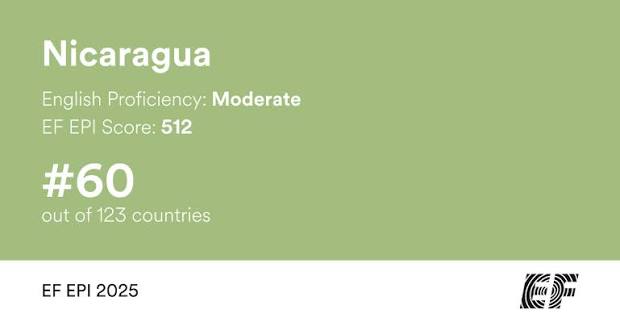
Employees handling internal administrative tasks may require less English proficiency than customer support representatives speaking directly with U.S. customers.
Advanced spoken and written English can narrow the candidate pool and affect compensation.
Nicaragua has professionals with experience supporting U.S. customers, particularly through its BPO sector. Employers should evaluate spoken and written communication against the actual responsibilities of the position.
An entry-level assistant following documented procedures is different from an experienced operations coordinator who can manage problems without constant supervision.
Companies should pay for the level of independence the role actually requires.
Nicaragua operates on Central Standard Time year-round, providing substantial overlap with U.S. business hours.
Standard weekday schedules are generally simpler to staff than evening, weekend, or extended-hour operations.
Additional shifts, supervision, and coverage requirements can increase costs.
A direct employee and a contractor engaged through a staffing partner carry different responsibilities and expenses.
Employers should compare recruiting, payroll, compliance, equipment, and ongoing support before deciding which arrangement offers the best value.
Hiring customer support agents or virtual assistants? Start with Nicaragua. Hiring software engineers? Start with Costa Rica.
That’s Plugg’s general market recommendation.
Nicaragua offers some of LATAM’s greatest cost-saving potential for nontechnical operations. Costa Rica has a more mature technology ecosystem and stronger documented evidence of specialized software engineering capabilities.
Hiring priority | Plugg’s recommended market |
Virtual assistants | Nicaragua |
Customer support | Nicaragua |
Call center and BPO staff | Nicaragua |
Routine back-office operations | Nicaragua |
Software developers | Costa Rica |
Specialized technical roles | Costa Rica |
For companies expanding administrative or customer service capacity, Nicaragua’s economics make it a compelling starting point.
For technical positions, Plugg generally favors Costa Rica because of its more established engineering ecosystem.
The distinction matters. A market that delivers excellent value for routine operations won’t necessarily offer the same depth of talent for specialized technical work.
The best hiring arrangement depends on your company’s existing infrastructure and how much responsibility you want to retain.
Hiring model | Best suited to |
Direct hire | Companies with local entity and payroll infrastructure hiring for core, long-term roles |
Contract-to-hire | Companies with local infrastructure evaluating roles with uncertain long-term requirements |
Contract staffing | Companies without local employment infrastructure or those seeking flexibility |
Outsourced BPO | Companies handing responsibility for an entire operational function to an external provider |
For U.S. companies that want dedicated operations employees working directly within their business, contract staffing is often a practical choice.
Your company manages day-to-day priorities and performance, while the staffing provider coordinates the agreed recruiting and administrative services.
If you’d rather hand over an entire customer support function, a BPO arrangement may be more appropriate.
The appropriate structure should also account for local employment and contractor-classification requirements.
Nicaragua's official 2024 investment guide reported a base call center salary of approximately $550 per month.
Upwork also publishes hourly hiring estimates of 8–11/hour for Nicaragua-based customer service representatives.
These are different types of benchmarks, not directly comparable all-in staffing rates. Actual hiring costs depend on experience, English proficiency, benefits, and the engagement model.
Savings vary by role, staffing arrangement, and the costs being replaced.
In one Plugg engagement, a Midwest FinTech company achieved approximately 50% monthly cost savings by transitioning its Missouri call center operation to a six-person team in Managua.
That result reflects a specific client engagement and shouldn't be treated as a guaranteed savings percentage.
Yes. Nicaragua is one of Plugg's preferred markets to evaluate for nontechnical positions, including virtual assistants, administrative support, and routine operations.
Nicaragua generally offers greater cost-saving potential for routine nontechnical work. Costa Rica is a higher-cost market that Plugg typically prefers for specialized technical roles.
Yes. Nicaragua has an established bilingual outsourcing industry, and Plugg has firsthand experience working with operations professionals who support U.S. businesses.
Employers should assess candidates' spoken and written English proficiency based on the specific demands of the role.
Not necessarily. Contracting and staffing arrangements may allow U.S. companies to engage Nicaraguan talent without establishing their own local entity.
The appropriate arrangement depends on local employment requirements and the services provided by the staffing partner.
Your operations team doesn’t need to be in the United States to work U.S. business hours. And routine administrative work doesn’t always justify U.S. salary levels.
Nicaragua offers an opportunity to build dedicated customer support and back-office teams while controlling costs.
Plugg has firsthand experience helping U.S. businesses establish operations in Nicaragua, including a six-person Managua team that achieved approximately 50% monthly cost savings for a FinTech client.
Whether you’re hiring one virtual assistant or expanding a customer support team, we’ll help you evaluate the right market, skills, and staffing model.