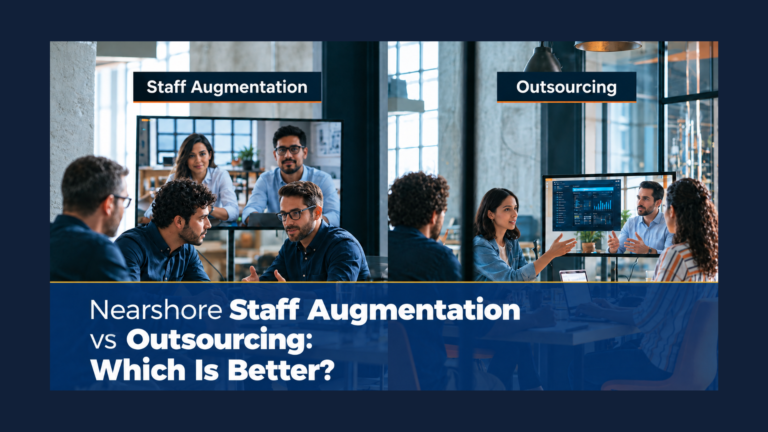
Short answer: If you already have technical leadership and need more engineering capacity, we’d usually choose nearshore staff augmentation, where outside engineers join and work as part of your existing team. If you want an outside company to own and deliver a defined project or function, we’d choose outsourcing.
In simple terms, staff augmentation means adding people to your team without handing over control of the work. With outsourcing, you’re handing responsibility for an agreed outcome to another company.
Our recommendation: choose staff augmentation for an evolving product and outsourcing for work you genuinely want to hand off.
This comparison is for CTOs, founders and engineering leaders deciding how to add technical capacity without building an entirely U.S.-based team.
It’s particularly useful if you’re choosing between adding LATAM engineers to an existing engineering organization and handing a project or function to an outside provider.
One distinction matters upfront: nearshoring and outsourcing aren’t opposites. Nearshoring describes where the talent is located. Staff augmentation and project outsourcing describe how the work is managed.
Plugg provides nearshore staff augmentation: it sources and supports LATAM talent while the client retains control over its projects.
Nearshore staff augmentation | Outsourcing | |
Best when | You need more capacity or specific skills | You want to hand off an outcome |
Who manages the work? | Your team | The provider |
Who owns priorities? | Your team | Usually the provider within the agreed scope |
Works well for | Evolving products and ongoing development | Defined projects or functions |
Flexibility | High as priorities change | Depends on scope and contract |
Plugg’s recommendation | Established teams with technical/product leadership | Teams that genuinely want to transfer delivery ownership |
Neither model is automatically cheaper. Staff augmentation primarily prices the talent you add, while outsourcing may also price in project management, delivery ownership and other services.
With nearshore staff augmentation, cost is typically driven by the number of people you add, their seniority, specialization and location. Plugg uses a flexible hourly structure, with no minimum contract term beyond a two-week notice period.
Outsourced development may instead be priced by project, milestone, dedicated team or statement of work. That makes a simple hourly comparison misleading. The outsourcing provider may be charging for responsibilities your own technical leadership would retain under staff augmentation.
For example, an augmented engineer still needs someone on your side to prioritize work, provide technical direction and make product decisions. If you already have that leadership in place, you may not need to pay another company to take over those responsibilities.
Our recommendation: if you already have the people internally to manage the work, compare the cost of adding the engineers you need. If you also need someone to own delivery, compare the full cost of that responsibility, not just developer rates.
This is the biggest reason we’d choose staff augmentation for an established product team.
The augmented engineers expand your capacity, but your company still determines priorities, architecture, workflows and what gets shipped.
Plugg explicitly defines its staff augmentation model around clients retaining control over their IT functions and deliverables.
If the product is core to your business and will continue to evolve, that control can matter more than handing a fixed scope to an outside company.
Staff augmentation doesn’t have to mean sending tickets to disconnected contractors.
One Plugg client, a fast-growing technology company that had raised $70 million, wanted senior engineers who could work as full members of its existing team. Plugg built a four-person senior full-stack team in Argentina whose engineers participated in daily standups and collaborated through Slack, Zoom and Jira.
Read the Argentina engineering-team case study
That kind of integration is particularly useful when engineers need regular access to product, design and technical leadership rather than a static list of requirements.
Software roadmaps move.
Customer feedback changes priorities. A technical problem takes longer than expected. A feature that looked critical three months ago gets deprioritized.
With staff augmentation, you’re adding engineering capacity rather than purchasing one predetermined deliverable. The team can move with the roadmap.
That’s one of the clearest advantages for companies developing products that don’t have a fixed endpoint.
Staff augmentation can also let you fill particular gaps without handing an entire function to another company.
You might need a senior React developer, DevOps engineer or data engineer without needing another organization to manage your whole engineering roadmap.
Plugg’s published engagements show that this model can scale. Its success stories include a four-person full-stack team in Argentina, 16 Salesforce developers across four pods in Mexico and more than 50 LATAM engineers hired during a client’s team transition.
Explore Plugg’s success stories
Staff augmentation gives you more control because you’re also keeping more responsibility.
Your company still owns the roadmap, prioritization, technical direction and day-to-day management.
If your engineering leadership is already overloaded, adding five developers can create five more people to manage rather than solving the underlying bottleneck.
That’s where outsourcing can win. A capable outsourcing provider can take responsibility for managing the work and delivering the agreed outcome. Plugg’s own comparison identifies delegation of deliverables as one of outsourcing’s advantages.
Staff augmentation also requires intentional integration. External engineers need product context, access to decision-makers and clear ownership just like internal engineers.
Staff augmentation loses much of its advantage if external engineers are treated like a separate workforce.
They need enough context to understand why they’re building something, not simply which ticket comes next.
On the Nearshore Cafe Podcast, Plugg Salesforce Team Lead Mario Corchado describes U.S.–Mexico teams using sprint planning, daily standups and retrospectives across the nearshore team, while emphasizing the need for intentional communication, documentation and expectation-setting.
Nearshore Cafe Podcast: Leading Nearshore Salesforce Teams With Mario Corchado
Who owns architecture? Who approves releases? Who reviews code? Who handles production incidents? Who sets priorities?
Those responsibilities should be clear from the start. Documentation, code review and shared ownership also help prevent one person or provider from becoming the only source of critical product or technical knowledge.
External team members may need access to code, systems, customer information and proprietary company data.
Permissions, security requirements, confidentiality and IP ownership should be clear before the engagement begins. Plugg also identifies IP protection and security as considerations when evaluating outsourced IT services.
Outsourcing introduces a different set of management risks.
The company may become dependent on the provider for technical knowledge, delivery processes or ongoing maintenance. Requirements that change substantially after a project is scoped can also affect timelines, cost and responsibilities.
The less control you want to retain, the more carefully you need to evaluate the provider taking it on.
Staff augmentation and traditional outsourcing aren’t your only choices.
You can hire LATAM employees directly if you’re prepared to manage recruiting, employment and local administration yourself.
An Employer of Record can make sense when you’ve already identified the person you want but don’t have an entity in their country.
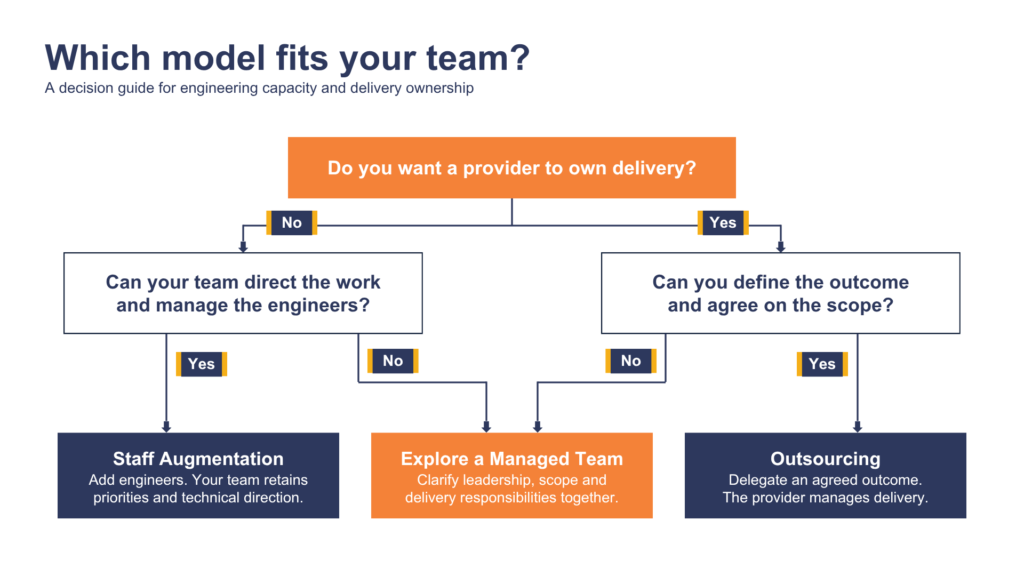
A dedicated or managed team can sit between the two models. You gain a defined external team and potentially more delivery ownership without necessarily handing off an entire product or function.
Project-based consulting can also work when you need specialist expertise for a specific technical problem rather than ongoing engineering capacity.
The decision comes back to what you’re actually trying to buy: people, expertise or an outcome.
The biggest mistake is choosing the delivery model before diagnosing the problem.
If your problem is “we have more roadmap than engineers,” staff augmentation is often a strong fit.
If the problem is “we don’t have the internal expertise or leadership to own this project,” simply adding engineers may not solve it. Outsourcing or a managed delivery model could make more sense.
If the problem is “we need this defined project delivered and don’t want to manage the team doing it,” outsourcing may be the cleaner choice.
Another mistake is outsourcing an evolving core product simply because you don’t want the administrative work of hiring. Staff augmentation can remove much of that hiring and employment burden without requiring you to transfer product ownership.
And don’t compare the models solely on hourly rates. A cheaper developer doesn’t necessarily produce a cheaper outcome, and a more expensive outsourcing proposal may include responsibilities you would otherwise need to provide internally.
Finally, don’t use nearshoring, staff augmentation and outsourcing interchangeably. Nearshoring tells you where the talent is. Staff augmentation and outsourcing tell you how responsibility for the work is divided.
Start with the problem and the ownership you want to retain. The right model becomes much easier to identify from there.
Staff augmentation adds external professionals to your existing team while your company retains responsibility for managing the work. Outsourcing transfers responsibility for a project, function or deliverable to an external provider.
Plugg uses the staff augmentation model, allowing clients to add LATAM talent while retaining control over their projects and deliverables.
For an established engineering organization that already has technical leadership and needs additional capacity, we’d usually choose staff augmentation.
It gives the company more control over priorities, technical decisions and how engineers integrate with the existing team.
Outsourcing may be better when the company wants the provider to own a clearly defined project or function.
Not necessarily, and comparing headline rates can be misleading.
Staff augmentation primarily buys additional talent. Outsourcing may bundle talent with project management, technical leadership and responsibility for delivering the agreed outcome.
Compare the total cost required to get the work done rather than assuming one model is always cheaper.
Choose staff augmentation when you already have product or technical leadership, know which skills or capacity you’re missing and want additional people working within your existing processes.
It’s particularly useful for products where priorities and requirements are likely to change over time.
Consider outsourcing when the work has a well-defined outcome and you want an external provider to take responsibility for delivering it.
That can be more appropriate when you don’t want to manage individual engineers or don’t have the internal capacity to oversee the work.
Yes.
Plugg has published examples of LATAM engineers joining existing communication tools, participating in daily standups and working within client workflows. Its Argentina full-stack case study describes engineers collaborating through Slack, Zoom and Jira and participating in daily standups.
The Nearshore Cafe Podcast also provides a firsthand example of U.S.–Mexico teams using daily standups and other Scrum ceremonies.
No, although they’re related.
Nearshoring describes using talent or providers in nearby countries. Staff augmentation describes a delivery model in which external talent joins your team while you retain control.
Traditional outsourcing generally transfers more responsibility for the work and its outcomes to the external provider.
Direct hiring can make sense if you’re building a permanent local organization and have the infrastructure to recruit, employ, onboard and support people in the countries where you’re hiring.
Staff augmentation can remove much of that operational burden while allowing engineers to work within your existing organization.
Plugg is built around the staff augmentation side of this comparison.
Plugg sources, vets and places LATAM talent to a client’s requirements. It also provides the surrounding employment infrastructure, including payroll processing, legal and compliance support, onboarding, bilingual support, hardware procurement and ongoing engagement management.
See how Plugg’s nearshore staffing model works
More importantly, the model is designed around adding people to the client’s organization rather than taking control of the client’s product.
That’s visible in Plugg’s actual engagements. The Series A client in Argentina needed engineers working in Slack, Zoom and Jira and participating in its daily standups. Plugg recruited four senior full-stack developers who joined that existing workflow.
Plugg has also demonstrated that the model can scale. Its published success stories include individual specialist placements, multi-pod teams and an engagement involving more than 50 LATAM engineers.
If you already know where your product is going and need more people capable of helping you get there, we’d generally recommend adding the right talent to your team rather than handing ownership of the work to someone else’s.