
Plugg’s Short answer: For 2027 planning, expect rates starting around USD $45 per hour, climbing into the USD $60s for senior and highly specialized engineers. That’s approximately USD $7,800–$10,400 per month for a full-time hire, based on Plugg’s historical pricing benchmarks.
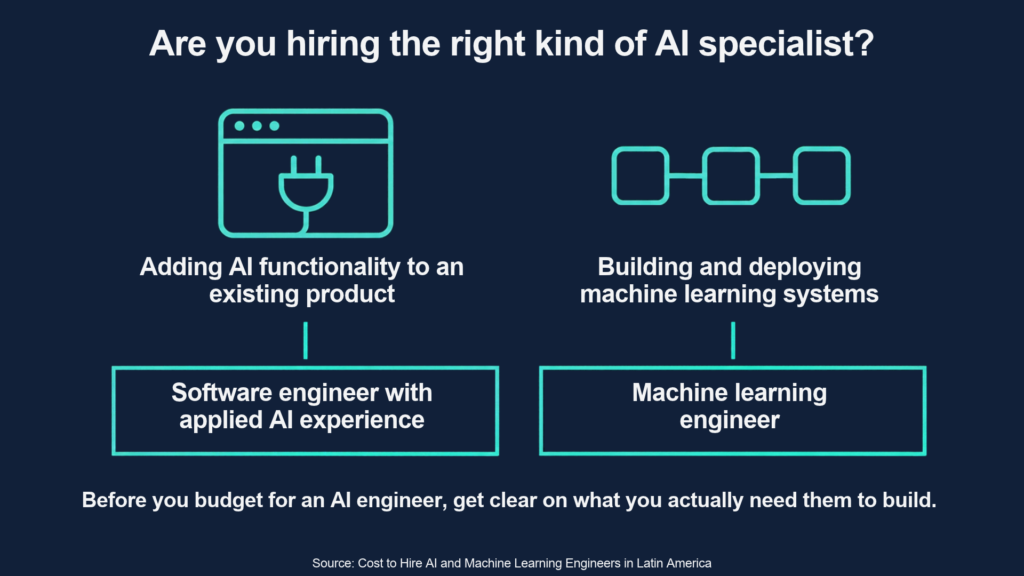
But there’s a big difference between adding an AI feature to your product and hiring someone to build, deploy and maintain a production machine learning system. The first may only require a software developer with applied AI experience. The second calls for deeper expertise and a bigger budget.
Before you budget for an AI engineer, get clear on what you actually need them to build.
Plugg’s historical hourly pricing data puts specialized AI/ML talent at approximately USD 45 per hour to start, extending into the USD 60s for more senior or specialized hires.
Hourly benchmark | Approximate monthly equivalent |
USD 45/hour | USD 7,800/month |
USD 60/hour | USD 10,400/month |
Monthly equivalents assume 40 hours per week and 52 weeks per year, divided by 12. These are planning calculations based on Plugg’s hourly benchmarks, not separate monthly rate data.
These hourly figures reflect Plugg’s historical pricing data. They should not be confused with direct talent costs, which represent compensation paid to the engineer rather than the amount billed to a client.
A software engineer integrating existing AI models or APIs has a different hiring profile from someone responsible for building and maintaining production machine learning systems.
Greater seniority, specialization and production ownership generally push the rate higher.
See Plugg’s guide to the best LATAM markets for AI and machine learning engineers
There’s a meaningful difference between using AI tools and building AI systems that work in production.
Familiarity with LLMs, prompt engineering, or popular frameworks like LangChain, LlamaIndex, and Hugging Face Transformers doesn’t necessarily mean someone has designed, deployed, evaluated, and maintained production AI systems.
If the role requires that experience, expect to pay for it.
An engineer working within an established system has different responsibilities from someone expected to make architecture decisions, own production systems and solve complex technical problems independently.
The latter requires a more senior profile and generally commands a higher rate.
The candidate pool gets smaller as requirements become more demanding.
A search requiring deep ML expertise, production experience, cloud or data skills, strong English, U.S. company experience and the ability to work independently will have fewer qualified candidates.
For these roles, the depth of the available talent pool becomes an important consideration when choosing where to recruit.
You want to add generative AI features using existing models or APIs, and you already have an established engineering team.
You may not need a dedicated machine learning engineer.
A strong software engineer with applied AI experience may be enough, particularly if the company isn’t building its own models or ML infrastructure.
The role might involve integrating an LLM API, building application features around an existing model or connecting AI functionality to an established product.
In this situation, hiring a highly specialized ML engineer could add cost without providing capabilities the project actually needs.
Now the engineer needs to develop, deploy and maintain ML systems in production.
This is much closer to the specialized talent represented by Plugg’s USD 45 per hour into the USD 60s planning range.
The role may require experience with model development, evaluation, deployment, monitoring and production reliability.
The final rate will depend on technical specialization, production experience, seniority and how much of the system the engineer needs to own.
The person needs deep technical expertise, significant ownership and the ability to solve difficult problems without extensive oversight.
For difficult-to-fill senior AI engineering, data engineering and data science roles in Brazil, Plugg President Brian Samson recommends budgeting approximately USD $7,000–$9,000 per month in direct talent cost.
Hear Brian discuss LATAM tech talent costs on the Nearshore Cafe Podcast
This figure represents direct talent cost, while Plugg’s historical hourly benchmarks reflect pricing data. They measure different things and should not be compared as equivalent hiring rates.
For senior specialist searches, the right budget depends on the technical problem, the available candidate pool and the experience required to deliver the work.
Based on Plugg’s recruiting experience, we’d start in Brazil, particularly Florianópolis, followed by Argentina and Colombia.
Brian has described Brazil as the “undisputed leader” in LATAM AI/ML talent.
Brazil is not the cheapest LATAM technical market. But Plugg’s recruiting experience points to greater depth in specialized AI and machine learning talent there, particularly for demanding searches.
Argentina is another strong option for AI/ML, while Colombia deserves consideration when technical requirements, available talent and hiring economics align.
For a detailed comparison of these markets, including Mexico, see Plugg’s Best LATAM Countries for Hiring AI & Machine Learning Engineers.
Not every AI project requires the same technical profile.
Role | When you’d hire one |
Software engineer with applied AI experience | You’re integrating existing models or adding AI functionality to an established product. |
Machine learning engineer | You’re developing, deploying or maintaining ML models and systems. |
Data engineer | Data quality, pipelines, infrastructure or data availability are the main challenges. |
Data scientist | The work focuses on analysis, experimentation, statistical modelling or model development. |
MLOps engineer | Deployment, monitoring, infrastructure and production reliability are central to the role. |
Senior AI engineer or architect | You need someone to make technical decisions and take ownership of complex production AI systems. |
Defining these responsibilities before recruiting helps avoid paying for expertise the project doesn’t need or hiring someone who lacks critical capabilities.
One experienced engineer may be enough if AI is one component of an existing product and the company already has strong engineering, data and infrastructure support.
A broader team may make sense when the company needs to cover several functions, including:
That doesn’t mean every function needs a separate specialist or a senior-level hire.
A company with existing application developers and DevOps support may only need one experienced ML engineer. A business building a complex AI product from the ground up may need dedicated technical leadership and supporting engineers.
Put senior talent where technical ownership matters most, then build the rest of the team around the work.
A generic LATAM developer rate isn’t particularly useful for pricing a senior ML engineer.
Neither is a broad domestic salary average.
Local-currency salary figures often reflect candidates working primarily in their domestic labor market. Those figures may not represent the compensation required for engineers with advanced English fluency, U.S. company experience, production AI expertise or significant technical ownership.
The strongest AI engineers can compete for opportunities well beyond their home countries.
For an accurate hiring budget, use benchmarks that reflect the role’s technical requirements and the market for candidates who meet them.
For 2027 planning, Plugg recommends starting at approximately USD 45 per hour for specialized AI/ML talent. Senior or highly specialized engineers can reach into the USD 60s per hour.
At 40 hours per week, USD 45/hour is approximately USD 7,800 per month, while USD 60/hour is approximately USD 10,400 per month.
These monthly amounts are calculated from Plugg’s historical hourly pricing benchmarks. Actual costs depend on the role and hiring arrangement.
Plugg’s specialized AI/ML planning guidance starts at approximately USD 45 per hour, extending into the USD 60s for more senior or specialized talent.
Machine learning engineers responsible for production architecture, deployment or complex systems are more likely to command higher rates.
Plugg would start in Brazil, particularly Florianópolis, followed by Argentina and Colombia.
Brazil stands out in Plugg’s recruiting experience for specialized AI/ML talent.
Compare the best LATAM countries for AI and machine learning engineers.
Brazil generally sits toward the higher end of LATAM technical pricing.
For difficult-to-fill senior AI engineering, data engineering and data science roles in Brazil, Brian recommends approximately USD 7,000–9,000 per month in direct talent cost.
That figure reflects compensation for the talent, not necessarily a fully loaded client billing rate.
If you’re primarily integrating existing models or APIs into a product, a strong software engineer with applied AI experience may be sufficient.
If you’re developing ML systems, building models or managing specialized AI infrastructure, a dedicated AI/ML specialist may be more appropriate.
Not necessarily.
U.S. companies may be able to hire through legitimate contractor arrangements, an Employer of Record or a nearshore staffing partner without establishing their own entities in every country.
The appropriate model depends on the employment relationship, local requirements and who will handle payroll, compliance, equipment, onboarding and ongoing administration.
The right budget depends on the system you’re building, the technical expertise required and how much responsibility the engineer needs to take on.
Plugg can help define the role, benchmark it against LATAM hiring data and identify the markets where the relevant talent is strongest.
Whether you need a software engineer with applied AI experience, a senior machine learning specialist or a broader technical team, we’ll help you understand the hiring options and costs.
Tell us what you’re building. We’ll help you price the talent required to build it.