
Short answer: For many remote software roles, the same engineering budget goes substantially further in LATAM than it does in the U.S.
Plugg’s current benchmarks put many experienced LATAM developers at roughly $4,000 to $7,000 per month in direct talent costs, or $48,000 to $84,000 per year. The median U.S. software developer, by comparison, earns $135,980 in salary alone, according to the U.S. Bureau of Labor Statistics.
And that’s before benefits enter the U.S. side of the equation.
But the opportunity isn’t to find the cheapest developer in Latin America. Rates vary by country, seniority and specialization, and a lower rate only creates value if you’re comparing engineers who can do the same job.
Our recommendation: compare what it costs to build the engineering capacity you need in each market. For many U.S. companies, that’s where the LATAM advantage becomes hard to ignore.
Who this is for
This guide is for CTOs, engineering leaders, founders and finance leaders deciding whether to hire software developers in the U.S. or build engineering capacity in Latin America.
It’s especially useful if you’re setting a hiring budget, comparing the cost of a U.S. developer with a LATAM hire or trying to understand what sits behind the headline salary numbers.
How much does a software developer cost in LATAM vs. the U.S.?
Plugg’s internal rate history shows why there isn’t one useful “LATAM developer rate.” Across hundreds of contractor starts, client bill rates have varied substantially by role and seniority. Software engineering roles have typically landed around the low-$40s per hour billed, while explicitly senior and leadership-level roles have averaged higher.
Here’s the high-level comparison:
| Developer cost | LATAM | U.S. |
| Junior developer | Starting around $24,000/year | Varies |
| Mid-level developer | Roughly $24,000–$48,000/year | Varies |
| Senior developer | Roughly $48,000–$72,000/year | Varies |
| Full-stack developer | Roughly $48,000–$84,000/year | Varies |
| Software developer benchmark | Varies by role and seniority | $135,980 median wage |
These LATAM developer rates are Plugg benchmarks based on direct talent costs and should be treated as ranges rather than fixed salaries. Country, seniority, English proficiency, technical specialization and international experience can all affect what a developer commands.
The U.S. figure comes from U.S. Bureau of Labor Statistics software developer data, which reports a $135,980 median annual wage for software developers in May 2025.
There is an important catch: these aren’t apples-to-apples total costs.
The U.S. number is a wage. The LATAM figures represent direct talent costs before Plugg’s recruiting and service fees. Neither number, on its own, tells you the complete cost of adding an engineer.
In our experience, the cost difference is primarily a labor-market difference, not a quality discount. U.S. companies hiring in LATAM are recruiting from markets with different compensation levels and employer competition.
Plugg saw the size of that opportunity firsthand with a San Francisco Series B company that was spending more than $200,000 per year on a U.S.-based remote engineer. After expanding its search to LATAM, the company hired senior engineering talent at approximately 40% of the U.S. cost, saving more than $120,000 per year on the role.
Read the Series B cost comparison
How do benefits change the U.S. developer cost comparison?
A U.S. developer earning the $135,980 median wage may represent roughly $196,000 in total employer compensation before recruiting, equipment and other operating costs.
BLS data shows that benefits account for a substantial share of total compensation for private-industry professional and related occupations. Applying that broad occupational compensation mix to the median software developer wage gives us a useful illustration:
| One developer | Approximate annual cost |
| U.S. software developer salary | $135,980 |
| U.S. estimated compensation including benefits* | ~$196,000 |
| LATAM full-stack developer | ~$48,000–$84,000 direct talent cost |
*This is an illustration, not a software-developer-specific BLS total-compensation estimate. See the BLS compensation data.
The difference becomes more significant as the team grows. Using the same benchmarks, three LATAM full-stack developers would represent roughly $144,000 to $252,000 per year in direct talent costs. Three U.S. developers earning the national median would receive about $408,000 in salary alone, before benefits and other employment costs.
Again, these aren’t perfectly equivalent cost categories. Plugg’s LATAM figures exclude its recruiting and service fees, while the U.S. figures don’t capture every recruiting, equipment or operational expense.
But they illustrate the decision engineering leaders actually face: the same annual budget can support materially more engineering capacity in LATAM.
What affects the cost of a software developer in LATAM?
The biggest cost drivers are:
- Seniority and scope. A developer who can independently own architecture, mentor engineers or lead technical decisions will cost more than someone who needs regular direction.
- Technical specialization. Harder-to-find AI, data, cloud, DevOps and security skills can push compensation higher.
- Country and talent market. LATAM isn’t one labor market. Compensation expectations and talent availability differ across countries and cities.
- English and international experience. Developers who can communicate directly with U.S. teams and already understand distributed working environments compete for a broader pool of international opportunities.
Plugg has seen those differences play out between countries. In one search for a senior React Native developer, for example, Bolivia offered better economics than Argentina and Costa Rica for that particular client. The developer ultimately stayed for more than three years.
Our recommendation: don’t choose a LATAM country based on its average salary. Define the engineer you need first, then compare what that level of talent costs across the markets where you can realistically hire.
What are the advantages of hiring software developers in LATAM?
The biggest advantage is engineering capacity per dollar without giving up most of the U.S. workday.
Plugg’s current benchmarks put many experienced LATAM developers at roughly $48,000 to $84,000 per year in direct talent costs, compared with a $135,980 median U.S. software developer salary.
That can allow a company to hire additional developers, add seniority or bring specialized capabilities into the team without increasing the engineering budget at the same rate.
LATAM also offers substantial working-hour overlap with U.S. teams, which makes it practical for developers to join standups, code reviews, planning sessions and day-to-day engineering discussions.
For fully remote roles, that’s why we’d compare the engineering capacity the same budget can buy rather than comparing headcount alone.
What are the disadvantages of hiring software developers in LATAM?
LATAM hiring adds cross-border complexity that doesn’t exist with a straightforward domestic hire.
Companies need an appropriate model for contracts or employment, payroll, compliance, equipment and ongoing support.
The lowest advertised LATAM rates can also be misleading. Senior engineers with strong English skills and international experience compete for international opportunities, so their compensation may be considerably higher than local salary averages suggest.
And LATAM isn’t one uniform talent market. The country with the lowest average costs may not have the strongest available candidates for the role you’re trying to fill.
What are the risks of hiring software developers in LATAM?
The biggest risk is treating the cost gap as a reason to lower the hiring bar.
A developer who requires significant additional management, produces more rework or leaves quickly can erase an apparent salary advantage.
There is also a risk in comparing numbers that represent different things. A U.S. salary, a contractor’s compensation, a staffing-company bill rate and a fully loaded employment cost are not interchangeable.
Finally, choosing a country solely because it appears cheaper can unnecessarily constrain the search.
Compare equivalent talent and equivalent cost categories before deciding how much you’re actually saving.
What mistakes should you avoid when comparing U.S. and LATAM developer costs?
The biggest mistake is assuming the lowest rate produces the lowest cost.
Four things matter when you’re comparing markets:
- Don’t compare salary with total cost. Know whether each figure includes benefits, recruiting, payroll, compliance, equipment or service fees.
- Don’t shop for the lowest rate. Rework, management overhead, turnover and slower delivery can wipe out an apparent rate advantage.
- Don’t compare headcount instead of capability. Two developers with the same title may have very different levels of independence and technical depth.
- Don’t choose a country on cost alone. The cheapest market may not have the strongest available candidates for the role you need.
Plugg has seen the hidden cost of low-rate hiring in underperforming nearshore engagements. Rework, additional coordination, turnover and delayed delivery can outweigh the initial savings.
Read Plugg’s analysis of why cheap nearshore teams can cost more
Optimize for cost per productive engineer, not cost per developer.
When does hiring a U.S. developer make more sense?
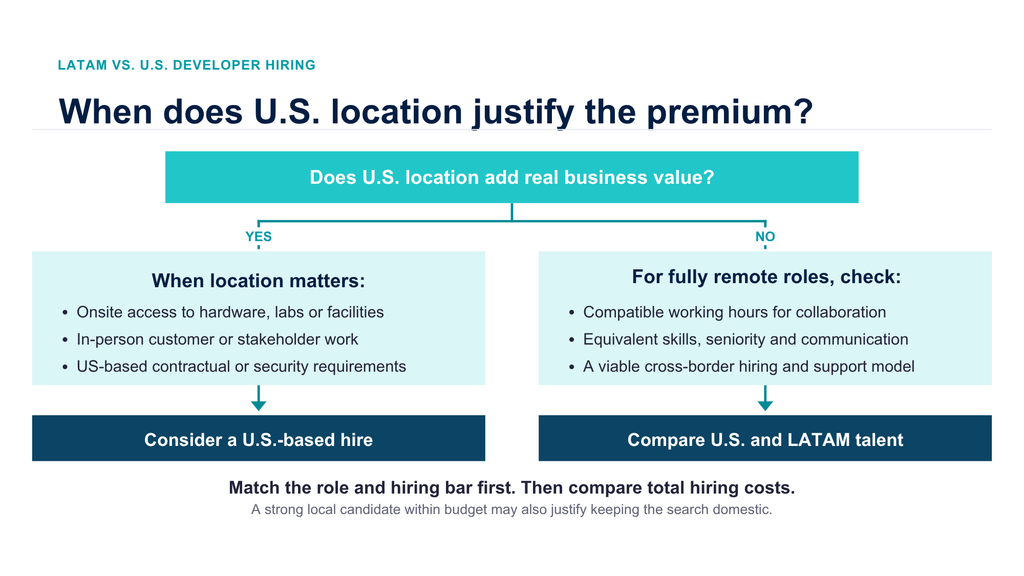
Hiring in the U.S. can make more sense when the role genuinely benefits from being physically close to your team, customers or operations. Paying the U.S. premium is harder to justify when the position is fully remote and location adds little operational value.
A U.S.-based hire may be the better choice when:
- The role needs to be onsite. Some engineering work requires regular access to physical infrastructure, hardware, labs or company facilities.
- Customer interaction is highly location-dependent. Certain roles may require frequent in-person meetings with customers, partners or internal stakeholders.
- You already have a strong local candidate. If you’ve found the right developer and the compensation fits your budget, expanding the search internationally may add unnecessary complexity.
- The role has specific U.S.-based requirements. Some positions may have contractual, regulatory, security or client requirements that restrict where the work can be performed.
For fully remote software development roles, however, we’d question whether U.S. location itself is worth paying a significant premium.
Our recommendation: pay the U.S. premium when location creates real business value. If the job can be performed effectively from anywhere in a compatible time zone, compare the talent available in LATAM before limiting the search to the U.S.
What are the alternatives to hiring software developers in LATAM?
LATAM isn’t the only alternative to hiring a full-time U.S. developer. The right model depends on your budget, timeline and how closely the developer needs to work with your existing team.
| Hiring approach | Best suited for | Main tradeoff |
| U.S. employee | Roles where U.S. location provides real value | Highest employment cost |
| LATAM developer | Long-term, embedded engineering capacity | Requires cross-border hiring infrastructure |
| Offshore developer | Teams prioritizing lower rates | Less working-hour overlap with U.S. teams |
| Freelancer | Short, clearly defined projects | Less continuity and long-term integration |
| U.S. contractor | Temporary or specialized expertise | Can still carry a significant U.S. cost premium |
For software development that requires frequent collaboration, we generally favor nearshore over traditional offshore hiring.
In the Nearshore Cafe Podcast, Brian Samson explores that tradeoff in Nearshoring vs. Offshoring: Global Talent, Time Zones & AI, including why hourly rates need to be considered alongside quality, collaboration and total cost.
Listen to Nearshoring vs. Offshoring: Global Talent, Time Zones & AI
Choose the hiring model based on how the developer needs to work with your team, then compare costs within that model.
Frequently asked questions about LATAM vs. U.S. software developer costs
How much does a software developer cost in Latin America?
Plugg’s current benchmarks put many experienced LATAM developers at roughly $4,000 to $7,000 per month in direct talent costs, or about $48,000 to $84,000 per year.
Junior developers may start around $2,000 per month, while highly specialized AI and data talent can reach $7,000 to $9,000 per month. Actual compensation depends on country, seniority, technical skills, English proficiency and international experience.
How much does a software developer cost in the U.S.?
The median U.S. software developer earns $135,980 per year, according to the U.S. Bureau of Labor Statistics.
That’s salary only. Benefits and other employment expenses make the employer’s actual cost higher.
How much cheaper are LATAM developers than U.S. developers?
There isn’t one percentage that applies to every hire.
Using Plugg’s benchmark of $48,000 to $84,000 for many experienced LATAM developers and the U.S. median wage of $135,980, the difference is roughly $52,000 to $88,000 per developer per year compared with U.S. salary alone.
The actual savings depend on the role, country, seniority, hiring model and U.S. developer you’re comparing against.
What is a good LATAM developer rate?
There isn’t one “good” LATAM developer rate. Plugg’s current benchmarks range from around $2,000 per month for some junior technical talent to $7,000 to $9,000 per month for highly specialized AI and data roles.
The right rate depends on country, seniority, technical specialization, English proficiency and international experience.
Why Plugg for hiring software developers in LATAM?
For many U.S. companies hiring remote software developers, the cost advantage of LATAM is compelling. But the goal shouldn’t be to replace an expensive U.S. developer with the cheapest developer you can find in Latin America.
Plugg helps U.S. companies find the right LATAM market and developer for their budget, then handles the infrastructure required to hire and support them.
We start by understanding the role, technical requirements, hiring bar and budget. From there, we can advise on which LATAM markets make sense rather than limiting the search to one country or chasing the lowest available rate.
Plugg handles sourcing and vetting, interview coordination, payroll and local compliance, hardware procurement and delivery, onboarding and bilingual support, and ongoing engagement management.
On average, Plugg delivers a shortlist of vetted, interview-ready candidates within three days and can onboard a first hire within 14 days or less. Our current offer-to-acceptance rate is 93%.
Plugg’s own hiring experience also shows what the cost difference can look like in practice. In the Series B example above, expanding a search from the U.S. to LATAM resulted in a senior engineering hire at approximately 40% of the U.S. cost, saving more than $120,000 per year on that role.
Our recommendation: hire for the seniority, technical skills, communication ability and experience your team actually needs, then compare what that engineering capacity costs across the U.S. and several LATAM markets.
The goal is to use LATAM’s cost advantage to find strong developers who meet your hiring bar and can stay productive on your team long term.
If you’re deciding whether LATAM makes financial sense for your next engineering hire, Plugg can help you compare the markets, compensation and available talent for your specific role and budget.