
How much does it cost to hire call center talent in Central America? In Nicaragua, Guatemala, and El Salvador, reported monthly salary bands start as low as $301-$600, according to Tecoloco’s 2026 salary index. Experienced bilingual agents and fully supported staffing arrangements cost more, but the region offers significant savings potential for U.S. companies.
According to Plugg’s Brian Samson, Nicaragua offers some of LATAM’s biggest cost-saving opportunities, particularly for call centers, customer support, and other nontechnical operations.
But Nicaragua isn’t the only market worth exploring. Guatemala, El Salvador, and Honduras offer additional talent pools for companies looking to build or scale their customer support teams.
Plugg’s take: Start with Nicaragua for cost-effective customer support. If you need a larger candidate pool or more specialized skills, broaden your search across Central America. The goal isn’t simply to find the cheapest agents. It’s to build a capable team at a competitive cost.
Call center compensation varies by country, experience, language proficiency, and responsibilities.
Tecoloco’s 2026 regional salary index provides a starting point for comparing local compensation expectations. Its figures represent commonly reported salary bands from candidate profiles, rather than standardized rates for equivalent bilingual agents.
Country | Monthly salary reference (USD) |
Nicaragua | $301-$600 |
Guatemala | $301-$600 |
El Salvador | $301-$600 |
Honduras | $601-$900 |
Source: Tecoloco Regional Call Center Salary Index, 2026. These are commonly reported salary bands based on candidate profiles, not verified employer-paid averages or current nearshore staffing rates.
The figures are useful for understanding local compensation, but they shouldn’t be used as direct quotes for hiring experienced bilingual agents serving U.S. customers. The cost to hire call center talent in Central America is different from regional salaries, as bilingual specialists manage a market of their own.
A candidate with advanced English proficiency, international customer service experience, and the ability to handle complex interactions may command significantly higher compensation.
The salary bands also shouldn’t be interpreted as proof that Honduras is more expensive than the other markets. Comparing equivalent candidates and staffing arrangements provides a more reliable picture of actual hiring costs.
For U.S. companies, the total staffing cost includes more than the employee’s salary.
Cost component | What it covers |
Employee compensation | Base pay based on experience, language proficiency, and responsibilities |
Employer obligations | Applicable payroll taxes, statutory contributions, and benefits |
Recruiting | Candidate sourcing, screening, interviews, and language assessments |
Equipment and technology | Computers, headsets, software, and connectivity |
Management and quality assurance | Supervision, training, performance monitoring, and scheduling |
Staffing provider fees | Payroll, contracting, compliance, and ongoing support, depending on the arrangement |
Plugg’s BPO and non-IT staffing services cover customer service representatives, call center agents, virtual assistants, and back-office support, including recruiting and onboarding assistance.
Plugg’s recommendation: Compare the total cost of hiring agents who meet the same service requirements. A lower salary means little if the employee can’t handle the work independently or meet your customer experience standards.
Central America has several established customer service and outsourcing markets. The strongest choice depends on the type of support you need and the talent available.
Country | Hiring considerations | Plugg’s perspective |
Nicaragua | Cost-sensitive customer support, call centers, and routine operations | Preferred starting point for nontechnical operations |
Guatemala | Established BPO industry with a substantial customer service workforce | Strong alternative for larger recruiting searches |
El Salvador | Established outsourcing market serving international customers | Another option for English-speaking support |
Honduras | Additional regional customer service talent pool | Consider when hiring requirements justify a broader search |
Costa Rica | Higher-cost market with a mature services and technology sector | Evaluate when specialized requirements justify the cost |
Brian Samson identifies Nicaragua as having some of the greatest cost-saving potential in Latin America.
Its strongest opportunities are in nontechnical roles, including call center agents, virtual assistants, and back-office operations.
Plugg has seen those savings firsthand. In one engagement, a Midwest FinTech company replaced a high-cost, high-attrition Missouri call center operation with a six-person team in Managua.
The company achieved approximately 50% monthly cost savings. Plugg also recruited the team, sourced hardware, configured the working environment, and tested the setup against the client’s requirements.
That result reflects a specific client engagement, not a guaranteed savings rate for all Nicaragua hires. But it demonstrates the market’s potential for companies building dedicated customer support operations.
Read Plugg’s Nicaragua FinTech case study.
Plugg’s take: For process-driven customer support, start with Nicaragua. If the required English proficiency, experience, or hiring volume proves difficult to source, expand the search to other Central American markets.
A broader search makes sense when your operation has more demanding requirements.
For example, a company hiring 30 bilingual agents for complex customer interactions may need access to a larger candidate pool than a company hiring five representatives for routine order inquiries.
Guatemala is a particularly strong alternative when you need a larger recruiting pool. According to AGEXPORT, the country’s contact center and BPO industry supports approximately 55,000 formal jobs, with sector exports exceeding $736 million in 2024.
The industry has extensive experience serving international clients across customer support and other business functions, making Guatemala worth evaluating alongside Nicaragua when building larger bilingual teams.
El Salvador also has an established outsourcing industry and is another logical market to consider for English-speaking support.
Honduras can expand the available talent pool when candidate availability or hiring volume warrants a broader search.
Costa Rica is generally a more expensive market. Plugg’s preference for Costa Rica is strongest in technical hiring, so its suitability for call center positions should be evaluated against the specific role rather than assumed.
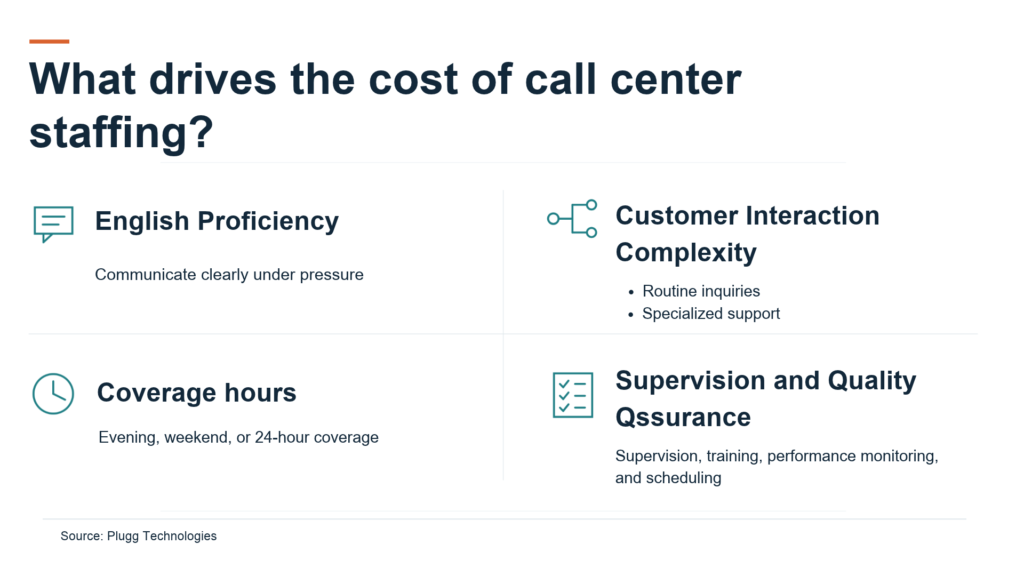
The country matters, but the work itself often has a greater impact on what companies ultimately pay.
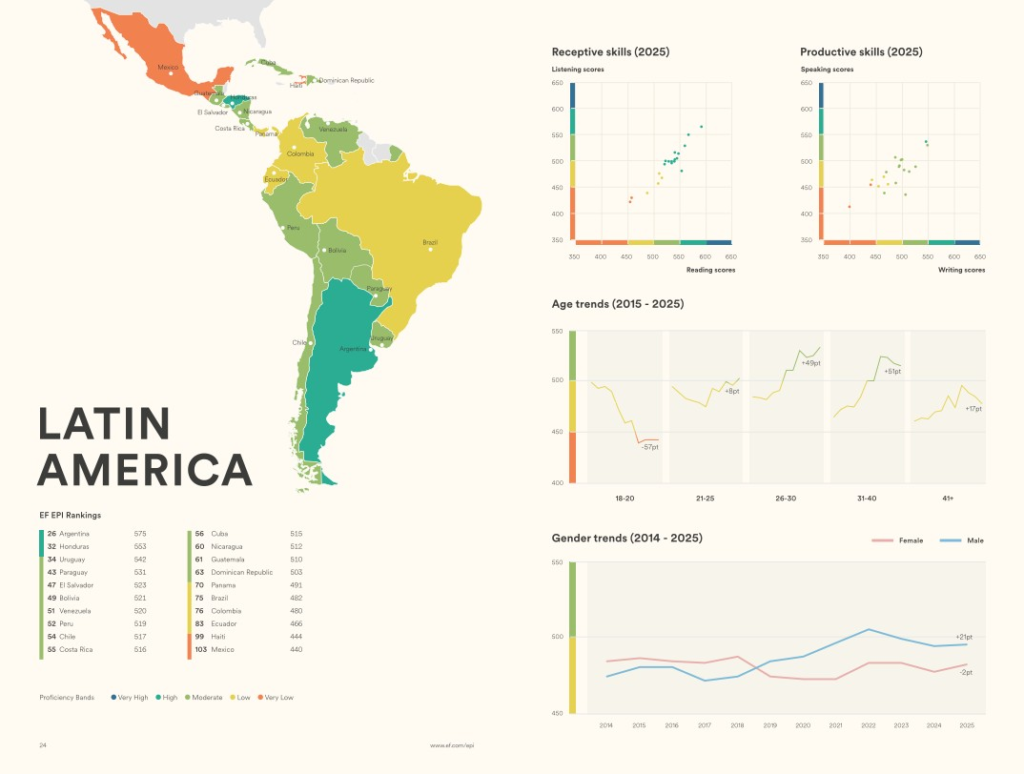
A bilingual agent supporting U.S. customers needs more than conversational English.
Customer-facing roles may require the ability to understand different accents, explain policies, resolve complaints, and communicate clearly under pressure.
Stronger language requirements can narrow the available candidate pool and increase compensation.
For a firsthand perspective, listen to Brian Samson’s conversation with CourtMoney CEO Joe Helleny about evaluating English proficiency, professionalism, and customer support operations in Nicaragua.
Not every call center role requires the same skills.
Type of support | Typical requirements |
Routine inquiries | Order status, scheduling, basic account questions |
General customer service | Returns, billing questions, account updates, and complaints |
Specialized support | Technical troubleshooting, complex products, or industry-specific knowledge |
Escalations | Difficult customer situations, exceptions, and independent problem-solving |
Companies should match compensation and experience requirements to the complexity of the work.
Hiring senior-level talent for routine inquiries increases costs unnecessarily. Hiring inexperienced agents for complex interactions can hurt service quality.
Central America offers substantial working-hour overlap with the United States, making it practical for live customer support.
However, an operation running eight hours per day has different staffing requirements from one providing evening, weekend, or 24-hour coverage.
Longer coverage windows require additional scheduling, supervision, and leave coverage.
As call center teams grow, so do management requirements.
A small group of experienced agents may work effectively under an existing U.S. customer service manager.
A larger operation may require dedicated supervisors, trainers, quality assurance staff, and workforce scheduling support.
If you want to hire call center talent in Latin America, you should know these costs belong in the staffing budget.
A monthly salary estimate is useful, but it doesn’t tell you what it will cost to operate a customer support team.
Before requesting quotes, establish the requirements each provider will need to price.
Budget input | Example requirement |
Team size | 10 or 20 agents |
Customer channels | Phone, email, and chat |
Language | English and Spanish |
Coverage | Monday–Friday, U.S. business hours |
Support complexity | Routine customer service |
Management | Existing U.S. manager |
Equipment | Computers and headsets included |
Staffing model | Dedicated contract staffing |
Then request quotes based on the same assumptions.
Your monthly budget should account for:
Total staffing cost = Agent compensation + employer obligations + provider fees + equipment + management and other operating costs
For example, if you’re comparing a 10-agent team in Nicaragua with a 10-agent team in Guatemala, make sure both proposals include the same language requirements, coverage hours, and management responsibilities.
Otherwise, the lower quote may simply exclude services included in the other proposal.
For a more meaningful comparison, calculate what you’re paying for the hours agents are actually available to serve customers.
Cost per productive agent hour = Total monthly staffing cost ÷ Total productive agent hours
Productive hours should exclude time unavailable for customer support, such as training, breaks, leave, and other nonproductive activities.
When comparing proposals, make sure every provider calculates productive hours using the same assumptions. Otherwise, differences in how training, breaks, or other activities are counted can make one proposal appear more economical than another.
Consider two hypothetical staffing proposals:
Metric | Proposal A | Proposal B |
Monthly staffing cost | $12,000 | $13,000 |
Productive agent hours | 1,000 | 1,200 |
Cost per productive hour | $12.00 | $10.83 |
Illustrative calculations only. These are not Plugg rates or actual Central American staffing quotes.
Proposal B has a higher monthly price but a lower cost per productive hour.
That’s why U.S. companies should evaluate staffing proposals based on the service capacity they’re purchasing, not simply the advertised cost per employee.
The hiring model also affects the cost and level of operational responsibility.
Dedicated contract staffing is a strong option when your company already has customer service leadership, systems, and established processes. The staffing model is also separate from the worker’s legal classification. For more on that distinction, see Plugg’s guide to contractors vs. employees in Latin America.
Agents work directly within your operation, while the staffing partner handles agreed recruiting and administrative responsibilities.
Outsourced BPO is better suited to companies that want an external provider to manage an entire customer service function, including staffing, supervision, and service delivery.
Plugg’s recommendation: If you already have the managers and systems to run customer support, dedicated staffing can provide additional capacity while preserving control. If you want to hand over the operation itself, consider a managed BPO provider.
Nicaragua is one of the region's most cost-competitive markets and Plugg's preferred starting point for nontechnical customer support.
Actual costs depend on English proficiency, experience, coverage requirements, and the staffing arrangement.
Tecoloco's 2026 salary index reports commonly cited monthly salary bands of $301-$600 in Nicaragua, Guatemala, and El Salvador, and $601-$900 in Honduras.
These are local candidate salary references, not verified rates for experienced bilingual agents serving U.S. customers.
Companies should request role-specific staffing quotes that include compensation, employer obligations, and provider fees.
Yes. The region offers substantial overlap with U.S. business hours and established outsourcing industries in several countries.
This makes it practical for companies that need live customer interactions and close coordination with U.S. teams.
For cost-sensitive, routine customer support, Plugg recommends starting with Nicaragua.
Costa Rica is a higher-cost market and may be worth considering for specialized requirements, but employers should compare actual candidate availability and total staffing costs.
Not necessarily. Staffing and contracting arrangements may allow U.S. companies to engage agents without establishing their own local entity, depending on the country and employment structure.
A lower salary won’t help your business if customers are waiting on hold, agents can’t resolve issues, or managers spend their days correcting mistakes.
Central America offers an opportunity to expand customer support capacity while controlling costs. Nicaragua is a particularly strong starting point for routine, nontechnical operations.
Plugg helps U.S. companies recruit talent across Latin America and choose staffing arrangements that fit their business requirements.
Whether you’re hiring a small group of customer service representatives or expanding a larger operation, we’ll help you evaluate the right market, skills, and staffing model.