
Short answer: Colombia has the edge when cost and U.S. workday overlap matter most. Brazil has the edge when talent depth or access to specialized technical skills matters more. If geography isn’t a constraint, we’d search both.
The price gap is hard to ignore. Across Plugg’s 2021–2026 rate history, Brazilian contractor starts have averaged around $45 per hour billed, compared with around $30 per hour in Colombia.
But price isn’t the whole story.
Brazil recorded approximately 494,000 formal IT employment relationships in 2025, including about 291,000 in systems development. It also has the stronger English-proficiency score among IT test takers. Colombia counters with closer U.S. time-zone alignment and, in Plugg’s hiring history, substantially lower rates.
Who this is for
This guide is for CTOs, engineering leaders and founders deciding whether to focus a nearshore software developer search in Brazil or Colombia.
It’s most useful if you’re making your first LATAM hires, comparing developer costs or weighing Colombia’s lower observed rates against Brazil’s large, documented technology workforce.
Brazil vs. Colombia for software developers at a glance
Colombia has the edge when cost and U.S. workday overlap are the priorities. Brazil has the edge when talent depth and specialization matter more.
Plugg’s hiring data shows substantially lower average bill rates in Colombia, while Brazil offers a large, documented systems-development workforce and a stronger English-proficiency signal among IT test takers.
| Factor | Brazil | Colombia |
| Talent-market evidence | ~494,000 formal IT employment relationships in 2025, including ~291,000 in systems development* | Government research identifies strong demand for Full Stack, DevOps, cloud, AI, cybersecurity and data talent† |
| Average Plugg bill rate | Around $45/hour | Around $30/hour |
| EF score among IT test takers¹ | 551 | 512 |
| U.S. workday overlap | UTC-3 in São Paulo, Rio and Brasília; substantial overlap with Eastern and Central teams | UTC-5 year-round; particularly close alignment with U.S. workdays |
| Our take | Strong market to search when talent availability or specialization matters | Stronger option when cost and U.S. workday overlap matter most |
*Brazil’s figure measures formal IT employment relationships. Approximately 58.8% are in systems development. Source: Brasscom.
†Colombia does not currently publish a directly comparable developer headcount through its occupational database. Its 2025 national digital-talent study identifies Full Stack development, DevOps, cloud computing, AI, cybersecurity and Big Data/analytics among areas of increasing demand. Source: MinTIC and Fedesoft.
¹Source: EF English Proficiency Index.
Which country has the deeper software developer talent pool?
Brazil recorded approximately 494,000 formal IT employment relationships in 2025, according to Brasscom data. Systems development accounted for about 291,000 of those, or 58.8%.
Colombia doesn’t publish a directly comparable developer headcount. Fedesoft reported 6,805 active software and IT companies in 2024, while a 2025 study by MinTIC and Fedesoft estimated that Colombia needs approximately 85,000 additional digital workers.
Because the countries don’t publish directly comparable developer counts, we wouldn’t use these figures to calculate which talent pool is larger.
But if you’re planning several hires or struggling to find a specialized engineer, we’d give Brazil the wider search.
Is it cheaper to hire software developers in Brazil or Colombia?
Colombia has been substantially less expensive in Plugg’s hiring history.
Across Plugg’s 2021–2026 rate history, we’ve seen dozens of contractor starts in Brazil averaging around $45 per hour billed, compared with around $30 per hour across several starts in Colombia. The samples are different sizes and include different roles, seniority levels and technical requirements.
But the gap is large enough that cost should factor into the decision. If qualified candidates in both countries meet your hiring criteria, we’d start with Colombia on price.
Which country is better for the software skills you need?
We wouldn’t choose Brazil or Colombia based on a country-level reputation for a particular programming language or technology. The specific candidate pool matters more.
Colombia’s 2025 national digital-talent study identified growing demand for Big Data and analytics, artificial intelligence, cloud computing, cybersecurity, DevOps and Full Stack development. The same study estimated that the country needs approximately 85,000 additional digital workers to meet employer demand.
Brazil gives you a large documented systems-development workforce to search, which can become useful when the technical requirements narrow the candidate pool. But neither country’s workforce data tells you whether the senior DevOps engineer, data specialist or full-stack developer you need is available when you start recruiting.
For a standard software engineering role, we’d consider both countries. For a specialized role that’s proving difficult to fill, we’d widen the search into Brazil.
Which country offers better U.S. time-zone alignment?
Colombia offers closer U.S. time-zone alignment overall. Brazil still provides substantial workday overlap, particularly for Eastern and Central teams.
Colombia operates on UTC-5 year-round, putting it on the same clock as U.S. Eastern Standard Time. During U.S. daylight saving time, Colombia is one hour behind New York.
Brazil spans four time zones. São Paulo, Rio de Janeiro and Brasília operate onUTC-3 year-round, putting developers in those major technology markets one to two hours ahead of New York, depending on U.S. daylight saving time.
For Eastern and Central U.S. teams, either country provides substantial overlap for standups, planning sessions and day-to-day collaboration.
The difference is greater for Pacific teams. A developer in Colombia is generally two to three hours ahead of Los Angeles, while a developer in São Paulo is four to five hours ahead.
If maximizing U.S. workday overlap is the priority, we’d give Colombia the edge. For most East Coast teams, time zone alone wouldn’t be a reason to rule out Brazil.
Which country has better English proficiency for software teams?
Brazil has the stronger English-proficiency signal among IT test takers, even though the two countries score almost identically at the national level.
In the 2025 EF English Proficiency Index, Brazil scored 482 and ranked 75th globally, while Colombia scored 480 and ranked 76th. Among EF test takers working in IT, Brazil scored 551 compared with Colombia’s 512.
That’s why Plugg doesn’t evaluate English by fluency scores alone. We also look for whether candidates can discuss U.S. news, technology and everyday topics naturally, which gives us a better sense of how they’ll communicate on a U.S. team.
EF’s data reflects people who took its English assessments, so it doesn’t mean every Brazilian developer will communicate better than every Colombian developer. If English communication carries unusual weight in the role, we’d give Brazil an edge based on the available data, while still assessing communication at the candidate level.
What are the pros, cons and risks of hiring in Brazil vs. Colombia?
Colombia combines lower observed rates with closer U.S. time-zone alignment. Brazil gives you a large systems-development workforce to search, but Plugg’s historical rates have been considerably higher.
| Brazil | Colombia | |
| Pros | Large documented systems-development workforce; stronger English-proficiency signal among IT test takers | Lower average bill rate in Plugg’s historical data; closer U.S. time-zone alignment |
| Cons | Higher average bill rate in Plugg’s historical data; less convenient overlap for some Pacific teams | Documented digital-talent shortage; less comparable developer-workforce data |
| Risks | Paying a market premium without confirming that the role benefits from a wider search in Brazil | Choosing primarily on cost without confirming that the candidate meets the technical and communication bar |
A larger talent market doesn’t guarantee a stronger candidate, just as a lower average rate doesn’t guarantee a better hire. Use these differences to decide where to search, not as a substitute for evaluating the engineer.
When should you choose Brazil or Colombia?
Choose Colombia when cost and U.S. workday overlap are major priorities. Plugg’s historical average client bill rate has been substantially lower there, and Colombia’s UTC-5 time zone provides close alignment with U.S. teams.
Choose Brazil when talent depth is the bigger constraint. Its large documented systems-development workforce gives you a substantial market to search, particularly when you’re making several hires or looking for a difficult technical profile. Brazil also has the stronger English-proficiency signal among IT test takers.
For a standard software engineering role where qualified candidates exist in both markets, we’d start with Colombia. For a specialized or difficult-to-fill role, we’d widen the search into Brazil rather than compromise.
What are the alternatives to choosing Brazil or Colombia first?
If geography isn’t a business requirement, define the role first and search across both markets. Compare the candidates you actually find based on technical ability, seniority, communication skills, availability and rate.
For harder-to-fill roles, it can make sense to go wider. Plugg recruits technical talent across Latin America, including Brazil, Colombia, Mexico and Argentina. A broader search can be particularly useful when you need a specialized skill set or a senior candidate who meets a narrow set of requirements.
The strongest market can also change from one hire to the next. Brazil might produce the better shortlist for one engineering role, while Colombia or another LATAM market may be stronger for the next.
What mistakes should you avoid when choosing between Brazil and Colombia?
The biggest mistake is choosing the country before you’ve defined the hire.
Start with the role, seniority, technical requirements, communication expectations, working hours and budget. Then determine which market gives you the best chance of finding the right person.
Don’t assume Colombia is the better value simply because historical rates are lower, or that Brazil is worth a premium because its technology workforce is larger. Candidate quality, experience, communication and fit for the role matter more than country-level averages.
The goal isn’t to hire from Brazil or Colombia. It’s to find the strongest engineer at a rate that makes sense for the business.
Why hire developers in Brazil or Colombia through Plugg?
Plugg has firsthand hiring experience in both markets, backed by rate data from actual contractor starts across Latin America.
We’ve also seen how nearshore developers perform once they’re embedded in U.S. engineering teams. SingleOps used Plugg to hire Rails engineers and QA professionals from Brazil and Mexico as it expanded its engineering capacity. Those hires became active members of the team, contributing ideas, asking questions and engaging with the company’s culture.
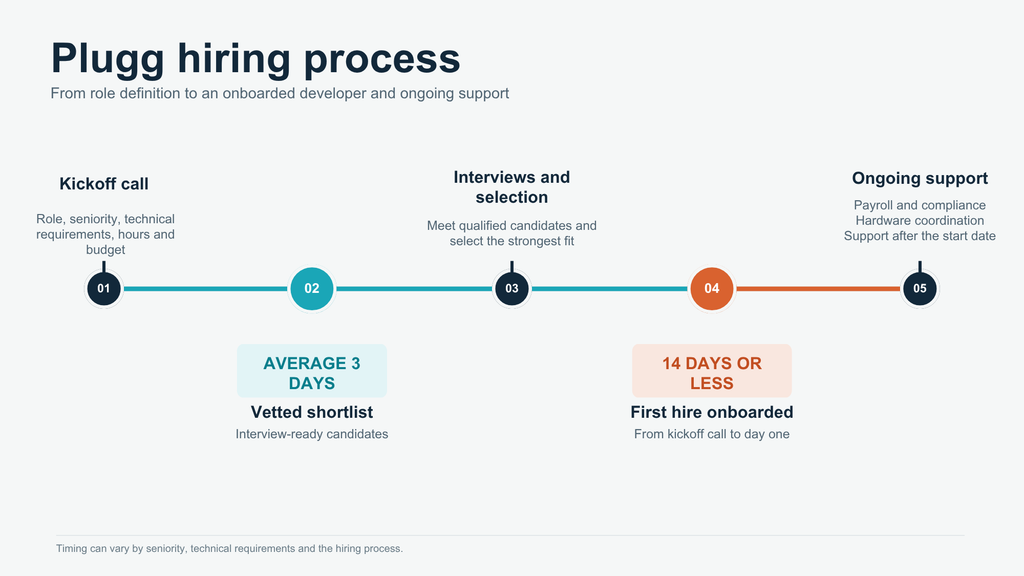
According to Plugg’s published hiring benchmarks, Plugg has made 500+ successful placements across Latin America. On average, we deliver a vetted, interview-ready shortlist within three days, with the first hire onboarded in 14 days or less, from kickoff call to day one.
We also handle sourcing, interview coordination, payroll, compliance and hardware, with ongoing support after your developer joins the team.
If Colombia offers the right engineer at a lower rate, we’ll tell you. If the role calls for a wider search into Brazil or elsewhere in LATAM, we’ll tell you that too. The goal is to find the strongest engineer for the role, not steer you toward a predetermined country.
Frequently asked questions
Is Brazil or Colombia better for hiring software developers?
Neither country is better for every software development hire. Colombia has historically offered lower rates in Plugg’s hiring data and provides excellent U.S. workday overlap. Brazil offers a large, documented systems-development workforce, which can make it an attractive market for specialized or difficult-to-fill roles.
For many searches, we’d recruit in both markets and compare the qualified candidates rather than choose a country first.
Is it cheaper to hire software developers in Brazil or Colombia?
Across Plugg’s 2021–2026 rate history, we’ve seen dozens of contractor starts in Brazil averaging around $45 per hour billed, compared with around $30 per hour across several starts in Colombia.
We wouldn’t assume every Brazilian developer will cost more. The samples are different sizes and include different roles, seniority levels and technical requirements.
Does Brazil or Colombia have better English proficiency?
Nationally, there is almost no difference. Among EF test takers working in IT, Brazil scores higher.
In the 2025 EF English Proficiency Index, Brazil scored 482 compared with Colombia’s 480. Among IT test takers, Brazil scored 551 compared with 512 in Colombia.
We’d still evaluate English and communication during interviews rather than make assumptions based on country-level data.
Which country has more software developer talent, Brazil or Colombia?
Brazil has a large documented systems-development workforce, while Colombia doesn’t publish a directly comparable developer headcount. That makes Brazil easier to evaluate when talent-market depth is a priority, but the available national datasets can’t be used to directly compare the number of developers in the two countries.
For most engineering searches, we’d still consider both markets.
Is Colombia in a good time zone for U.S. software teams?
Yes. Colombia operates on UTC-5 year-round, giving U.S. companies substantial workday overlap.
It’s particularly convenient for Eastern and Central teams and generally provides more late-day overlap for Pacific teams than Brazil’s major technology centers.
Can I recruit developers in both Brazil and Colombia?
Yes, and that’s often the better approach when geography isn’t a business requirement. Define the role, technical bar, communication expectations and budget first, then compare qualified candidates from both markets.
For specialized roles, we’d expand the search across LATAM rather than lower your standards to stay within Brazil or Colombia.
How quickly can Plugg find developers in Brazil or Colombia?
Plugg delivers a vetted, interview-ready shortlist in an average of three days. The first hire can be onboarded in 14 days or less, from kickoff call to day one.
Timing for an individual search can vary based on seniority, technical requirements and the hiring process.
Brazil vs. Colombia: Where should you hire software developers?
Colombia has the edge when cost and U.S. workday overlap are the priorities. Brazil has the edge when talent depth and specialization matter more.
Colombia has been substantially less expensive in Plugg’s hiring history and offers straightforward U.S. time-zone alignment. Brazil gives employers a large, documented systems-development workforce to search and has the stronger English-proficiency signal among IT test takers.
Prioritize Colombia when cost and workday overlap matter most. Prioritize Brazil when you need greater talent depth or specialization. If geography isn’t a constraint, search both and let the candidate pool determine the answer.
Tell us what you’re hiring for, and Plugg can show you qualified candidates and real rates from Brazil, Colombia and the broader LATAM market.