
Short answer: Toptal and Plugg solve the hiring problem differently. Toptal matches companies with professionals from an existing, highly selective global talent network. Plugg starts with the role, then searches Latin America for candidates who match the company’s specific technical requirements, hiring bar, and team needs.
The difference matters when you’re deciding what you want from the search.
Toptal prioritizes rapid access to pre-vetted global talent, advertising hiring in under 48 hours. Plugg prioritizes role fit, delivering a vetted shortlist in an average of three days from a search built around the position you’re actually trying to fill.
This guide compares cost, speed, vetting, flexibility, engagement models, and post-hire support to help you determine which approach makes more sense for the way you’re building your team.
Plugg vs. Toptal: side-by-side comparison
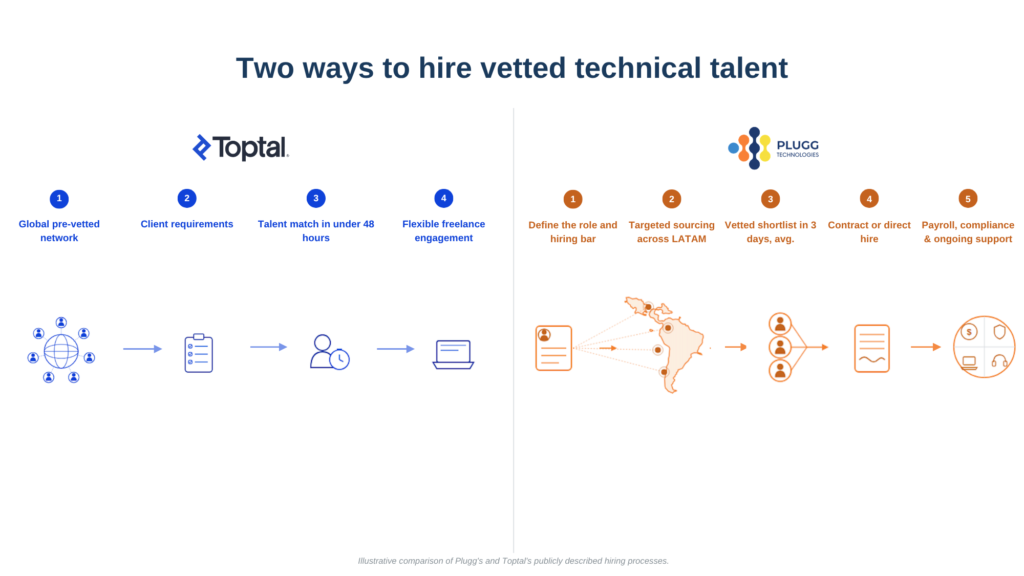
Plugg and Toptal both provide access to vetted remote talent, but they differ in how talent is sourced, how engagements are structured, and what happens after the match.
| Category | Plugg | Toptal |
| Talent model | LATAM-focused recruiting and staffing | Global network of pre-vetted freelance talent |
| Recruiting approach | Candidates sourced and screened against the client’s specific role and hiring requirements | Clients matched with professionals from an established, pre-vetted network |
| Candidate vetting | Technical fit, communication, English proficiency, and role alignment | Rigorous pre-vetting before talent enters the network; fewer than 3% of applicants are accepted |
| Hiring timeline | Average shortlist in 3 days; first hire onboarded within 14 days or less | Hire in under 48 hours |
| Talent availability | Candidates sourced after role requirements are defined | Talent drawn from an existing pre-vetted global network |
| Engagement model | Contract, contract-to-hire, and direct-hire options | Hourly, part-time, and full-time freelance engagements |
| Geographic focus | Latin America | Global |
| Payroll and compliance | Included as part of Plugg’s staffing support | Standard talent engagements are freelance; additional contractor, payroll, and EOR services available through HireGlobal |
| Equipment support | Included | Not highlighted as part of the standard talent engagement |
| Post-hire support | Ongoing employee and client support | Ongoing matching support; global workforce services available separately through HireGlobal |
| Best suited to | Companies that want LATAM-specific sourcing and operational support around the hire | Companies that want rapid access to highly screened global freelance talent |
Pros and cons of Plugg vs. Toptal
Toptal’s biggest advantages are speed, selectivity, and global reach. Plugg is more specialized: it focuses on Latin America and builds the search around the company’s specific role, with more of the operational infrastructure around the hire included.
Plugg
Pros
- Role-specific recruiting. Plugg starts with the role, then sources and vets candidates against the company’s technical requirements, communication needs, and hiring standards.
- LATAM specialization. Plugg focuses specifically on Latin America, with recruiting and operational support built around hiring in the region.
- Hiring infrastructure included. Plugg handles payroll, compliance, equipment, onboarding, and ongoing support around the engagement.
- Multiple hiring models. Companies can use contract, contract-to-hire, and direct-hire structures.
Cons
- Limited to LATAM. Companies that want to search globally have access to a much broader geographic pool through Toptal.
- Not as fast for the initial match. Plugg delivers a vetted shortlist in an average of three days. Toptal says companies can hire from its existing talent network in under 48 hours.
Toptal
Pros
- Fast access to talent. Toptal says companies can hire in under 48 hours, making it particularly useful when a team needs specialized expertise quickly.
- Highly selective network. Toptal uses a multi-stage screening process covering communication, technical expertise, problem-solving, and performance. It says fewer than 3% of applicants are accepted into its network.
- Global talent pool. Toptal isn’t limited to Latin America, giving companies access to professionals across a much broader geographic market.
- Flexible engagements. Talent is available for hourly, part-time, and full-time freelance work, giving companies flexibility to match the engagement to the project or workload.
- Up-to-two-week trial. Toptal engagements begin with a trial period of up to two weeks. If the client isn’t satisfied, Toptal says it won’t bill for the trial.
Cons
- Not LATAM-specific. Companies deliberately building a nearshore team in Latin America may prefer a provider whose recruiting and support model is centered on that market.
- Core talent engagements are freelance. Companies that need employment, payroll, or broader workforce infrastructure can access those services separately through Toptal’s HireGlobal offering.
Plugg vs. Toptal pricing
Plugg and Toptal price engagements differently, and neither publishes a single rate that applies to every hire.
Toptal’s talent rates vary by professional and engagement. Clients who proceed with talent matching also pay a $79 monthly platform subscription, which can be canceled at any time. Toptal engagements begin with a trial period of up to two weeks; if the client isn’t satisfied, Toptal says they won’t be billed for that trial.
Plugg’s costs vary by role, seniority, country, specialization, and engagement size. In a recent Nearshore Cafe podcast discussion on LATAM tech talent costs, Brian Samson, Plugg’s founder and an 11+ year veteran of building teams in Latin America, puts mid-level Java talent at roughly $2,000 to $4,000 per month and senior Java talent at $4,000 to $6,000, based on current LATAM hiring conditions.
Plugg also offers volume discounts of 8% to 10% for a four-person POD and 15% to 18% for multiple teams.
More specialized roles can cost considerably more. Samson puts AI engineers, data engineers, and data scientists at roughly $7,000 to $9,000 per month.
For companies that need employment or workforce infrastructure beyond a standard Toptal talent engagement, Toptal’s HireGlobal offers separate contractor management, payroll, AOR, and EOR services. Contractor management currently starts at $19 per worker per month, with other services priced separately.
Risks to consider when choosing Plugg vs. Toptal
A strong candidate can come through either model. The bigger risk is choosing a hiring model that doesn’t match how you want to build and support the team.
An existing network vs. a new search
Toptal’s speed comes from having a global network of professionals who have already passed its screening process. Toptal says companies can hire in under 48 hours, which can be a significant advantage when a team needs specialized expertise quickly.
Plugg takes a different approach. The role and hiring requirements come first, and candidates are then sourced and screened against them. That means waiting longer for the initial shortlist, which Plugg delivers in an average of three days, but the search starts with the company’s specific requirements rather than an existing talent pool.
Neither approach is inherently better. The tradeoff is between faster access to an established network and a search built specifically around the role.
Pre-vetted doesn’t mean pre-fitted
Toptal’s screening process is deliberately selective. It evaluates applicants across communication, technical expertise, problem-solving, and performance, and Toptal says fewer than 3% of applicants are accepted into its network.
That establishes a high bar for entering the network, but companies still need to determine whether an individual is right for their particular role. Toptal addresses this through its matching process, which considers the client’s technical needs and team dynamics when identifying candidates.
Plugg approaches fit from the other direction: candidates are sourced after the company’s technical requirements, communication needs, and hiring standards have been defined.
The distinction is important. Pre-vetting tells you about the quality threshold for the talent pool. Role-specific vetting tells you how closely the search is being built around your particular hire.
Freelance flexibility vs. employment infrastructure
Toptal’s core talent network is built around freelance engagements, with professionals available on an hourly, part-time, or full-time basis. That flexibility can work well for projects, specialized skill gaps, or companies that don’t need a traditional employment structure.
Companies that need more workforce infrastructure can also use Toptal HireGlobal, which offers separate contractor management, Agent of Record, EOR, payroll, and other global employment services.
Plugg builds more of that operational support into its LATAM staffing model, including payroll, compliance, equipment, onboarding, and ongoing support.
Before choosing between them, determine how much you want the provider to handle after the candidate is selected. The recruiting model may get the most attention, but the engagement structure determines how much ongoing work remains with your team.
Alternatives to Plugg and Toptal
Plugg and Toptal aren’t the only options for hiring remote technical talent. Other providers may fit better depending on whether you need a LATAM talent network, flexible hiring structures, or outsourced software delivery.
| Alternative | Worth considering when you need |
| Revelo | A large pre-vetted LATAM engineering network with payroll, benefits, taxes, and compliance built into the platform |
| TECLA | Software, data, and AI talent across Latin America and the U.S., with staffing, recruiting, and fractional leadership options |
| Terminal | Direct-hire, contract, and contract-to-hire options, with optional EOR support for international teams |
| BairesDev | Staff augmentation or outsourced software development when you want the provider to take on more delivery responsibility |
| Traditional recruiting firms | Permanent hires without the ongoing talent platform or workforce-management services offered by these providers |
What Plugg’s LATAM model looks like in practice
Plugg’s model is built around the requirements of the role rather than an existing talent network. Its current hiring results include a three-day average shortlist, 14 days or less to onboard a first hire, 91% retention, 93% offer acceptance, and more than 500 placements.
Those numbers show how the model performs at the individual-hire level. The difference becomes more visible when companies need to build a larger team.
Building an engineering team in Mexico. One Plugg client initially worked with another nearshore provider to build a 20-person engineering team. After shifting the search to Plugg, the company made 20 hires in Mexico within three months and more than 40 senior engineering hires within six months. Read the engineering case study
That example is particularly relevant for companies comparing Plugg with a global talent network such as Toptal. The goal wasn’t simply to access one pre-vetted specialist quickly. It was to assemble a larger engineering team in a specific LATAM market around the company’s hiring requirements.
Finding specialized senior talent. A Series B software company needed a senior DevOps engineer after an acquisition. Plugg sourced a candidate in Mexico with more than 20 years of experience and reported annual savings of more than $120,000 compared with a similar U.S. hire. Read the Series B case study
These examples illustrate where Plugg’s model is most relevant: companies that want to recruit deliberately in Latin America, whether they’re filling a specialized senior role or building a larger team over time.
Frequently asked questions
Is Plugg or Toptal better for hiring developers?
It depends on the type of search. Toptal is a strong fit for companies that want fast access to a global network of highly screened freelance talent. Plugg focuses on LATAM and sources candidates against the company’s specific role requirements, with payroll, compliance, equipment, onboarding, and ongoing support included in its staffing model.
Which is faster, Plugg or Toptal?
Toptal has the advantage in initial matching speed, reporting an average match time of under 48 hours. Plugg delivers a vetted shortlist in an average of three days and reports 14 days or less from kickoff to onboarding a first hire.
How much do Plugg and Toptal cost?
Toptal’s talent rates vary by professional and engagement, and clients who proceed with matching pay a $79 monthly platform subscription. Plugg’s costs vary by role, seniority, country, specialization, and engagement size. Plugg also offers volume discounts for larger teams.
How does vetting differ between Plugg and Toptal?
Toptal screens professionals before admitting them to its network, with fewer than 3% of applicants accepted. Plugg starts with the client’s requirements, then sources and vets candidates against that specific role, including technical skills, English fluency, communication, and cultural fit.
Can I hire someone full-time through Plugg or Toptal?
Yes, but the models differ. Toptal’s network consists of freelance talent, with engagements that can extend to full-time availability. Plugg supports contract, contract-to-hire, and direct-hire structures.
Does Toptal hire employees or freelancers?
Toptal’s core talent network consists of freelance professionals available for hourly, part-time, and full-time engagements. Through HireGlobal, Toptal also offers separate EOR, contractor-management, AOR, payroll, and other global workforce services.
Plugg vs. Toptal: Which is right for your team?
Choose Toptal when speed and global reach are the priority. Its highly selective, pre-vetted network can be particularly useful when you need specialized expertise quickly, want access beyond Latin America, or prefer the flexibility of hourly through full-time freelance engagements.
Consider Plugg when you’re deliberately building in Latin America and want the search built around your role. Plugg sources against the company’s technical and communication requirements, then handles the operational infrastructure around the engagement, including hardware, payroll, compliance, onboarding, and ongoing support.
Ready to build your LATAM team? Schedule a consultation to discuss the roles, skills, seniority, and team structure you need.