
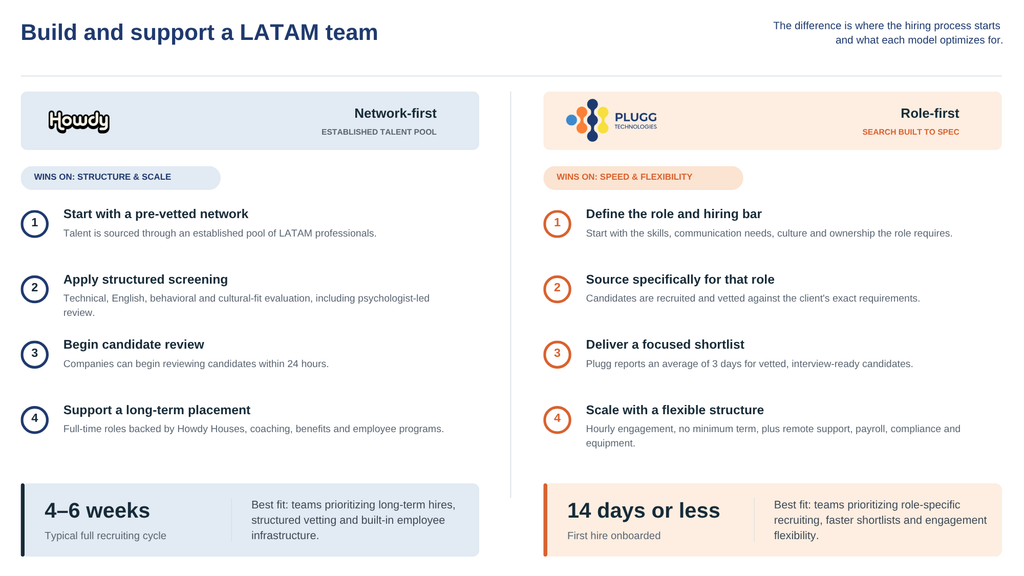
Short answer: Plugg and Howdy solve the same hiring problem in very different ways. Howdy has built a large, pre-vetted LATAM talent network supported by physical offices and employee programs. Plugg starts with the role itself, then sources and vets candidates against the skills, communication requirements, culture, and hiring bar of the company.
That difference shows up in speed, flexibility, and the hiring experience. Plugg delivers a vetted shortlist in an average of three days, while Howdy’s full recruiting cycle typically takes four to six weeks.
This guide compares cost, speed, vetting, flexibility, retention, and post-hire support to help you decide which model fits your team.
Plugg vs. Howdy: side-by-side comparison
Plugg and Howdy both support recruiting, onboarding, and ongoing workforce management. Here’s how their models compare.
| Category | Plugg | Howdy |
| Recruiting approach | Candidates sourced and screened against the client’s role and hiring requirements | Candidates sourced through an established, pre-vetted talent network |
| Candidate vetting | Technical fit, communication, English proficiency, and role alignment | Technical, English, behavioral, and cultural-fit screening, including psychologist-led evaluation |
| Hiring timeline | Average shortlist in 3 days; first hire onboarded within 14 days or less | Candidate review can begin within 24 hours; full recruiting cycle typically takes 4–6 weeks |
| Engagement model | Flexible hourly structure; no minimum contract term; two weeks’ notice | Full-time, long-term placements rather than short-term project work |
| Physical LATAM offices | No; remote model | Yes; Howdy Houses across LATAM |
| Payroll and compliance | Included | Included |
| Equipment support | Included | Included |
| Post-hire support | Ongoing employee and client support | Benefits, performance coaching, English programs, AI training, and community programming |
| Reported retention | 91% in 2026 | 98% across 12,500+ placements |
| Best suited to | Teams prioritizing role-specific recruiting, faster shortlists, and engagement flexibility | Teams prioritizing long-term hires, structured vetting, and built-in employee infrastructure |
Pros and cons of Plugg vs. Howdy
Plugg stands out for speed, role-specific recruiting, and flexibility. Howdy brings a larger pre-vetted network and more extensive employee infrastructure.
Plugg
Pros
- Role-specific recruiting. Candidates are sourced and vetted against your technical requirements, communication needs, and hiring standards.
- Fast shortlists. Plugg delivers vetted candidates in an average of three days.
- Flexible engagements. Hire one person, build a POD, or scale multiple teams without a minimum contract term.
Cons
- No physical LATAM offices. Plugg operates remotely, without the workspace and in-person community Howdy provides through its Howdy Houses.
- Smaller placement history. Plugg reports 500+ placements, compared with Howdy’s 12,500+.
Howdy
Pros
- Large pre-vetted network. Howdy reports 12,500+ placements and maintains a large network of vetted LATAM professionals.
- Structured vetting. Screening covers technical skills, English, behavior, and cultural fit, with psychologist-trained recruiters involved in the process.
- Extensive employee infrastructure. Howdy Houses, performance coaching, benefits, and community programs support employees after placement.
Cons
- Longer hiring cycle. Howdy’s full recruiting cycle typically takes four to six weeks.
- Focused on long-term placements. Howdy places full-time hires with no predetermined end date rather than staffing short-term projects.
Plugg vs. Howdy pricing
Plugg and Howdy structure pricing differently. Plugg’s costs vary by role, seniority, country, and engagement size, while Howdy publishes all-in benchmarks by country and seniority.
| Pricing factor | Plugg | Howdy |
| Pricing approach | Costs vary by role, country, seniority, and specialization | All-in benchmarks by country and seniority |
| Volume pricing | 8–10% off for a four-person POD; 15–18% for multiple teams | Volume discounts may apply to larger engagements |
| Final cost depends on | Role, country, seniority, specialization, and team size | Role, country, seniority, and engagement |
In a recent Nearshore Cafe podcast discussion on LATAM tech talent costs, Brian Samson, Plugg’s founder and an 11+ year veteran of building teams in Latin America, puts mid-level Java developers at roughly $2,000 to $4,000 per month and senior Java developers at $4,000 to $6,000 per month based on current LATAM hiring conditions. More specialized AI, data engineering, and data science talent can reach roughly $7,000 to $9,000 per month.
Samson describes Mexico as roughly the midpoint of the LATAM market, with Colombia generally below it and Argentina, Brazil, and Costa Rica generally higher.
Plugg also offers volume pricing for larger engagements, with current discounts of 8% to 10% for a four-person POD and 15% to 18% for multiple teams.
Howdy uses a 15% management fee and publishes all-in cost benchmarks that account for compensation, local employment costs, and provider fees. See Howdy’s LATAM cost benchmarks
Risks to consider when choosing Plugg vs. Howdy
A strong provider can still be a poor fit if its recruiting model, timeline, or support structure doesn’t match your needs.
Prioritizing network size over candidate fit
Howdy’s large pre-vetted network can be an advantage, but size alone doesn’t guarantee a match for a specialized role. Plugg’s role-specific recruiting also works best when the requirements are clearly defined. Before comparing providers, define the skills, seniority, communication requirements, and level of ownership the role requires.
Comparing retention rates at face value
Plugg reports 91% retention in 2026, while Howdy reports 98% across more than 12,500 placements. The companies may use different time periods, populations, and definitions of retention, so the figures aren’t necessarily directly comparable.
If retention is a deciding factor, ask each provider how it is calculated and over what period.
Choosing a model that doesn’t fit your hiring plans
Plugg averages three days to deliver a shortlist and offers flexible engagements. Howdy’s full recruiting cycle typically takes four to six weeks and focuses on long-term, full-time placements.
Consider both how quickly you need to hire and the type of engagement you need when comparing the two.
Alternatives to Plugg and Howdy
Plugg and Howdy aren’t the only options for building a LATAM team. Other providers may fit better depending on the roles, engagement model, and level of support you need.
| Alternative | Worth considering when you need |
| Revelo | A large pre-vetted LATAM engineering network, published pricing, and built-in payroll and compliance support |
| TECLA | A strong focus on software and AI talent, with vetted professionals across the U.S. and Latin America |
| Terminal | Flexible direct-hire, contract, and contract-to-hire options for technical talent |
| BairesDev | Staff augmentation or outsourced delivery teams, including project-based software development |
| Traditional recruiting firms | Permanent hires without ongoing payroll, compliance, or workforce-management support |
Plugg emphasizes role-specific recruiting, speed, and engagement flexibility. Howdy brings a large pre-vetted network and more built-in employee infrastructure. The alternatives above expand the options for companies that need a different employment or delivery model.
What Plugg’s model looks like in practice
Plugg combines role-specific recruiting with the operational support needed to hire and manage LATAM talent, including onboarding, payroll and compliance support, equipment, and ongoing employee support.
Current Plugg results include:
- 3 days average time to shortlist
- 14 days or less to onboard a first hire
- 91% retention rate in 2026
- 93% offer acceptance rate
- 500+ successful placements
Scaling from 20 to 40+ engineers. When one client shifted engineering operations from Eastern Europe to Mexico, Plugg placed 20 engineers within three months and grew the team to more than 40 senior engineers within six months. Read the engineering case study
Saving $120,000+ on a senior hire. A Series B San Francisco startup was paying more than $200,000 annually for a U.S.-based engineering role. Plugg placed a senior LATAM engineer at roughly 40% of the U.S. cost, saving the company more than $120,000 annually. Read the Series B case study
Frequently asked questions
Is Plugg or Howdy better for hiring LATAM developers?
It depends on your priorities. Plugg is geared toward role-specific recruiting, faster shortlists, and flexible engagements. Howdy offers a large pre-vetted network, structured screening, and more built-in employee infrastructure.
Which is faster, Plugg or Howdy?
Plugg reports an average shortlist time of three days and onboards a first hire within 14 days or less. Howdy says companies can begin reviewing candidates within 24 hours, with a full recruiting cycle of four to six weeks. Plugg Tech Talent Howdy FAQ
How much do Plugg and Howdy cost?
Plugg’s costs vary by role, country, seniority, specialization, and engagement size. In a recent Nearshore Cafe podcast discussion, Plugg founder Brian Samson estimated $2,000 to $4,000 per month for mid-level Java developers and $4,000 to $6,000 for senior Java developers across LATAM, before Plugg’s service fees. Howdy publishes all-in cost benchmarks and charges a 15% management fee. Exact costs with either provider depend on the role and hiring structure.
Does Plugg or Howdy have better retention?
Howdy reports 98% retention across more than 12,500 placements, while Plugg reports 91% retention in 2026. Because the companies may use different time periods, populations, and methodologies, the figures aren’t necessarily directly comparable.
Can I hire just one developer through Plugg or Howdy?
Yes. Plugg supports individual hires, PODs, and larger teams with a flexible engagement structure. Howdy focuses on long-term, full-time placements rather than short-term project work. Howdy FAQ
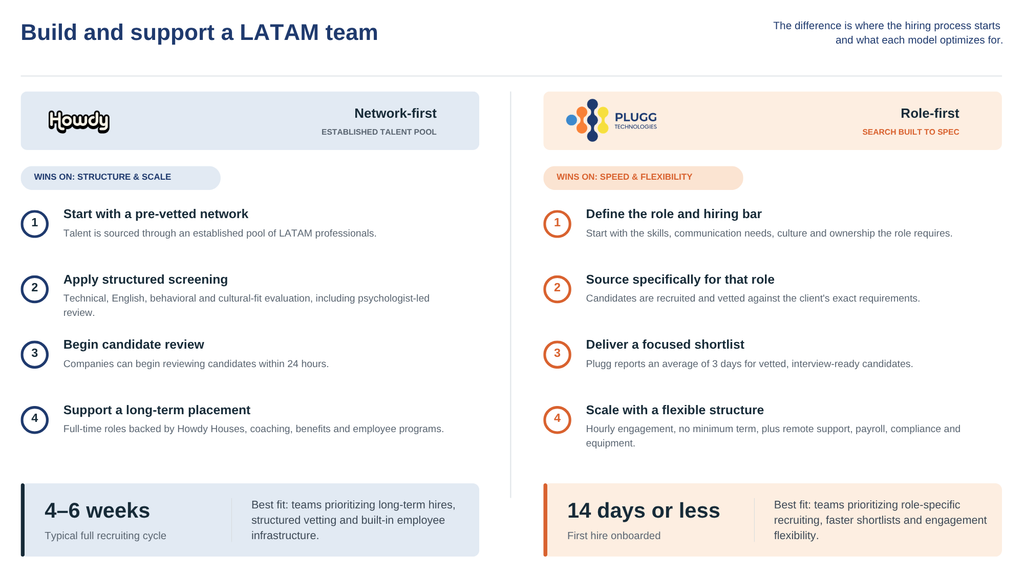
Plugg vs. Howdy: Which is right for your team?
Choose Howdy if your priority is a large pre-vetted network paired with physical LATAM offices, structured employee programs, and long-term full-time placements.
Consider Plugg if you want recruiting built around your specific role, faster shortlists, or more flexibility in how you structure and scale the engagement.
Ready to build your LATAM team? Schedule a consultation to discuss the roles, skills, seniority, and team structure you need.