
Your data stack may tell you more about where to hire than a country ranking ever could.
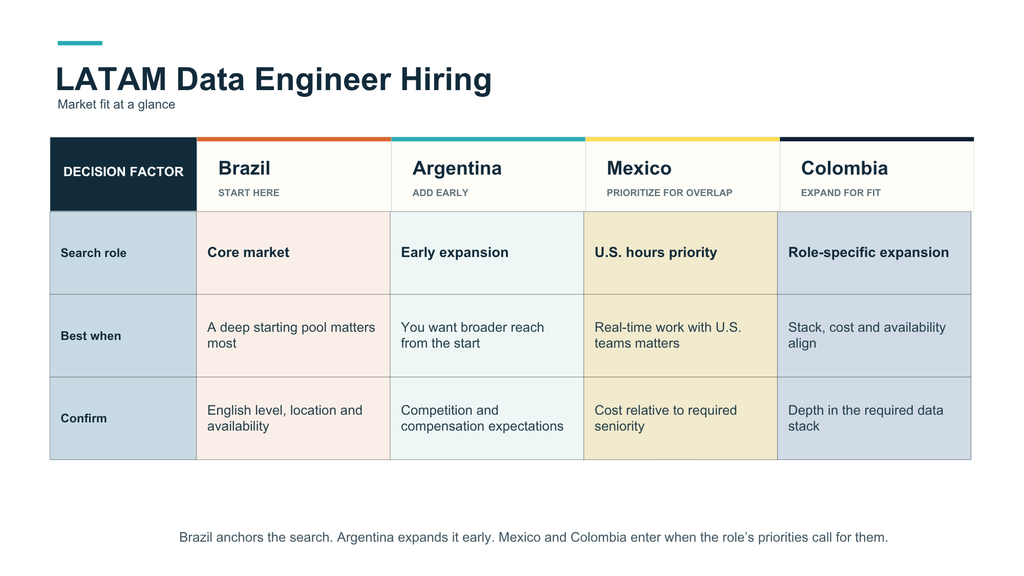
Short answer: For data engineers in Latin America, we’d start in Brazil, with Argentina as our second choice. Based on Plugg’s recruiting experience, those are the two markets we’d prioritize for these roles.
Mexico and Colombia can still make sense for particular searches. Mexico offers strong U.S. workday overlap and is Plugg’s deepest overall recruiting market, while Colombia is particularly interesting when cost and collaboration matter.
But if a U.S. CTO asked us where to begin a data-engineering search today, Brazil would be our first recommendation.
Our recommendation: start in Brazil, add Argentina early, then widen the search to Mexico, Colombia or elsewhere in LATAM based on the stack, budget and candidate pool.
This guide compares the markets we’d consider based on cost, technical requirements, talent depth and collaboration.
Who is this for?
This guide is for U.S. CTOs, founders and engineering leaders deciding where to hire data engineers in Latin America.
It’s particularly useful if you need someone to build or maintain data pipelines, warehouses, lakes or cloud data infrastructure using technologies such as SQL, Python, Snowflake, Databricks, AWS, Azure or Google Cloud.
It’s less useful if the person you actually need will primarily analyze data, build dashboards or develop predictive models. Those may be data analyst, analytics engineer or data scientist searches instead.
What does it cost to hire a data engineer in LATAM?
Based on Plugg’s internal data and recruiting experience, data engineers in Latin America typically fall around $45–$60 per hour.
Where a hire lands within that range depends on seniority, technical stack and the complexity of the data environment.
An engineer maintaining established SQL pipelines has a different hiring profile from someone architecting a cloud data platform, processing large datasets or owning Snowflake, Databricks, Kafka or Spark infrastructure.
Plugg’s historical data doesn’t always label Data Engineer placements cleanly as a standalone category, so we wouldn’t treat $45–$60 as a fixed rate card. It’s a planning range based on Plugg’s internal data and recruiting experience with these roles.
For planning purposes, we’d use $45–$60 per hour as the starting range, then adjust for the architecture, scale and ownership the role requires.
What are the advantages of hiring data engineers in LATAM?
Brazil is Plugg’s top recommendation for data engineers
Based on Plugg’s recruiting experience, Brazil is the first market we’d recommend for a data-engineering search in Latin America.
Brazil also gives recruiters a large broader technical market to search. In 2025, the country recorded approximately 494,000 formal IT employment relationships, including about 291,000 in systems development, according to Brasscom.
Those aren’t data-engineer counts, and we shouldn’t present them that way. But they demonstrate the scale of the broader technology workforce available when a role requires a specific combination of cloud, infrastructure and data-platform experience.
See the Brasscom 2025 sector report
For both general and specialized data-engineering searches, Brazil would be our first market.
Argentina is Plugg’s second choice
After Brazil, Argentina would be the next market we’d add to a data-engineering search.
Based on Plugg’s recruiting experience, Argentina has the technical talent to make it one of our strongest markets for these roles.
The country also gives us access to an established broader software-engineering market, which can be useful for data-engineering searches that cross into cloud architecture, backend systems and infrastructure.
We wouldn’t wait for a Brazil search to fail before looking in Argentina. For most data-engineering searches, we’d include both markets early.
Mexico is a strong alternative when U.S. collaboration matters
Mexico remains worth considering when extensive real-time collaboration with a U.S. team is particularly important.
Mexico represents the largest share of Plugg’s overall 2021–2026 contractor history, giving us substantially more firsthand recruiting experience there than in any other LATAM country in the dataset. That isn’t a measure of Mexico’s data-engineering talent pool, but it does give Plugg deep experience hiring technical talent in the market.
There are also signs that Mexico’s data and cloud talent pipeline is expanding. The government-backed MEXIA program is targeting 30,000 trainees in 2026 and includes dedicated certifications in data analysis and cloud technologies, alongside AI, cybersecurity and infrastructure.
Mexico’s geography adds another advantage. For a data engineer working with U.S.-based software, analytics, product and infrastructure teams, substantial workday overlap makes architecture discussions and troubleshooting easier to handle in real time.
Mexico wouldn’t replace Brazil or Argentina as our first recommendation for data engineers, but we’d include it when U.S. collaboration and workday overlap carry particular weight.
Colombia is worth considering when cost and overlap matter
We’d consider Colombia when U.S. workday overlap and cost carry significant weight.
The country’s 2025–2030 national digital-talent study analyzed 16 datasets and more than 3.5 million data points. It found that employer demand is increasingly moving toward specialized profiles in Big Data and analytics, artificial intelligence, cloud computing, cybersecurity and DevOps.
Colombia’s 2025–2030 Digital Talent Study
Colombia has also invested directly in digital-skills training that includes data science, machine learning, cloud computing, Big Data and data analytics.
Colombia MinTIC: Talento Digital
Colombia operates on UTC-5 year-round, giving U.S. companies substantial workday overlap. In Plugg’s broader hiring history, Colombia has also been a lower-cost market than Brazil, although the samples differ significantly in size and include different technical roles.
We’d include Colombia when economics and collaboration matter, particularly when widening the search beyond Brazil and Argentina.
What are the disadvantages?
Data-engineering talent can be difficult to compare across markets because the title covers a wide range of technical depth.
Someone building basic ETL pipelines isn’t interchangeable with an engineer designing distributed data systems or architecting a modern cloud data platform.
That can also make salary benchmarks misleading. A national “data engineer salary” doesn’t tell you whether the people represented have experience with your cloud provider, data volume, architecture or production requirements.
Highly specialized requirements can narrow the candidate pool quickly. One company may need AWS, Redshift and Airflow. Another may need Azure Data Factory and Databricks. Requiring deep experience with several specific platforms may mean searching beyond your preferred country.
What are the risks?
One of the biggest risks is hiring someone who can work with data but hasn’t actually owned production data infrastructure.
A résumé may include SQL, Python, dashboards and cloud platforms without demonstrating experience designing reliable pipelines, managing data quality or handling failures at scale.
Data engineers can also have significant access to company information. Permissions, credentials, personally identifiable information and production datasets require appropriate security and access controls.
There’s also a key-person risk. If one engineer becomes the only person who understands your pipelines, schemas or warehouse architecture, routine turnover can become an operational problem.
Finally, poorly designed data infrastructure compounds. A quick pipeline that works with today’s data volume may become expensive and unreliable as the business grows.
Screen for what candidates have actually built and operated, not simply the technologies listed on their résumé.
What are the alternatives?
Make sure a data engineer is actually the role you need.
If your infrastructure already exists and the primary job is transforming data for business users, an analytics engineer may be the better hire.
If you need reporting, dashboards and business insights, you may need a data analyst or BI analyst.
If the work involves experimentation, predictive modelling or statistical analysis, consider a data scientist.
And if your primary problem is cloud infrastructure, deployments or reliability rather than data pipelines, Cloud/DevOps talent may be a better fit.
What common mistakes should you avoid?
Don’t write a generic data-engineer job description. Specify the data environment, cloud provider, major platforms, expected scale and what the engineer will own.
Don’t confuse data engineering with data analysis. Someone who can write SQL and build dashboards isn’t necessarily prepared to architect and operate production pipelines.
Don’t require every tool your organization has ever touched. Separate the technologies someone genuinely needs on day one from those a strong engineer can learn.
And don’t choose a country simply because you’ve heard it has inexpensive developers. For data engineering, experience with the systems you’re actually running can matter more than a small difference in hourly rate.
FAQ
Which LATAM country is best for hiring data engineers?
Brazil is our first recommendation, with Argentina second. That’s based on Plugg’s recruiting experience with these roles.
Mexico and Colombia can still be useful markets when collaboration, cost or a particular technical stack changes the requirements.
What does a data engineer cost in LATAM?
Based on Plugg’s internal data and recruiting experience, we’d use approximately $45–$60 per hour as a planning range for data engineers in Latin America.
Actual rates will depend on seniority, technical stack, architecture, scale and the amount of ownership the engineer takes on.
Is Brazil or Argentina better for hiring data engineers?
We’d give Brazil the edge, with Argentina second.
For most searches, however, we’d rather include both markets early than unnecessarily restrict the candidate pool.
What’s the difference between a data engineer and a data scientist?
A data engineer generally builds and maintains the infrastructure that collects, moves, transforms and stores data.
A data scientist typically uses data to analyze problems, run experiments and build predictive or statistical models.
What skills should I look for in a LATAM data engineer?
That depends on your environment, but common requirements include SQL, Python, data modelling, ETL/ELT, cloud platforms and data warehouses.
More specialized roles may require technologies such as Spark, Kafka, Airflow, Snowflake or Databricks.
The important question isn’t how many technologies appear on the résumé. It’s whether the candidate has built and operated systems comparable to yours.
Should I search one country or all of LATAM?
Start with Brazil and Argentina, then expand if the candidate pool is too narrow.
Mexico and Colombia are useful additional markets when workday overlap, cost or specific technical requirements warrant a broader search.
Why hire data engineers through Plugg?
Plugg recruits specifically across Data & Analytics roles, including data engineers, data scientists, data analysts, BI analysts and data visualization specialists.
Plugg’s internal data and recruiting experience give buyers a more specific planning benchmark for data engineering: approximately $45–$60 per hour.
Our recruiting team’s market view is also clear. We’d start in Brazil for data-engineering talent, with Argentina second, then expand the search based on the stack, seniority, budget and collaboration requirements.
The goal isn’t to pick the country with the lowest average rate. It’s to search the markets most likely to produce someone who has actually built and operated systems like yours.