
Short answer: Mexico and Brazil can both give U.S. companies access to deep technical talent, but choosing between them isn’t simply a question of which country has more developers or lower salaries.
The answer can change with the role you’re hiring.
Mexico’s major tech hubs offer especially close working-hour alignment with U.S. teams and a broad engineering market. Brazil operates at a larger scale and offers deep talent across software, AI, data, and other specialized fields.
This guide compares talent depth, technical specialization, hiring costs, working-hour alignment, English proficiency, and employment considerations to help you decide where to search first.
Explore Plugg’s LATAM talent model
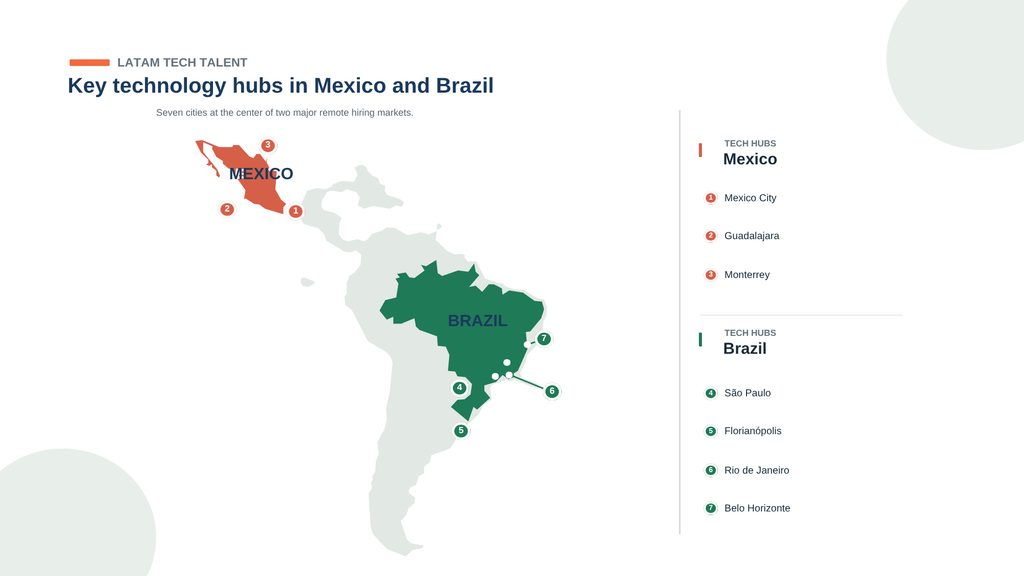
Mexico vs. Brazil: side-by-side comparison
Both countries offer large technology talent markets and substantial overlap with U.S. working hours. The differences become more useful when you look at specific tech hubs, hiring costs, and the roles you’re trying to fill.
| Factor | Mexico | Brazil |
| Major tech hubs | Mexico City, Guadalajara, Monterrey | São Paulo, Florianópolis, Rio de Janeiro, Belo Horizonte |
| Talent market | Large engineering market with strong nearshore ties to U.S. companies | Latin America’s largest overall technology ecosystem |
| Technical strengths | Broad software engineering talent across established stacks | Large, diverse technology market with strong fintech, data, and emerging-tech ecosystems |
| U.S. working-hour alignment | Mexico City and Guadalajara are generally 0–1 hour from U.S. Central Time, depending on season | São Paulo and Florianópolis are generally 1–2 hours ahead of U.S. Eastern Time, depending on season |
| English proficiency | 440 nationally; 559 among IT professionals | 482 nationally; 551 among IT professionals |
| Hiring costs | Vary significantly by role and seniority; current Plugg benchmarks provide role-level comparisons | Vary significantly by role and seniority; specialized talent can command higher rates |
| Employment considerations | Local employment, payroll, benefits, and contractor-classification rules apply | Local employment, payroll, benefits, and contractor-classification rules apply |
| Best suited to | Teams prioritizing close U.S. working-hour alignment and broad engineering hiring | Teams seeking access to a large technology ecosystem, deep specialist talent pools, or hiring at scale |
Talent pool and technical specialization
Mexico and Brazil both have deep technology talent markets, but Brazil operates at a larger scale, while Mexico has developed a strong engineering ecosystem closely tied to U.S. nearshore demand.
Mexico has a large and expanding IT sector, supported by nearshoring, cloud investment, and established technology hubs in Mexico City, Guadalajara, and Monterrey. According to the U.S. International Trade Administration’s Mexico IT market guide, the country’s IT market was estimated at roughly $20.4 billion in 2025, with IT services accounting for the largest share.
The talent market also extends beyond traditional software development. Mexican professionals are rapidly building skills in AI and cybersecurity. Coursera’s 2025 Global Skills Report found that GenAI course enrollment increased 356% year over year, while cybersecurity enrollment rose 94% among learners in Mexico.
Brazil: greater scale and deep specialist ecosystems
Brazil operates at a larger scale. Its IT market leads Latin America in regional investment, while major talent hubs include São Paulo, Florianópolis, Rio de Janeiro, and Belo Horizonte.
A 2026 São Paulo municipal labor-market study found more than 221,000 formal technology-services jobs in São Paulo alone, accounting for about 19% of Brazil’s technology-sector employment. The study also identified cybersecurity, data and AI, and software engineering as areas with particularly strong growth potential.
Brazil’s advanced-skills ecosystem is another differentiator. Coursera’s 2025 Global Skills Report ranked Brazil second in Latin America for AI readiness, citing strength in AI research, patent activity, and its startup ecosystem.
Working-hour alignment with U.S. teams
Both Mexico and Brazil offer substantial overlap with U.S. working hours, but Mexico’s major tech hubs generally provide closer alignment with U.S. Central Time.
Mexico: close alignment with U.S. Central Time
Mexico spans multiple time zones, so the exact overlap depends on where the developer is located. Mexico City and Guadalajara remain on UTC−6 year-round. That puts them on the same clock as Chicago and Dallas during U.S. standard time and one hour behind during U.S. daylight saving time.
For U.S. teams that rely heavily on standups, pair programming, live reviews, or frequent meetings, that creates substantial overlap throughout the workday.
Brazil: strong overlap with U.S. Eastern Time
Brazil spans four time zones, although major tech hubs including São Paulo and Florianópolis use Brasília Time (UTC−3) year-round. These cities are two hours ahead of New York during U.S. standard time and one hour ahead during U.S. daylight saving time.
That still provides significant same-day collaboration with U.S. teams. A developer in São Paulo or Florianópolis can work a conventional local schedule while overlapping with most of the U.S. East Coast business day.
For teams prioritizing maximum synchronous overlap, Mexico’s major tech hubs have an edge. Brazil’s main technology markets remain close enough to U.S. Eastern Time for regular real-time collaboration.
Mexico vs. Brazil hiring costs
Mexico and Brazil sit at different points in the LATAM tech market. Based on Plugg’s current LATAM hiring benchmarks, Mexico generally sits near the middle of the regional pricing range, while Brazil tends to be one of the more expensive markets for technical talent.
Brian Samson, Plugg’s founder and an 11+ year veteran of building teams in Latin America, puts LATAM technical talent at roughly $2,000 per month at the junior end to $8,000–$9,000 per month for senior or lead-level engineers, depending on the role and country. Mid-level Java developers typically fall around $2,000–$4,000 per month, while senior Java developers are closer to $4,000–$6,000 per month. These figures represent direct talent costs before recruiting or Plugg service fees.
The country matters more as roles become specialized. Plugg generally places Mexico around the midpoint of LATAM pricing, while Brazil sits toward the higher end. For difficult-to-fill roles such as senior data engineering, AI engineering, and data science, Samson specifically points to Brazil and recommends budgeting around $7,000–$9,000 per month.
Hear Brian Samson break down LATAM tech talent costs on the Nearshore Cafe Podcast
English proficiency and communication
Brazil scores considerably higher than Mexico on national English proficiency, but the comparison changes when you look specifically at technology professionals.
The 2025 EF English Proficiency Index scores Brazil at 482 and Mexico at 440 nationally. Among people working in IT, however, the countries are much closer: Brazil scores 551 and Mexico 559.
That distinction matters for technical hiring. National rankings provide useful market context, but they don’t predict how well an individual developer will communicate with a U.S. team. English proficiency should still be assessed at the candidate level, including technical vocabulary, written communication, and clarity in meetings.
Explore the 2025 EF English Proficiency Index
Hiring and compliance
Both Mexico and Brazil have local employment requirements covering payroll, statutory benefits, social contributions, working conditions, and termination.
Mexico. Employees are entitled to statutory benefits including aguinaldo, paid vacation, social security, and profit sharing where applicable. Mexico also restricts personnel subcontracting, making the structure of the employment relationship important. Mexico’s Secretariat of Labor explains the subcontracting rules here.
Brazil. Formal employees are generally entitled to paid vacation plus a one-third vacation premium, a 13th-month salary, and employer-funded FGTS contributions, alongside local payroll and employment-reporting requirements.
Plugg handles payroll, compliance, onboarding, and other employment infrastructure for LATAM hires, reducing the local administration clients need to manage directly.
Explore Plugg’s LATAM hiring model
Pros and cons of hiring tech talent in Mexico vs. Brazil
Mexico stands out for close working-hour alignment with U.S. teams and competitive hiring costs. Brazil offers a larger technology ecosystem and particularly strong advanced-tech talent markets, but specialized talent can command higher rates.
Mexico
Pros
- Close U.S. working-hour alignment. Major tech hubs such as Mexico City and Guadalajara are generally within zero to one hour of U.S. Central Time, depending on the season.
- Competitive hiring costs. Plugg’s current benchmarks generally place Mexico around the midpoint of LATAM technical talent pricing.
- Broad engineering market. Mexico has established talent hubs supporting software development alongside growing AI, data, and cybersecurity skills.
- Strong nearshore location. Geographic proximity and substantial working-hour overlap make Mexico practical for teams that collaborate frequently with U.S. colleagues.
Cons
- Lower national English benchmark. Mexico scored 440 in the 2025 EF English Proficiency Index, compared with Brazil’s 482, although candidate-level proficiency varies considerably.
Brazil
Pros
- Large technology ecosystem. Brazil offers substantial talent depth across software engineering and major technology centers such as São Paulo, Florianópolis, Rio de Janeiro, and Belo Horizonte.
- Strong advanced-tech ecosystem. Brazil ranks highly in Latin America for AI readiness and has significant activity across AI, data, fintech, cybersecurity, and software engineering.
- Higher national English benchmark. Brazil scores higher than Mexico nationally, while the two countries post similar English-proficiency scores among IT professionals.
- Strong U.S. working-hour overlap. Major hubs such as São Paulo and Florianópolis are generally only one to two hours ahead of U.S. Eastern Time.
Cons
- Higher costs for some technical roles. Plugg’s current hiring benchmarks place Brazil toward the higher end of LATAM pricing, particularly for specialized AI, data engineering, and data science talent.
- Slightly less U.S. time-zone alignment. Brazil’s major tech hubs sit farther from U.S. working hours than Mexico’s major hubs, although they still provide substantial same-day overlap.
Which market fits your hiring needs?
Mexico is often the stronger starting point for U.S. companies building broad engineering teams that need close day-to-day collaboration. Major hubs such as Mexico City and Guadalajara offer strong working-hour alignment with U.S. Central Time, while Mexico’s expanding IT market supports hiring across software, cloud, cybersecurity, data, and other technical functions.
Brazil becomes particularly compelling when talent depth or specialized expertise matters more than minimizing cost. São Paulo alone has more than 221,000 formal technology-services jobs, and current labor-market research identifies software engineering, data and AI, and cybersecurity as areas with strong growth potential.
For some companies, the strongest strategy may be to hire across both markets rather than choose one exclusively. Opening a search across Mexico and Brazil expands the candidate pool and allows the requirements of each role to determine where the strongest match comes from.
What a multi-market LATAM search looks like
Then the copy becomes much more connected to this comparison:
Choosing a country is only the first step. Plugg builds each search around the role, seniority, technical requirements, budget, English proficiency, and working-hour needs, then advises clients on which LATAM markets to prioritize.
Candidates are sourced and vetted against the client’s requirements rather than a generic regional profile. Plugg also handles background checks, hardware procurement and delivery, payroll, compliance, onboarding, and ongoing bilingual support, allowing companies to hire across Mexico, Brazil, or multiple LATAM markets without coordinating separate providers.
Current Plugg results include:
- 3 days average time to a vetted shortlist
- 14 days or less from kickoff to a first hire
- 91% retention in 2026
- 93% offer acceptance
- 500+ successful placements
That multi-market approach is already in use. One client, for example, describes using nearshore talent in Mexico and Brazil to add Rails engineers and QA professionals who contribute directly to the team’s work and culture.
Frequently asked questions
Is Mexico or Brazil better for hiring remote developers?
It depends on the role and hiring priorities. Mexico offers particularly close working-hour alignment with U.S. Central Time and competitive LATAM hiring costs. Brazil has a larger technology ecosystem and can be especially attractive for searches requiring deep or specialized talent pools. For some teams, hiring across both markets gives access to a broader candidate pool than limiting the search to one country.
Is it cheaper to hire developers in Mexico or Brazil?
Based on Plugg’s current LATAM hiring benchmarks, Mexico generally sits around the middle of the regional pricing range, while Brazil tends to be more expensive, particularly for specialized roles. Plugg recommends budgeting roughly $7,000 to $9,000 per month for difficult-to-fill senior data, AI, and data science roles in Brazil.
Hear Plugg Founder Brian Samson discuss LATAM tech talent costs
Which country has better working-hour overlap with U.S. teams?
Mexico’s major tech hubs generally provide closer alignment. Mexico City and Guadalajara are on UTC−6 year-round, putting them on the same clock as U.S. Central Time during standard time and one hour behind during U.S. daylight saving time. Major Brazilian hubs such as São Paulo and Florianópolis are typically one to two hours ahead of U.S. Eastern Time, depending on the season. Both markets still provide substantial overlap for real-time collaboration.
Do developers in Brazil speak better English than developers in Mexico?
National averages suggest higher English proficiency in Brazil, but they don’t tell the whole story for technical hiring. The 2025 EF English Proficiency Index scores Brazil at 482 and Mexico at 440 nationally. Among people working in IT, however, EF reports 551 for Brazil and 559 for Mexico. English proficiency should therefore be evaluated at the candidate level rather than inferred from the country.
Explore the 2025 EF English Proficiency Index
Can a U.S. company hire developers in both Mexico and Brazil?
Yes. A company doesn’t need to choose a single LATAM market for every role. Plugg can source across Mexico, Brazil, and other LATAM countries based on the technical requirements, seniority, budget, communication needs, and hiring structure of each search. This can be useful when one market works well for the core team but a specialized role benefits from a broader regional search.
Explore Plugg’s LATAM talent model
Mexico vs. Brazil: Where should you hire?
Mexico and Brazil both give U.S. companies access to deep technical talent, but the strongest market can change from one role to the next. Mexico combines competitive hiring costs with a broad engineering market and particularly close U.S. working-hour alignment. Brazil offers greater market scale and deep talent across software, AI, data, cybersecurity, and other technical fields.
For companies hiring across multiple roles, the answer may be a mix of both. Start with what each hire needs, then choose the market, rather than forcing every role into the same country.
Ready to build your LATAM team?
Schedule a consultation to discuss the roles, skills, seniority, and markets that fit your hiring plans.