
Short answer: Mexico is our stronger default for building a software team. But we wouldn’t automatically choose it for your next developer.
Mexico gives us stronger evidence of talent depth, with approximately 390,000 software developers, analysts and multimedia developers in the country’s latest occupational data. Plugg also has substantially more hiring experience there.
Colombia changes the equation when you get down to the individual hire. Across Plugg’s 2021–2026 rate history, both markets have averaged in the $30-per-hour range, with Colombia coming in slightly lower. Both also offer substantial overlap with U.S. working hours.
Our recommendation: Start with Mexico when you’re building a team. For an individual role, search both and let the candidates decide.
Who this is for
This guide is for CTOs, engineering leaders and founders deciding where to focus a nearshore software developer search.
It’s most useful if you’re choosing between Mexico and Colombia for your first hires, planning to scale a LATAM engineering team or deciding whether to recruit in both markets.
Mexico vs. Colombia for software developers at a glance
Mexico and Colombia can both support U.S. companies hiring software developers, but they don’t offer exactly the same hiring market.
| Factor | Mexico | Colombia |
| Talent depth | ~390,000 software developers, analysts and multimedia developers in Q1 2026* | No directly comparable official headcount identified |
| U.S. workday overlap | Strong across multiple U.S.-aligned time zones | UTC-5 year-round |
| Plugg experience | Substantially more hiring experience | Less hiring history, but still a market we’d search |
| Our take | Better starting point for depth and scaling | Worth searching for the right role, candidate and economics |
*Mexico’s figure comes from Data México’s occupational category “software developers, analysts and multimedia developers,” so it should not be interpreted as 390,000 software developers alone.
Which country has the deeper software developer talent pool?
Mexico gives us stronger evidence of talent depth, which is one reason we’d prioritize it when building a larger engineering team.
Mexico’s Data México platform counted approximately 390,000 employed software developers, analysts and multimedia developers in Q1 2026. The largest concentrations were in Mexico City (92,600), the State of Mexico (77,700) and Jalisco (35,700).
We haven’t found directly comparable official occupational data that would let us make a reliable Mexico-versus-Colombia developer headcount comparison. So we wouldn’t claim that Mexico has X times as many developers as Colombia.
Our recommendation: if you’re planning several hires or expect the team to grow, we’d start with Mexico. For one specialized role, we’d still search both countries.
Which country costs less for software developers?
Colombia has had a slightly lower average client bill rate in Plugg’s hiring history, but the difference isn’t large enough to choose the country on price alone.
Across Plugg’s 2021–2026 rate history, contractor starts in both markets have averaged in the $30-per-hour range, with Colombia coming in slightly lower than Mexico.
The samples are different sizes and include different roles, seniority levels and technical requirements. So this reflects what Plugg has actually billed in each market, not proof that Colombian developers are generally cheaper.
Don’t choose Colombia because its historical average is slightly lower. Define the role and seniority first, then compare qualified candidates and actual rates.
Which country offers better U.S. time-zone alignment?
Time zone shouldn’t be the deciding factor between Mexico and Colombia. Both offer substantial overlap with U.S. working hours.
Colombia operates on UTC-5 year-round. Mexico spans multiple time zones, with most of the country remaining on standard time year-round and seasonal clock changes limited to parts of the northern border.
For U.S. engineering teams, developers in either country can generally participate in standups, code reviews, planning and troubleshooting during the same workday.
Which country has better English proficiency for software teams?
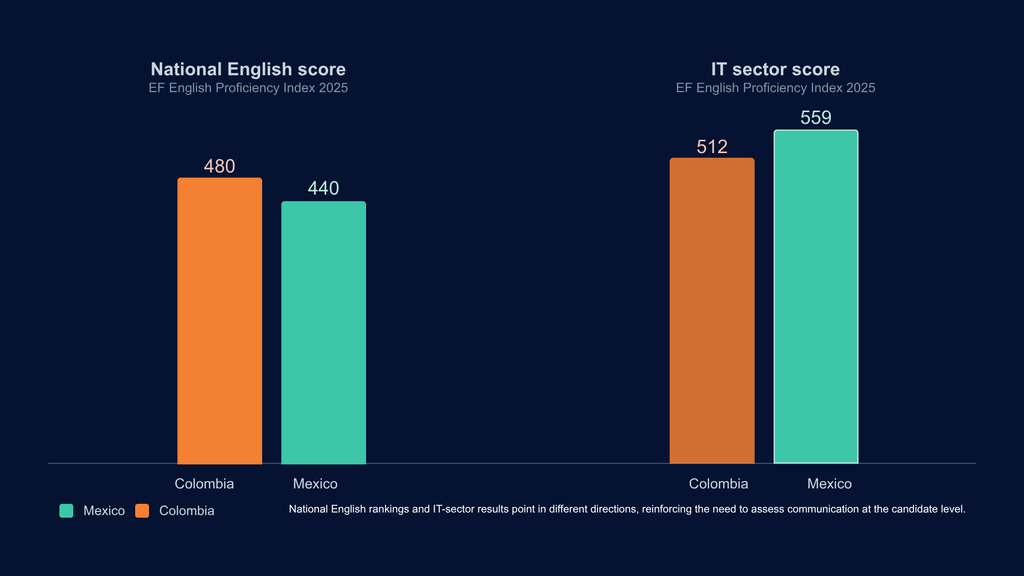
We wouldn’t choose Colombia over Mexico based on national English rankings. The developer-level picture is more complicated.
In the 2025 EF English Proficiency Index, Colombia scored 480 and ranked 76th globally, compared with Mexico at 440 and 103rd. View Colombia’s EF results and Mexico’s EF results.
But among EF test takers working in IT, the results went the other way. Mexican IT test takers scored 559, compared with 512 for Colombian IT test takers.
EF’s data comes from people who took its online English assessment, so these figures shouldn’t be treated as representative of every developer in either country. But they illustrate why national rankings aren’t a good substitute for evaluating the people you’re considering hiring.
For developers who will work directly with U.S. product and engineering teams, we care about whether they can explain a technical decision, ask the right questions and participate comfortably in real-time discussions.
Our recommendation: don’t choose Mexico or Colombia based on a national English score. Assess communication at the candidate level as part of the hiring process.
What are the pros, cons and risks of hiring in Mexico vs. Colombia?
Mexico gives you stronger evidence of talent depth. Colombia can still produce the better hire for a specific role, particularly when the candidate and rate are stronger.
| Mexico | Colombia | |
| Pros | Stronger evidence of talent depth; extensive Plugg hiring experience; better starting point for multi-hire searches | Strong U.S. workday overlap; competitive rates in Plugg’s hiring history; worth searching alongside Mexico for individual roles |
| Cons | Plugg’s historical average bill rate has been slightly higher; a larger documented market doesn’t guarantee better candidates for every role | Less comparable public data on overall developer depth |
| Risks | Assuming a deeper market means every role will be easier or cheaper to fill | Assuming the lower historical average rate means Colombian developers will always cost less |
The biggest risk in either country is making the country the hiring criterion. Market-level data can help you decide where to search, but candidate-level evidence should decide who you hire.
When should you choose Mexico or Colombia?
Choose Mexico when you’re making several hires, expect the team to grow or want the stronger starting market for a difficult search. Mexico gives us stronger evidence of market depth, and Plugg has substantially more hiring experience there.
We’ve seen that scaling advantage firsthand. When a fast-growing health-tech company came to Plugg frustrated with the time-zone overlap and value of its existing Salesforce teams in the Philippines, Plugg recommended Mexico. We found a senior Salesforce leader within two weeks, built the first pod around that hire and then repeated the model. Within several months, the client had four Salesforce pods in Mexico, with low attrition and strong engagement.
Choose Colombia when it produces the stronger candidate or better economics for the specific role. For one or a few hires, there may be little reason to exclude Colombia before you’ve seen the available talent.
If you’re building a team, Mexico is our stronger default. If you’re filling a role, let the candidates decide.
What are the alternatives to choosing Mexico or Colombia first?
You don’t necessarily need to choose a country before you start recruiting. If you don’t have a business reason to concentrate hiring in one market, we’d search both.
Start by defining the role, seniority, technical requirements, budget and communication expectations. Then look for candidates who meet that hiring bar in Mexico and Colombia.
This gives you something more useful than a country-level comparison: real candidates at real rates.
If neither country produces the right candidate, expand the search across LATAM rather than lowering your hiring bar to stay within an arbitrary geographic boundary.
What mistakes should you avoid when choosing between Mexico and Colombia?
Don’t let national averages substitute for evaluating the actual hire.
We’ve seen companies spend too much time comparing national salary averages while giving too little attention to the factors that determine whether an engineer will actually add capacity to the team.
A developer with a lower hourly rate isn’t a better hire if the work requires more oversight, creates rework or slows the rest of the engineering team. In Plugg’s analysis of failed and underperforming nearshore engagements, the lowest bidder almost never produced the lowest total cost once rework, coordination overhead, turnover and opportunity cost were considered.
The same applies to geography. Don’t exclude Colombia because Mexico has stronger evidence of talent depth. Don’t choose Colombia simply because Plugg’s historical average rate there has been lower. And don’t use a national English ranking as a proxy for how well an individual engineer communicates.
Optimize for cost per productive engineer, not cost per developer.
How does Plugg help you hire in Mexico and Colombia?
You don’t need to decide between Mexico and Colombia before you see a candidate. Plugg can search both markets, or expand the search across LATAM, based on the role you’re actually trying to fill.
We start with your hiring bar: technical requirements, seniority, budget, communication skills and how the person needs to work with your existing team. Then we source and vet candidates in the markets that make sense for that search.
Because we’ve spent 11 years hiring across Latin America and made more than 500 successful placements, we can also bring real hiring and rate data into the decision. If Mexico is producing more qualified candidates, we’ll tell you. If a Colombian candidate gives you the capability you need at a better rate, we won’t steer you toward Mexico simply because it was the original target market.
Plugg delivers a vetted, interview-ready shortlist in an average of three days, with the first hire onboarded in 14 days or less, from kickoff call to day one. We also handle the infrastructure around the hire, including payroll, compliance, interview coordination and hardware, with ongoing support after the developer joins your team.
The goal isn’t to build a team in Mexico or Colombia. It’s to build the strongest team your budget can support.
Frequently asked questions
Is Mexico or Colombia better for hiring software developers?
For most U.S. companies that need to prioritize one market, we’d start with Mexico, particularly when making multiple hires or building a team.
For an individual role, we’d search both countries and compare the qualified candidates.
Is it cheaper to hire software developers in Mexico or Colombia?
In Plugg’s 2021–2026 rate history, Colombia has had a slightly lower average client bill rate than Mexico. But the samples differ in size and role mix, so we don’t consider that evidence that Colombia is universally cheaper.
Role, seniority and specialization can have a larger effect on the rate than country.
Which country has better English-speaking software developers?
Neither country should be chosen based on national English rankings. Colombia scored higher than Mexico overall in the 2025 EF English Proficiency Index, but Mexican IT test takers scored 559 compared with 512 in Colombia.
English and communication skills should be assessed at the candidate level.
Can I hire developers in both Mexico and Colombia?
Yes. In fact, we generally recommend searching both unless you have a reason to concentrate hiring in one country. That lets you compare qualified candidates, rates and availability instead of deciding which market is better before the search begins.
How quickly can Plugg find software developers in Mexico or Colombia?
Plugg delivers a vetted, interview-ready shortlist in an average of three days and reports 14 days or less from kickoff call to the first hire’s day one.
The timeline for an individual search can vary based on seniority, specialization and the hiring requirements.
Mexico vs. Colombia: Where should you hire?
If you need to choose one market, start with Mexico. It gives us stronger evidence of talent depth and is the better starting point when you expect to make multiple hires or scale a team.
If you don’t have a reason to restrict the search, search both. The right Colombian developer may be a better hire than the available options in Mexico.
Mexico is our stronger default. The best candidate is the final decision.
Ready to see what the market looks like for your roles? Talk to Plugg about the developers you need, and we’ll show you qualified candidates and real rates across Mexico, Colombia and the broader LATAM market.