
Short answer: Tech salaries in Mexico can be 40% to 60% lower than U.S. salaries, according to Plugg’s Mexico Country Guide.
But that doesn’t tell you what your Java developer will cost.
A mid-level developer maintaining an existing application is a very different hire from a senior engineer expected to design microservices, make architecture decisions, and own critical systems. Both may have “Java developer” on their résumé, but they shouldn’t have the same hiring budget.
Seniority, technical specialization, communication requirements, and hiring structure all affect what you’ll pay.
Who this is for
This guide is for CTOs, VPs of Engineering, engineering managers, and founders considering Mexico for a Java hire and trying to determine what they should actually budget.
It’s most useful if you’re past “should we nearshore?” and need to determine the level of Java experience you need, what you can realistically save, and what the hire will cost beyond salary.
How much does a Java developer in Mexico cost?
In a recent Nearshore Cafe discussion on LATAM tech talent costs, Plugg founder Brian Samson puts mid-level Java developers at roughly $2,000 to $4,000 per month and senior Java developers at $4,000 to $6,000 per month across Latin America.
Mexico sits around the midpoint of the LATAM technical talent market, according to Samson, with markets such as Brazil, Argentina, and Costa Rica generally costing more and Colombia and Nicaragua generally costing less.
These are market ranges rather than fixed rates. For a Java hire in Mexico, experience, technical stack, specialization, English proficiency, and level of ownership can all affect where the final cost lands.
For companies hiring multiple developers, Plugg’s current volume-pricing model can also affect the per-developer cost:
| Hiring structure | Discount |
| Single developer | 0% |
| POD of 4 | 8–10% |
| Multiple teams | 15–18% |
Under Plugg’s current pricing, a four-person POD can receive an 8% to 10% volume discount, while larger multi-team engagements can receive 15% to 18% off.
What affects the cost of a Java developer in Mexico?
Seniority
A senior Java developer costs more than a mid-level developer, but years of experience aren’t the only difference. A developer maintaining an existing application needs a different level of expertise from someone expected to lead migrations, make architecture decisions, mentor engineers, or own a production system.
The more ownership the role requires, the more senior the hire typically needs to be.
Java stack and specialization
“Java developer” can describe very different skill sets.
The candidate profile changes depending on the frameworks, architecture, cloud platforms, databases, APIs, and DevOps environments the role requires. Plugg’s technical hiring guidance emphasizes close stack alignment across technologies including Java/Kotlin, REST/GraphQL, cloud platforms, CI/CD, and containerization.
Specialization can also push costs higher. In his Nearshore Podcast Cafe discussion on LATAM tech talent costs, Brian Samson puts AI engineers, data engineers, and data scientists at roughly $7,000 to $9,000 per month, compared with $2,000 to $4,000 for a mid-level Java developer.
Scarcity, domain expertise, and technical complexity can all push a role toward the higher end of the market.
English proficiency and communication
According to Plugg’s Mexico Country Guide, 47.4% of Mexican tech professionals speak English at an advanced level or higher.
If the role requires daily standups, code reviews, documentation, and direct collaboration with U.S. colleagues, adding strong English communication to your requirements can narrow the pool of qualified candidates.
Location
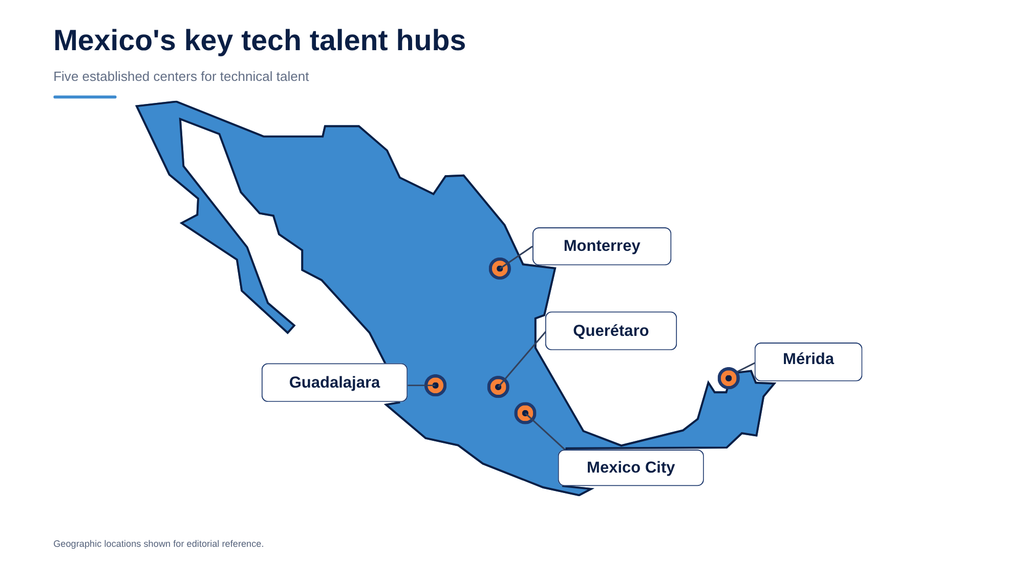
Plugg identifies Mexico City, Guadalajara, Monterrey, Querétaro, and Mérida as key technology centers.
For a remote Java role, searching nationally can broaden the candidate pool. Requiring hybrid or in-office work in a particular city adds another constraint to the search.
Hiring model
Salary and total hiring cost aren’t the same thing.
Plugg supports contract, contract-to-hire, and direct-hire models for technical talent. Depending on the model, companies may also need to account for recruiting, payroll, compliance, benefits, equipment, onboarding, and ongoing support.
Two Java developers with similar salaries can have very different total hiring costs.
Why hire a Java developer in Mexico?
Cost may put Mexico on the shortlist, but it isn’t the only reason to hire there.
According to Plugg’s Mexico Country Guide, Mexico has more than 600,000 IT professionals, with roughly 65,000 new professionals joining the sector each year.
Mexico’s time zones also give U.S. engineering teams substantial working-hour overlap, making live standups, pair programming, code reviews, and same-day problem solving easier to coordinate.
For companies hiring Java talent, the value proposition isn’t simply lower salaries. It’s access to a sizable engineering market that can work alongside a U.S. team in real time.
Pros, cons, and risks of hiring a Java developer in Mexico
Pros
U.S. working-hour overlap. Mexico’s time zones support real-time standups, code reviews, and day-to-day collaboration with U.S. teams.
Large technical talent pool. Mexico has more than 600,000 IT professionals, with roughly 65,000 joining the workforce each year.
Lower hiring costs. Plugg reports tech salaries in Mexico at roughly 40% to 60% below U.S. salaries, although actual savings for a Java hire depend on seniority and specialization.
Cons
English proficiency varies. For roles embedded in U.S. teams, technical communication and English proficiency still need to be screened at the candidate level.
Specialization narrows the pool. Finding a Java developer is one thing. Finding one who matches your framework, cloud environment, architecture, and enterprise requirements is a much narrower search.
Risks
Hiring for price instead of fit. A lower rate stops being a bargain if gaps in technical depth, communication, or ownership lead to more oversight or rework.
Getting the hiring model wrong. Contractor, direct-hire, and other employment models come with different payroll, compliance, and operational responsibilities. Companies need to understand which obligations apply to their hiring model before making the hire.
Alternatives to hiring a Java developer in Mexico
Mexico isn’t the only LATAM market worth considering for Java talent. The right market depends on what your team values most, from talent depth and cost to working-hour overlap.
| Market | Worth considering when you prioritize |
| Mexico | Cost savings + talent depth + U.S. working-hour overlap |
| Colombia | Working-hour overlap + established tech hubs |
| Brazil | Talent-pool size + depth in areas such as fintech, AI, and cloud. |
| Argentina | Skilled technical talent + strong English proficiency |
There’s no universally best LATAM market for a Java hire. The question is which market best matches the skills, budget, and collaboration requirements of your role.
Common mistakes when budgeting for a Java developer in Mexico
- Hiring for “Java” instead of your actual stack. Spring Boot, cloud architecture, microservices, databases, APIs, and DevOps requirements can narrow the candidate profile.
- Comparing salary instead of total cost. A salary benchmark doesn’t necessarily include the operational costs required to get that developer hired and working on your team.
- Choosing the lowest rate. A cheaper developer can become an expensive hire if gaps in experience lead to more oversight, slower delivery, or rework.
- Overlooking communication skills. Technical ability isn’t enough if the role requires standups, code reviews, documentation, and daily collaboration with a U.S. team.
- Paying for seniority you don’t need. Not every Java role requires an architect or technical lead. Define the level of ownership first, then hire to match it.
What does the total cost of hiring a Java developer in Mexico include?
A Java developer’s salary is only one part of the hiring cost. Depending on how you hire, the total cost can also include:
- Recruiting and technical screening
- Payroll administration
- Local employment and compliance support
- Benefits and taxes
- Computer equipment
- Onboarding
- Ongoing employee support
A salary benchmark tells you what the developer earns, not necessarily what it costs to get that developer hired, equipped, and working on your team.
Plugg’s nearshore staffing model combines talent sourcing with equipment, payroll and compliance support, onboarding, and ongoing support.
What Plugg’s Java hiring process looks like
We start with the role behind the job title. That means understanding the seniority, stack, frameworks, architecture, cloud environment, and level of ownership your team actually needs.
From there, we source and screen technical talent for fit and communication skills, then handle the operational work around the hire, including onboarding, payroll and compliance support, equipment, and ongoing support.
We’ve also hired technical talent at scale in Mexico. In one engagement, we placed 20 engineers within three months and more than 40 senior engineers within six months as a client shifted engineering operations from Eastern Europe to Mexico.
The goal isn’t to send you the most Java resumes, but rather to find the developer whose experience actually matches the work you need done.
Frequently asked questions
How much does it cost to hire a Java developer in Mexico?
Plugg’s current starting costs in Mexico are $2,500 per month for a mid-level Java developer, $3,800 for a senior developer, and $4,700 for a lead. Across LATAM, Plugg founder Brian Samson puts mid-level Java talent at roughly $2,000 to $4,000 per month and senior talent at $4,000 to $6,000, with Mexico sitting around the midpoint of the regional market. Final cost depends on the stack, specialization, seniority, and hiring structure.
Is it cheaper to hire a Java developer in Mexico than in the U.S.?
Generally, yes. Plugg reports that tech salaries in Mexico can be 40% to 60% lower than U.S. salaries. Actual savings for a Java developer depend on seniority, specialization, and hiring model.
What skills should I look for in a Java developer in Mexico?
Start with your existing environment. Depending on the role, that may include Java or Kotlin, Spring or Spring Boot, REST or GraphQL APIs, databases, cloud platforms, CI/CD, containerization, and microservices. Senior roles may also require architecture, mentoring, or technical leadership experience.
Do Java developers in Mexico work U.S. business hours?
Mexico offers substantial working-hour overlap with U.S. teams, making real-time standups, code reviews, pair programming, and same-day collaboration easier to coordinate.
Where can I hire Java developers in Mexico?
Plugg identifies Mexico City, Guadalajara, Monterrey, Querétaro, and Mérida as key technology centers. For fully remote roles, searching nationally rather than restricting the search to one city can broaden the candidate pool.
Should I hire a Java contractor or a full-time developer in Mexico?
It depends on the role. Contractors can provide flexible capacity or support defined projects, while longer-term hires may make more sense for developers who will own core systems or become deeply integrated with your engineering team. Your hiring model also affects payroll, compliance, benefits, and other costs beyond compensation.
How long does it take to hire a Java developer in Mexico?
Timing depends on the seniority, stack, specialization, and communication requirements of the role. Across Plugg placements, the current average time to deliver a shortlist of vetted candidates is three days, with first hires typically onboarding within 14 days or less.
Don’t hire “a Java developer.” Hire the Java developer your stack needs.
The right Java hire starts with the work, not the job title.
Define the stack, seniority, technical ownership, and communication requirements first. Then compare candidates and total hiring costs against those needs. A lower salary won’t save money if the developer doesn’t have the experience the role requires.
The goal isn’t the cheapest Java developer in Mexico. It’s the right developer at a cost that makes sense.
Ready to see what that looks like? Schedule a consultation to map out the skills, seniority, and experience your next Java hire needs.