
For a senior React developer who will work closely with a U.S. engineering team, we’d often start in Argentina. But there isn’t one LATAM country we’d recommend for every React search. Budget, seniority, team size and the rest of the technical stack can quickly change where we’d look.
Plugg founder Brian Samson has deep firsthand experience building engineering teams in Argentina. At a company he previously co-founded, he built a team of more than 85 software developers in Palermo, Buenos Aires, including dozens of React developers. Today, he puts a senior React developer in Argentina at roughly $40 to $44 per hour.
But Argentina isn’t always the right answer. When a San Francisco SaaS startup needed a senior React Native developer on a tighter budget, Plugg recommended Bolivia over Argentina and Costa Rica. That developer stayed with the company for more than three years.
Our recommendation: don’t choose a country because you’re hiring React. Choose it based on the kind of React developer you need.
Who this is for
This guide is for CTOs, engineering leaders and founders deciding where in Latin America to search for React talent.
It’s especially relevant if you need a senior React or React Native developer and are weighing budget, seniority, time-zone overlap, English proficiency or plans to build a larger team.
Which LATAM country is best for hiring React developers?
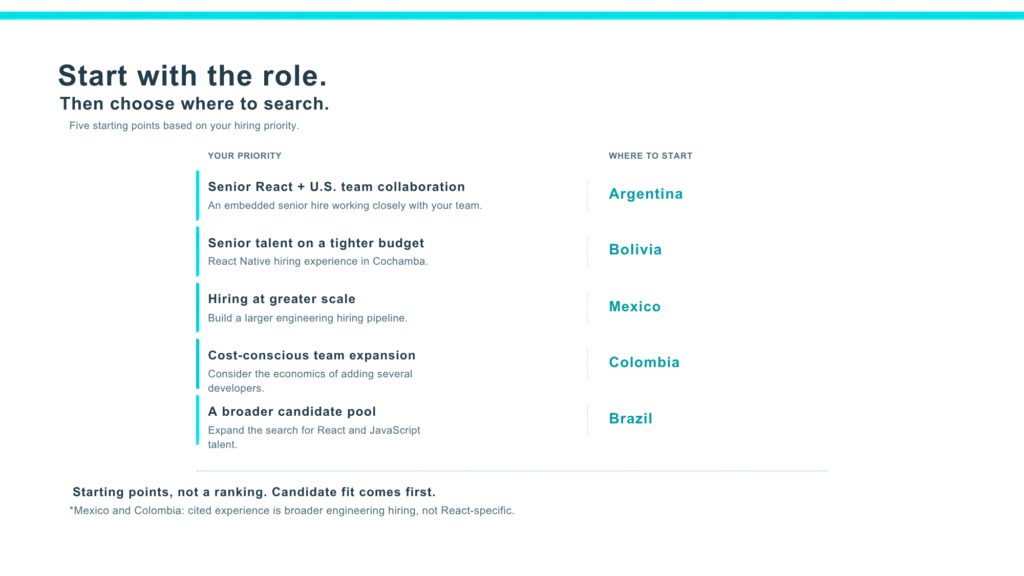
For a senior React developer who will work closely with a U.S. engineering team, we’d often start in Argentina. Other markets become more attractive when cost, hiring volume or the requirements of the role take priority.
| Your priority | Where we’d start |
| Senior React developer embedded with a U.S. team | Argentina |
| Senior talent on a tighter budget | Bolivia or other emerging LATAM markets |
| Hiring developers at greater scale | Mexico |
| Cost-conscious team expansion | Colombia |
| Expanding the candidate pool | Brazil |
Why Argentina often comes first
Our Argentina recommendation comes from firsthand React hiring experience.
Plugg founder Brian Samson previously co-founded a company where he built a team of more than 85 software developers in Buenos Aires, including dozens of React developers.
Based on that experience and his current view of the market, Samson puts a senior React developer in Argentina at roughly $40 to $44 per hour.
For one Series A client, Plugg introduced full-stack developers from Argentina and Brazil with React and JavaScript experience. They joined the client’s Slack and daily standups and worked as part of the existing engineering organization. The VP of Engineering praised their ability to move the product forward, hit milestones and integrate with the team.
Read the Series A engineering case study
In another engagement, Plugg recommended Argentina to a fast-growing company that had raised more than $70 million and wanted senior engineers who would contribute ideas, not simply complete assigned work. Plugg ultimately built a team of four senior full-stack developers there.
Read the Argentina full-stack team case study
Taken together, that experience is why Argentina would often make our initial shortlist for a senior, collaborative React role.
When is another LATAM country better for React hiring?
We’d look beyond Argentina when the economics, hiring volume or requirements of the role point elsewhere.
Bolivia: when budget is tight
A San Francisco SaaS startup came to Plugg looking for a senior React Native developer but couldn’t compete with well-funded Bay Area companies. Plugg compared several LATAM markets and recommended Cochabamba, Bolivia, where costs were lower than in Argentina and Costa Rica.
The developer stayed with the company for more than three years and became an important part of the team.
Read the Bolivia React case study
Mexico: when you’re hiring at scale
Mexico becomes more interesting when a single hire may grow into a much larger engineering team.
For one technology company moving engineering capacity out of Eastern Europe, Plugg identified Mexico as the best fit and made 20 engineering hires within three months. Within six months, Plugg had made more than 40 senior engineering hires.
This wasn’t a React-specific search, but it demonstrates Plugg’s ability to build a large engineering pipeline in Mexico.
Read the Mexico engineering case study
Colombia: when team economics matter
We’d include Colombia when you’re adding several developers and total team cost carries more weight. Plugg’s broader hiring history has shown competitive economics in Colombia, although that data isn’t specific to React.
For a single senior React hire, we wouldn’t choose Colombia purely because we expect a lower rate. The individual candidate still needs to meet the technical and communication requirements of the role.
Brazil: when you want to expand the candidate pool
Brazil is another market we’d include when the first countries searched aren’t producing the right candidates.
Plugg has placed Brazilian React and JavaScript developers alongside Argentine engineers on U.S. teams, giving us firsthand experience recruiting that talent.
This country-by-country approach extends beyond React. In the Nearshore Cafe Podcast, Plugg’s Evan Greenberg discusses how U.S. companies are increasingly looking across multiple LATAM markets to access different talent profiles rather than treating the region as one interchangeable labor pool.
Listen to Evan Greenberg on what’s changing in LATAM nearshore hiring
How much do React developers in LATAM cost?
Seniority and scope affect cost more than the React label alone. A developer building React components within an established team will command a different rate than a senior engineer expected to make architectural decisions, work across the stack or own a product area.
Plugg’s current LATAM benchmarks provide a useful starting point:
| Role / level | Typical monthly direct talent cost |
| Junior technical talent | Starting around $2,000 |
| Mid-level developer | Roughly $2,000–$4,000 |
| Senior developer | Roughly $4,000–$6,000 |
| Full-stack developer | Roughly $4,000–$7,000 |
We now have a more specific benchmark for Argentina. Plugg founder Brian Samson puts a senior React developer in Argentina at approximately $40 to $44 per hour, based on his experience building a team of more than 85 software developers in Buenos Aires, including dozens of React developers.
He also places Argentina and Costa Rica toward the higher end of the LATAM React market, with Bolivia roughly 20% lower.
That lines up with Plugg’s more recent experience. When a San Francisco SaaS startup needed a senior React Native developer but couldn’t compete at the rates it was seeing in Argentina and Costa Rica, Plugg recommended Bolivia instead.
What are the advantages of hiring React developers in LATAM?
The biggest advantage is the ability to search across several technical markets while keeping developers close to U.S. working hours.
Plugg’s experience shows why that flexibility matters. A senior collaborative search may point toward Argentina. A budget-sensitive React Native search led Plugg to Bolivia. Larger engineering builds have led to Mexico, while Brazil can expand the candidate pool.
That gives U.S. companies the ability to balance seniority, cost, specialization and collaboration rather than recruiting from a single market.
LATAM can be particularly attractive when the React developer needs to join standups, collaborate directly with product and engineering leaders, and make decisions alongside a U.S. team rather than working through an offshore handoff model.
What are the disadvantages of hiring React developers in LATAM?
There isn’t one LATAM market that will give you the best combination of cost, seniority and talent depth for every React search.
The strongest market can change when you add requirements such as React Native, Node.js, Next.js, TypeScript, advanced English or significant architectural ownership.
Senior developers working for international companies may also cost considerably more than local salary benchmarks suggest. And if the role becomes highly specialized, restricting the search to one country can unnecessarily shrink the candidate pool.
LATAM also won’t necessarily be the lowest-cost option. If minimizing hourly cost is the primary goal and real-time U.S. collaboration isn’t important, traditional offshore markets may offer lower labor costs.
What are the risks of hiring React developers in LATAM?
The biggest risk is treating “React developer” as a sufficiently detailed hiring requirement.
Framework experience alone doesn’t tell you whether someone can architect an application, work across the stack, make independent technical decisions or collaborate effectively with a U.S. product team.
There’s also a risk in choosing geography too early. Plugg’s Bolivia case study is a good example: the client’s budget made Bolivia a better fit than the more established markets it initially considered.
Communication is another risk for embedded roles. English proficiency on a resume doesn’t necessarily tell you whether a developer can explain technical trade-offs, challenge assumptions and participate naturally in engineering discussions.
Finally, cross-border hiring still requires the right approach to contracts, payroll, compliance and equipment.
What should you look for in a LATAM React developer?
React experience is only one part of what matters. For a senior hire, evaluate the broader engineering skills the developer will need on your team.
Look for:
- JavaScript and TypeScript fundamentals. React expertise should be backed by strong core language skills.
- Relevant React experience. Look at what candidates have actually built and owned rather than years with the framework alone.
- The surrounding stack. Depending on your product, that might include Next.js, Node.js, APIs, testing frameworks, state management or React Native.
- Engineering judgment. Senior developers should be able to explain trade-offs, identify problems and make decisions without waiting for detailed instructions.
- Communication. Developers working directly with a U.S. team need to explain decisions, ask useful questions and participate confidently in technical discussions.
Plugg has seen this matter in practice. In its Argentina full-stack engagement, the client specifically wanted senior developers who would contribute ideas rather than simply complete tickets. The four-person team joined the client’s daily standups and existing Slack, Zoom and Jira workflows.
Define what the developer needs to own before deciding where to search. That’s more useful than starting with a requirement such as “five years of React.”
What are the alternatives to hiring React developers in LATAM?
LATAM makes the most sense when you want React developers working directly with a U.S. team during overlapping hours. If that’s not important, another model may fit better.
| If you need… | Consider… |
| Strong U.S. working-hour overlap | LATAM nearshore developers |
| Lowest possible labor cost | Traditional offshore markets |
| A defined project delivered externally | Development agency |
| Direct employment and complete internal control | Local or U.S. hiring |
For companies building long-term engineering capacity, we generally prefer developers who become part of the client’s existing team. An agency may make more sense when you want to hand off a defined project.
What mistakes should you avoid when hiring React developers in LATAM?
The biggest mistake is choosing a country before defining the role.
Other mistakes we see include:
- Optimizing too heavily for cost. A lower rate isn’t useful if the developer lacks the seniority or autonomy the role requires.
- Screening for React instead of engineering ability. Framework experience doesn’t replace JavaScript fundamentals, problem-solving and technical judgment.
- Restricting the search too early. A strong candidate outside your first-choice market may be a better fit.
- Treating English as a checkbox. Embedded developers need to discuss trade-offs and communicate with product and engineering leaders.
- Dragging out the interview process. Decide who will interview candidates and approve an offer before the shortlist arrives.
- Underestimating cross-border administration. Contracts, payroll, compliance and equipment still need to be managed.
Set the requirements first. Then use geography to find candidates who can meet them within the available budget.
Frequently asked questions
What is the best LATAM country for hiring React developers?
For many senior React searches, we’d start with Argentina, particularly when the developer will work closely with a U.S. engineering team. We’d expand the search when budget, scale or the requirements of the role point elsewhere.
Is Argentina or Mexico better for React developers?
Argentina is often our starting point for a small number of senior, collaborative hires. Mexico becomes more attractive when you’re planning to hire at greater scale.
The distinction comes from Plugg’s hiring experience rather than a claim that Mexican React developers are inherently better or worse. Plugg has successfully built senior engineering pipelines in Mexico at significant scale, including one engagement that produced 20 hires in three months.
Can I find lower-cost React developers elsewhere in LATAM?
Yes. Plugg successfully hired a senior React Native developer in Bolivia after determining that the market offered better economics for that particular search. The developer has remained with the company for more than three years.
How much does a React developer in LATAM cost?
For a senior React developer in Argentina, Plugg founder Brian Samson currently estimates roughly $40 to $44 per hour. That estimate is based on his experience building a team of more than 85 software developers in Buenos Aires, including dozens of React developers.
Across LATAM, rates vary by country, seniority and the surrounding stack. Samson places Argentina and Costa Rica toward the higher end of the market, while Bolivia can be roughly 20% lower.
Should I search one country or all of LATAM?
Start with the markets most likely to fit the role, then expand if needed. For most searches, there’s little benefit in excluding qualified candidates simply because they’re outside your first-choice country.
How quickly can I hire a React developer through Plugg?
Plugg currently averages three days to deliver a vetted, interview-ready shortlist and 14 days or less to onboard a first hire.
Why hire React developers through Plugg?
Plugg searches across LATAM rather than pushing every React role toward the same country. Each search starts with the technical requirements, seniority, budget, communication needs and working model.
There’s no bench of developers to place. Each search is built around what the client actually needs.
That approach has led Plugg to different markets for different searches, including Argentina, Brazil and Bolivia in the React and full-stack engagements discussed above.
Plugg currently averages:
- Three days to deliver a vetted, interview-ready shortlist
- 93% offer-to-acceptance
- 14 days or less to onboard a first hire
Plugg also coordinates interviews, manages candidate expectations, handles hardware procurement and delivery, and provides bilingual post-placement support.
For a senior React developer who will work closely with a U.S. engineering team, we’d often start in Argentina. But we wouldn’t assume Argentina, or any other country, is automatically the best fit.
Plugg’s experience recruiting React talent across LATAM shows why. A collaborative senior search may lead to Argentina. A tighter budget has led us to Bolivia. A larger engineering build can make Mexico more attractive. And sometimes the strongest candidate will simply come from a market you didn’t expect.
Start with the role. Then search the LATAM markets that make the most sense for it.
If you’re deciding where to begin, Plugg can help you compare markets and find candidates who fit your requirements.