
Short answer: Argentina is one of our first choices for a small, experienced Agile team that needs to work closely with U.S. engineering leaders.
But don’t start by asking how many developers you need. Start by asking what you want the team to own.
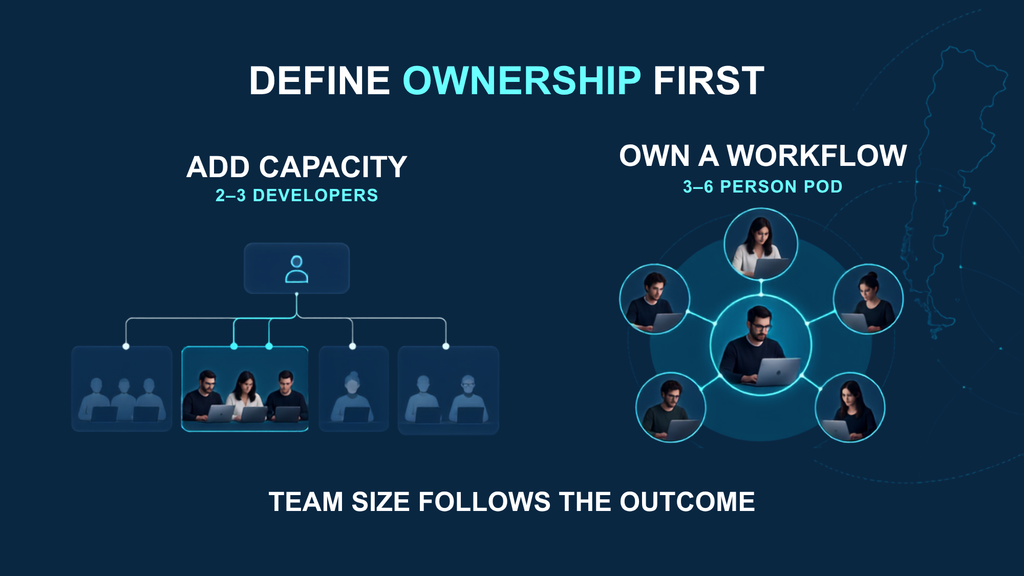
If you’re adding capacity to an established U.S. engineering organization, two or three Argentine developers may be enough. If you want a team that can take ownership of a product or workstream, we’d consider a cross-functional POD of roughly three to six people, with strong technical leadership at its core. For planning purposes, Plugg founder Brian Samson puts a representative four-person engineering team at roughly $22,000 per month.
We’ve seen that model work.
Plugg built a four-person senior full-stack team in Argentina whose developers joined daily standups, worked in the client’s existing Slack, Zoom and Jira workflows, and contributed ideas rather than simply completing tickets.
Argentina isn’t necessarily where we’d go for the lowest rate. It’s where we’d look when seniority, communication, ownership and real-time collaboration matter more than finding the cheapest developer.
Who this is for
This guide is for CTOs, engineering leaders and founders deciding whether to add Argentina-based developers to an existing team or build a more autonomous Agile POD.
Define what the team will own before deciding how many people to hire. That should determine your roles, seniority mix and hiring criteria.
How do you hire an Agile team in Argentina?
1. Define what the team will own
Are you adding development capacity? Owning a feature? Building a new product? Taking responsibility for an entire workstream?
The more ownership you expect, the more self-sufficient the team needs to be.
2. Build around the capabilities you’re missing
You don’t need to recreate your U.S. organization in Argentina.
Plugg’s POD teams typically have three to six members. Common roles include a Tech Lead, developers, QA Engineer, Product Manager and UX/UI Designer. If product, design, QA or technical leadership already exists in the U.S., don’t duplicate it unnecessarily.
3. Get the seniority mix right
For teams expected to work autonomously, establish technical leadership first. An experienced lead or senior engineer can provide direction while identifying where mid-level talent can add capacity at a lower cost.
4. Vet for communication and ownership
Agile engineers need to do more than pass a coding assessment. Ask candidates how they’ve handled unclear requirements, technical disagreements and problems they identified themselves.
Look for developers who can explain decisions, ask useful questions and push back constructively.
5. Integrate the team
Give Argentina-based engineers access to the same meetings, tools, documentation and decision-makers as your U.S. engineers.
Build one engineering organization across two countries, rather than a separate Argentina team that receives work from the U.S.
How much does an Agile team in Argentina cost?
For planning purposes, a four-person Argentina engineering team with mixed seniority could cost around $22,000 per month. Plugg founder Brian Samson estimates a weighted average of roughly $33 per hour for a representative team consisting of one lead, one senior developer, one mid-level developer and one junior developer.
A three- to six-person team’s actual cost will depend on its size, seniority and role mix. An all-senior team will cost more, while a team that can rely on existing U.S.-based product, design, QA or technical leadership may cost less.
Plugg’s broader hiring history supports that variation. Across its 2021–2026 rate history, Argentina has sat above some LATAM markets on price, while senior and leadership roles command a visible premium over other technical roles.
Our recommendation: use $22,000 per month as a planning benchmark for a four-person mixed-seniority team, then build the actual budget around what the team needs to own.
What are the advantages of hiring an Agile team in Argentina?
We recommend Argentina when experienced engineers and close collaboration with U.S. product and engineering leaders are priorities.
Plugg has seen this work firsthand. One Series A client had raised more than $70 million and needed senior engineers who could contribute ideas from day one. Plugg built a team of four senior full-stack developers in Argentina who joined the client’s daily standups and existing Slack, Zoom and Jira workflows.
Argentina also operates on UTC-3 year-round, without daylight-saving clock changes. That gives Agile teams substantial overlap with U.S. working hours for standups, code reviews, product discussions and resolving blockers in real time.
In Plugg’s experience, time-zone alignment can matter more than squeezing out a lower hourly rate when a role requires frequent collaboration.
What are the disadvantages of hiring an Agile team in Argentina?
Argentina isn’t necessarily the lowest-cost LATAM market. Plugg’s hiring history shows lower average bill rates in several other countries, which is why we’d choose Argentina when its talent and collaboration advantages justify the economics.
Argentina’s compensation market can also move quickly, so historical local salary averages may not reflect what internationally competitive technical talent expects today. The Nearshore Cafe Podcast has explored how inflation, currency changes and local salary adjustments affect Argentina’s nearshore talent market.
Listen to Nearshoring in Argentina Under Milei
Strong candidates can also have several international opportunities in play, so a slow interview process can cost you a hire.
Benchmark against the nearshore talent market you’re actually hiring in, rather than Argentina-wide historical salary averages.
What are the risks of building an Agile team in Argentina?
Some of the biggest risks have less to do with Argentina itself and more to do with how the team is built:
- Wrong team structure: Five strong engineers don’t automatically make a strong Agile team. Define ownership and leadership before hiring.
- Wrong seniority mix: An all-senior team can be unnecessarily expensive, while a team without enough senior leadership may struggle with autonomy. Be deliberate about where you need seniority.
- Weak communication screening: Test whether candidates can explain decisions, ask questions and disagree constructively.
- Poor integration: Treat Argentina-based engineers as part of the engineering organization, not a separate offshore delivery center.
- Cross-border complexity: Contracts, payroll, classification, equipment and compliance need an appropriate operating model.
What are the alternatives to Argentina?
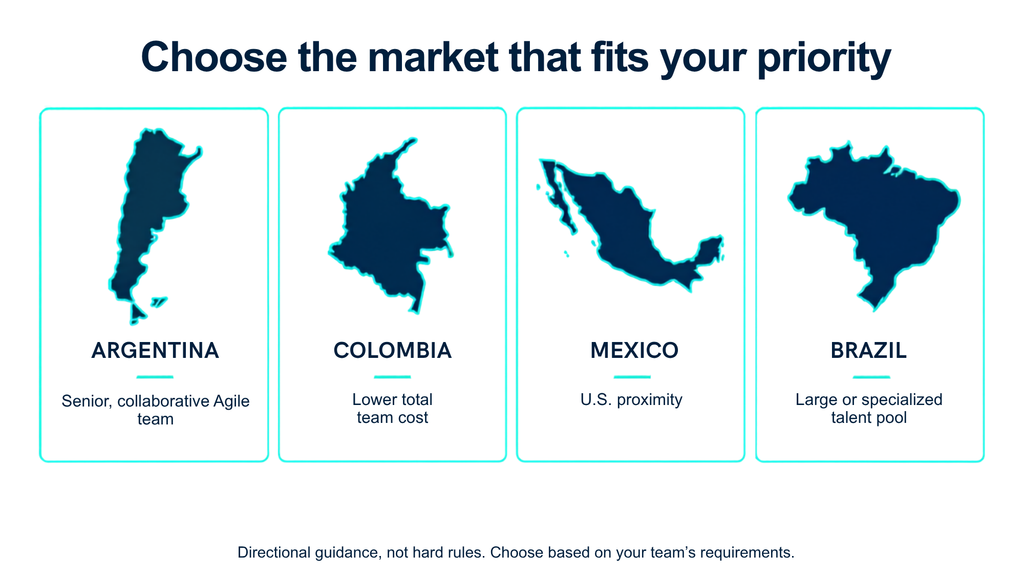
We’d compare Argentina primarily with Colombia, Mexico and Brazil:
| Priority | Market we’d consider first |
| Senior, collaborative Agile team | Argentina |
| Lower total team cost | Colombia |
| U.S. proximity | Mexico |
| Large or specialized talent pool | Brazil |
These aren’t hard rules. Define the team first, then identify which markets best fit its technical requirements, budget and collaboration needs.
Common mistakes when hiring an Agile team in Argentina
Hiring for headcount instead of an outcome. “We need four developers” isn’t enough. Define what those four people need to accomplish.
Recreating the U.S. team. Don’t duplicate product, QA, design or technical leadership in Argentina if those functions can effectively support the team from the U.S.
Using local salary averages. Senior engineers pursuing international opportunities aren’t competing only in Argentina’s domestic employment market.
Moving too slowly. Agree on the interview process and decision-makers before candidates arrive. Plugg currently averages three days to deliver a vetted, interview-ready shortlist and reports a 93% offer-to-acceptance rate.
Frequently asked questions
How big should an Agile team in Argentina be?
Three to six people is a practical starting point for a POD. If you’re adding capacity to an existing team, two or three developers may be enough.
What roles should an Agile team include?
Depending on what the team owns, it may include a Tech Lead, developers, QA Engineer, Product Manager and UX/UI Designer. Only hire the capabilities your existing organization can’t provide.
Can developers in Argentina work U.S. hours?
Yes. Argentina operates on UTC-3 year-round, providing substantial overlap with U.S. business hours and making real-time Agile collaboration practical.
Do software developers in Argentina speak English?
Argentina has a strong English-proficiency signal, including among IT test takers. In the 2025 EF English Proficiency Index, Argentina scored 575 nationally and ranked 26th globally. Among EF test takers working in IT, Argentina scored 589.
We’d still assess communication at the candidate level. Agile engineers need to discuss technical decisions and tradeoffs, ask questions and communicate naturally with the rest of the team.
See Argentina’s EF English Proficiency Index results
How much does an Agile team in Argentina cost?
About $22,000 per month is a reasonable planning benchmark for a four-person Agile engineering team in Argentina. Plugg founder Brian Samson estimates a weighted average of approximately $33 per hour for a team consisting of one lead, one senior developer, one mid-level developer and one junior developer.
A three- to six-person team’s actual cost will vary depending on its seniority and role mix.
Should I hire developers individually or build a POD?
Hire individual developers if your existing organization can provide the leadership and supporting functions they need. Build a POD when you want the nearshore team to own a product, feature or workstream more independently.
Do I need an Argentine legal entity?
Not necessarily. Your options depend on whether you’re hiring employees directly, engaging contractors or working through a nearshore partner. Get appropriate legal and tax advice when hiring directly.
How quickly can I hire in Argentina?
Plugg currently averages three days to deliver a vetted shortlist and 14 days or less to onboard a first hire. A complete POD may take longer depending on the roles required.
Why Plugg for building an Agile team in Argentina?
Plugg doesn’t maintain a bench of developers waiting to be assigned to clients. Each search is built around the client’s roles, technical requirements and working style.
Today, Plugg averages:
- Three days to deliver a vetted, interview-ready shortlist
- 14 days or less to onboard a first hire
- 93% offer-to-acceptance rate
Plugg also supports onboarding, payroll and compliance, hardware procurement and delivery, and bilingual post-placement support.
And we have firsthand experience building the type of team described in this guide. Plugg built a four-person senior full-stack team in Argentina whose developers worked directly within the client’s existing U.S. engineering organization.
We recommend Argentina for U.S. companies building small, experienced engineering teams that need to collaborate closely with product and engineering leaders.
If your primary goal is the lowest possible cost, we’d compare other LATAM markets. When seniority, communication, ownership and real-time collaboration matter more, Argentina should be high on the shortlist.
Plugg can help you compare markets based on the roles, seniority, budget and working model you actually need. If another LATAM market makes more sense, we’ll tell you.
Ready to build your nearshore engineering team? Talk to the Plugg team