
Short answer: Plugg’s current LATAM benchmarks put mid-level Java developers at roughly $2,000 to $4,000 per month and senior Java developers at $4,000 to $6,000 per month, with Colombia generally sitting below the midpoint of the regional technical talent market.
But developer rates are only part of the budget. The real cost of building a team also depends on team size, seniority, hardware, office space if you need it, and how you hire.
Below, we’ll break down what a Colombia-based development team can actually cost, from individual developer rates to a four-person POD and the operational costs that come with it.
Who this is for
This guide is for CTOs, VPs of Engineering, and founders deciding whether to build a development team in Colombia and what that team should cost. It’s most useful if you’re past “should we nearshore?” and into “how many people, which roles, and what will it cost?”
What does a development team in Colombia cost?
There isn’t one standard rate for a development team in Colombia. Cost depends on team size, seniority, specialization, and how you hire.
Plugg founder Brian Samson estimates mid-level Java developers across LATAM at roughly $2,000 to $4,000 per month and senior Java developers at $4,000 to $6,000 per month in a recent Nearshore Cafe podcast discussion on LATAM tech talent costs.
Colombia-specific data supports a similar range. Invest in Bogotá’s 2025 IT Talent report puts gross monthly Java salaries at approximately $2,000 to $3,000 for professionals with three to five years of experience, $3,000 to $4,000 for five to eight years, and $4,000 to $6,000 for eight to 12 years.
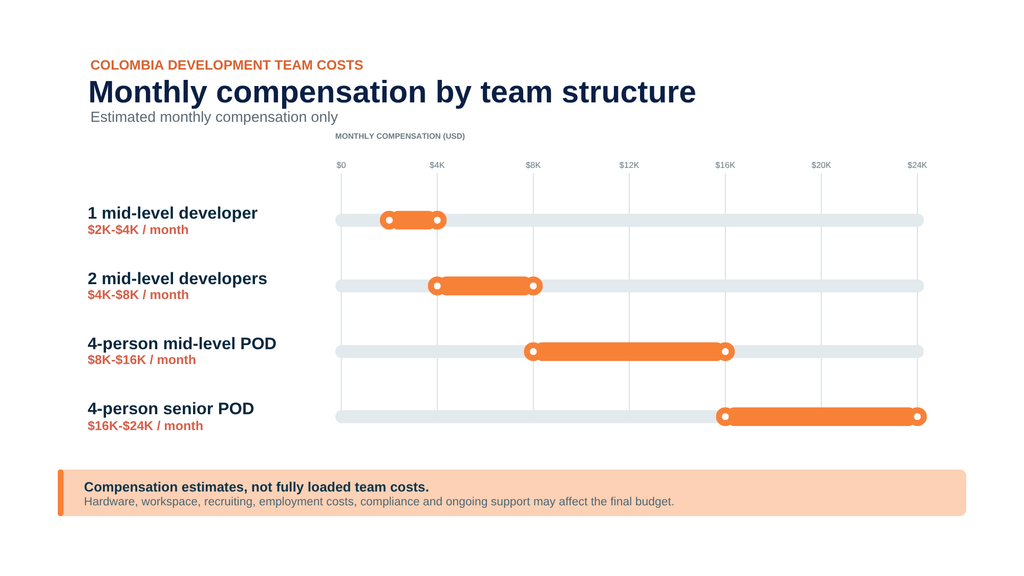
So what does that look like when you’re budgeting for an actual team?
| Example team | Estimated monthly compensation | Estimated annual compensation |
| 1 mid-level developer* | $2,000–$4,000 | $24,000–$48,000 |
| 2 mid-level developers* | $4,000–$8,000 | $48,000–$96,000 |
| 4-person mid-level* POD | $8,000–$16,000 | $96,000–$192,000 |
| 4-person senior POD | $16,000–$24,000 | $192,000–$288,000 |
“mid-level salaries used for illustration purposes to give a weighted average cost structure.
These are compensation estimates, not fully loaded team costs. Hardware, office space if you want it, recruiting, employment costs, compliance, and ongoing support can all affect the final budget. Some of those expenses may already be included when you work with a staffing partner.
That’s why it’s important to compare total team cost, not salary alone.
Team size can lower the per-developer cost
The cost doesn’t necessarily scale dollar-for-dollar as your team grows. Plugg’s pricing accounts for the size of the engagement, with volume discounts available for companies building PODs or multiple teams.
| Hiring structure | Plugg volume discount |
| Single developer | Standard rate |
| 4-person POD | 8–10% |
| Multiple teams | 15–18% |
A four-person POD can qualify for an 8% to 10% discount, while companies building multiple teams can receive 15% to 18% off Plugg’s standard pricing.
That means companies comparing team-building options should look beyond the per-developer rate. The size and structure of the engagement can change the effective cost per hire.
What affects the cost of a Colombian development team?
Team size and composition
The biggest cost variable is who you actually need. If you already have product leadership, DevOps, and QA in the U.S., two or three Colombian developers may be enough to add engineering capacity.
A more autonomous team may need its own technical leadership, QA, product, or design expertise. The goal is to fill the capabilities your existing team is missing, not duplicate every function in Colombia.
Seniority
A team of experienced senior engineers will cost more than one that combines senior leadership with mid-level talent.
In one Plugg technical staffing engagement, the client took a leadership-first approach, hiring an experienced technical leader and then building the rest of the team around that person. That structure can provide senior oversight without paying senior-level rates for every seat.
Technical specialization
Specialized skills can push costs well beyond standard developer rates. In a recent Nearshore Cafe podcast discussion on LATAM tech talent costs, Plugg founder Brian Samson puts AI engineers, data engineers, and data scientists at roughly $7,000 to $9,000 per month, compared with $2,000 to $4,000 for a mid-level Java developer.
If your Colombia team needs scarce AI, data, cloud, or other specialized expertise, don’t build the budget around a general software developer benchmark.
Hiring model
How you hire can change total cost as much as who you hire. Direct employment, contractors, EOR arrangements, and staffing partners package recruiting, payroll, compliance, benefits, equipment, and ongoing support differently.
Compare what’s included, not just the headline rate. A lower salary can still produce a higher operational cost if your company has to source candidates, manage local employment requirements, procure equipment, and coordinate support separately.
Why build a development team in Colombia?
Lower costs may get Colombia onto the shortlist, but they aren’t the only reason companies build technical teams there.
Colombia has developed a growing technology ecosystem, with Bogotá and Medellín emerging as important talent hubs. Its time-zone alignment with the U.S. also supports real-time standups, code reviews, meetings, and same-day feedback.
Plugg’s firsthand experience supports that talent story. In a Nearshore Cafe podcast conversation about Bogotá’s technology ecosystem, Brian Samson noted that companies exposed to Colombian talent often expand their hiring in the country, with Medellín coming up frequently for software development.
Colombia can also support teams at scale. In another Nearshore Cafe conversation, CloudTask founder Amir Reiter described building operations in Bogotá and Medellín as his Colombia-based organization grew to 265 active contractors.
The takeaway isn’t that every company should immediately build a large Colombian operation. Colombia is most compelling when its combination of cost, talent availability, U.S. working-hour overlap, and ability to scale matches the team you’re trying to build.
Trade-offs to weigh before you hire
Pros
- Time zone overlap. Colombia works close to U.S. business hours, which supports real-time standups, code reviews, and same-day feedback.
- Competitive hiring costs. Nearshore technical hiring across LATAM can offer roughly 40% to 70% savings compared with U.S. talent. The actual savings for a Colombia-based team depend on the roles, seniority, specialization, and U.S. market used for comparison.
- Established talent hubs. Plugg’s firsthand experience in Colombia points to Bogotá and Medellín as important markets for technical talent, including software development.
Cons
- English proficiency varies. Colombia’s EF English Proficiency Index score is 480, below the global average of 488. However, IT professionals score considerably higher at 512, while Medellín and Bogotá score 516 and 513, respectively. For U.S.-facing roles, English fluency should still be evaluated at the candidate level rather than assumed from national averages.
- Specialized talent can be competitive. Demand in Colombia is increasingly concentrated in areas such as AI, cloud, cybersecurity, DevOps, Big Data, and Full Stack development. Companies hiring for highly specialized roles may face more competition than those hiring for broadly available development skills.
Compliance risk
- Hiring employees directly in Colombia means navigating local employment and social-security requirements. Companies need to understand which obligations apply to their hiring model or work with a partner that manages local compliance.
Alternatives to consider
Colombia isn’t the only nearshore option, and it isn’t automatically the right one for every team.
- Mexico: Strong option when maximum U.S. time-zone overlap, proximity, and the flexibility to build larger teams matter.
- Brazil: Offers a large technology market with deep specialist talent and can be a strong choice for highly specialized or senior technical roles.
- Argentina: Strong technical market worth considering when talent availability and competitive costs are priorities.
The right market depends on the roles you’re hiring, your budget, and the kind of team you’re building. Colombia tends to be a strong fit for companies that want competitive technical talent costs, substantial U.S. working-hour overlap, and access to established talent hubs such as Bogotá and Medellín.
Common mistakes companies make when budgeting for a Colombia team
- Comparing salary alone instead of total cost. A lower base salary doesn’t always mean lower total spend once benefits, compliance, and support are factored in.
- Treating LATAM-wide benchmarks as country-specific. Regional averages are useful for early planning, but Colombia-specific salary data gives you a better starting point when it’s time to make an offer.
- Choosing roles before defining the work. Starting with a generic headcount can leave you paying for capabilities your U.S. team already has or overlooking skills the Colombia-based team needs to operate effectively.
- Ignoring the hiring model. Direct employment, contractors, EORs, and staffing partners package costs differently. Compare what’s included in each model before deciding which option is actually less expensive.
- Forgetting operational costs. Laptops, monitors, peripherals, workspace, onboarding, and ongoing employee support may seem small compared with salaries, but across an entire team they can materially change the first-year budget.
What does the total cost of hiring in Colombia include?
Developer compensation is only one line in the budget. Depending on how you hire, you may also need to account for equipment, workspace, recruiting, payroll, benefits, compliance, and ongoing support.
Here’s what some of those costs can look like:
| Cost | What to budget for | What to know |
| Developer compensation | $2,000–$6,000+/month per developer | Varies by seniority and specialization |
| Specialized technical talent | $7,000–$9,000/month | Plugg benchmark for roles such as AI, data engineering, and data science |
| Laptop | From ~$1,000+ USD per developer | Hardware needs vary by role and technical requirements |
| Coworking membership in Bogotá | From COP 713,741/month per person | Optional for remote teams |
| 4-person private office in Bogotá | From COP 3,021,870/month | Optional; current WeWork starting price, plus taxes and fees |
| Recruiting, payroll, compliance and support | Varies by hiring model | May be separate costs or bundled into a staffing/EOR rate |
Hardware: A business-ready laptop can easily add around $1,000 or more per developer upfront. As one benchmark, Apple’s 13-inch MacBook Air starts at $999 USD, with 16 GB of memory standard. More demanding engineering roles may require higher-spec machines, additional monitors, docks, or other peripherals.
Office space: A Colombia-based team doesn’t necessarily need an office. But if employees want or need a shared workspace, current WeWork Bogotá pricing provides a useful benchmark. Coworking memberships currently start at COP 713,741 per month, while a four-person private office starts at COP 3,021,870 per month, plus taxes and fees. Private-office pricing is based on a 12-month commitment and can vary by location.
The distinction matters when comparing salary benchmarks with all-in staffing costs. A $4,000 monthly salary and a $4,000 all-in hiring rate aren’t the same thing. One reflects compensation for the developer; the other may also include some combination of recruiting, payroll, compliance, benefits, equipment, and ongoing support.
Plugg’s nearshore tech talent model combines recruiting with the employment infrastructure and ongoing support needed to build and manage a LATAM team. Instead of coordinating those pieces separately, companies can manage them through one nearshore staffing partner.
How Plugg helps you build the right team in Colombia
Building the right Colombia team starts with deciding what you actually need. Plugg works with companies to define the roles, seniority, and capabilities that complement their existing engineering organization. That might mean adding a few developers to an established U.S. team or building a cross-functional POD with its own technical leadership and supporting roles.
Once the team structure is defined, Plugg sources and screens LATAM technical talent and handles the operational work around each hire, including onboarding, payroll and compliance support, equipment, and ongoing team support.
That matters when you’re comparing costs. Instead of separately coordinating recruiting, local employment infrastructure, hardware, and employee support, companies can manage those pieces through one partner and get a clearer picture of what the team will actually cost.
With 500+ successful placements, our average shortlist time is three days, most first hires onboard within 14 days, and our 2026 retention rate is 91%.
The goal isn’t to find the cheapest developers in Colombia. It’s to build the right team and know what you’re paying for.
Frequently asked questions
How much does a Colombian software developer cost?
Cost varies by role and seniority. Plugg’s current LATAM benchmarks put mid-level Java developers at roughly $2,000 to $4,000 per month and senior Java developers at $4,000 to $6,000 per month, with Colombia generally falling below the midpoint of the LATAM technical talent market. Colombia-specific salary data from Invest in Bogotá shows similar ranges depending on experience.
Is hiring developers in Colombia cheaper than hiring in the U.S.?
Colombia is part of a LATAM tech hiring market where we typically see 40% to 70% cost savings compared with U.S. technical talent. The exact savings for a Colombia-based team depend on role, seniority, specialization, team structure, and hiring model.
How many developers should I hire in Colombia?
It depends on the capabilities already on your existing team. If you already have technical leadership, product, QA, and DevOps resources, one or two additional developers may be enough. For more autonomous product delivery, we typically structure cross-functional PODs with three to six people.
Why do companies hire tech talent in Bogotá and Medellín?
Bogotá and Medellín are established Colombian technology hubs with substantial working-hour overlap with U.S. teams, which makes real-time collaboration like standups, meetings, code reviews, and same-day feedback easier.
Should I hire individual developers or a development POD?
If you’re filling specific gaps in an existing engineering organization, individual hires may be enough. A cross-functional POD makes more sense when you need a team capable of owning more of the development process independently.
What costs should I consider beyond developer salary?
Depending on your hiring model, additional costs can include recruiting, payroll, local employment costs, compliance, benefits, equipment, onboarding, office or coworking space, and ongoing employee support. Some staffing and EOR models bundle several of these expenses into one rate, while direct hiring may require you to budget for them separately.
Build the team first. Then build the budget.
The cost of a development team in Colombia depends on more than the number of developers you hire. Seniority, specialization, team structure, equipment, workspace, and hiring model all affect the final budget.
Start with the work your team needs to own. Then identify the roles and level of experience required, what your existing U.S. team already covers, and which costs are included in your hiring model.
The goal isn’t simply to find the lowest developer rate. It’s to build the right Colombia team at a total cost you understand from the start.
Schedule a consultation to map out the roles, seniority, and team structure your Colombia team needs.