
Short answer: A remote job doesn’t automatically need a U.S. ZIP code. If the work can be done from anywhere, we’d usually open the search to LATAM, where companies can find experienced engineers in U.S.-aligned time zones, often at substantially lower cost.
Some roles genuinely need to stay in the U.S. Others don’t.
Our recommendation: make U.S.-only hiring a requirement you can explain, not the default.
Who is this for?
This comparison is for U.S. CTOs, founders and engineering leaders deciding whether their next remote developer actually needs to live in the United States.
It’s particularly relevant for companies that already know how to hire, onboard and manage people remotely. If the position requires regular physical presence, U.S.-specific authorization or access to systems that can’t be used internationally, the decision may already be made for you.
For everyone else, there’s a useful question to ask: what does restricting this role to U.S. candidates actually buy us?
What does nearshore hiring cost compared with U.S. remote developers?
LATAM can offer a meaningful cost advantage, but we’d avoid using one generic “nearshore developer rate.”
According to the U.S. Bureau of Labor Statistics, the median annual wage for software developers was $135,980 in May 2025, with the highest-paid 10% earning more than $214,670. That’s a wage benchmark, not the employer’s total cost, and it isn’t directly comparable with Plugg’s hourly nearshore planning ranges. But it provides a neutral starting point for understanding U.S. software developer compensation.
Based on Plugg’s internal hiring data and recruiting experience, current LATAM planning ranges include approximately:
- Senior React developers in Argentina: $40–$44/hour
- Cloud/DevOps: $38–$45/hour
- Data engineers: $45–$60/hour
- AI/ML engineers: starting around $45/hour and extending into the $60s for more specialized talent
These aren’t directly equivalent to a U.S. employee’s annual wage. Employment structure, benefits, seniority and what is included in a nearshore rate can all affect the comparison.
That’s why an actual Plugg client example is more useful.
In one Plugg case study, a San Francisco Series B startup had been spending more than $200,000 annually on a fully remote U.S. engineering role. By hiring a senior LATAM engineer for a comparable remote role, the company brought the cost to approximately 40% of its previous U.S. spend, saving more than $120,000 annually.
Read the U.S.-vs-LATAM cost case study
That doesn’t mean every company will save 60%. The economics change with specialization, seniority, country and hiring model.
Our recommendation: price the role you actually need in both markets and compare the total cost of qualified candidates.
What are the advantages of hiring nearshore developers?
You can expand the candidate pool without giving up the remote model
If you’ve already decided a developer doesn’t need to sit in your office, opening the search to LATAM gives you more places to find the right person.
And that isn’t only useful when budget is tight.
One fast-growing Plugg client had recently raised more than $70 million but was struggling to find the senior engineering talent it wanted in a competitive market. The company wanted senior engineers who could join the existing organization, contribute ideas and work alongside its U.S. team.
Plugg recommended Argentina and ultimately built a four-person senior full-stack team there.
Read the Argentina full-stack team case study
The company wasn’t simply looking for the lowest-cost developers it could find. It needed experienced engineers who could contribute during a critical growth period.
Nearshoring can be a talent strategy as much as a cost strategy.
Geography gives you another lever when a difficult search isn’t working
Sometimes cost is the problem.
A San Francisco SaaS startup needed a senior React Native developer but couldn’t compete with better-funded Bay Area companies for the talent it wanted.
Rather than lowering the technical bar, Plugg widened the geographic search. It ultimately recommended a senior developer from Cochabamba, Bolivia, a less expensive market than more established LATAM locations such as Argentina and Costa Rica.
The developer remained with the company for more than three years and participated in its annual offsites.
Read the Bolivia React Native case study
The lesson isn’t that Bolivia is always better than the U.S. It’s that geography becomes another lever when a difficult search isn’t producing the right candidate at the right cost.
You can build more engineering capacity with the same budget
Lower hiring costs don’t have to mean simply spending less.
They can mean doing more with the engineering budget you already have.
That could mean adding QA alongside development, filling several open positions or building a mixed-seniority team rather than concentrating most of the budget in one U.S. hire.
For planning purposes, Plugg founder Brian Samson estimates that a representative four-person engineering team in Argentina, consisting of one lead, one senior developer, one mid-level developer and one junior developer, could average roughly $33 per hour across the team, or around $22,000 per month.
Actual costs will change with the roles and seniority mix.
But for a CTO planning headcount, that’s often a more useful way to think about the economics: what technical capacity can we build with the budget available?
Nearshore engineers can work inside the existing U.S. team
Nearshoring doesn’t require creating a disconnected offshore development shop.
The four senior engineers Plugg recruited for its Argentina client used Slack, Zoom and Jira, participated in daily standups and were expected to contribute ideas as members of the existing engineering organization.
That’s particularly important for product development, where engineers may need regular access to product, design and technical leadership.
For a company already operating remotely, nearshoring can change where some team members live without fundamentally changing how the team works.
You retain U.S. workday overlap
LATAM’s location also makes real-time collaboration practical.
Depending on the country, nearshore engineers may be on the same clock as a U.S. team or only a few hours ahead. That makes it practical to participate in standups, architecture discussions, code reviews, product meetings and incident response during the same working day.
The exact overlap depends on where the engineer and the U.S. team are located, but you don’t generally need to build the working relationship around an overnight handoff.
What are the disadvantages?
Hiring a U.S. remote developer can still be the simpler or better decision.
If your company already has U.S. payroll, benefits and HR infrastructure, adding another domestic employee may involve fewer cross-border considerations.
Some positions also genuinely benefit from U.S.-specific experience. A role deeply embedded in a regulated industry, government contract or U.S.-specific business process may require knowledge that’s easier to find domestically.
Security and contractual requirements can matter too. Some organizations restrict where particular systems or data can be accessed.
And sometimes the strongest candidate simply lives in the U.S.
Nearshoring should expand your options, not replace one geographic restriction with another.
What are the risks?
Choosing primarily on cost
Nearshore hiring goes wrong quickly when “cheaper” becomes the hiring requirement.
Technical depth, communication, reliability, ownership and experience with your stack still matter.
The goal is to take advantage of different labor-market economics without lowering the hiring bar.
Comparing numbers that aren’t actually comparable
A U.S. employee salary, contractor rate and nearshore staff-augmentation rate can represent different things.
Benefits, employer taxes, equipment, recruiting, administration and provider services may all affect the total cost.
Compare total hiring cost and capability rather than placing an annual U.S. salary beside a LATAM hourly rate and calling the difference savings.
Creating a two-tier engineering organization
Nearshore engineers shouldn’t become a separate group that receives tickets but little context or influence.
If they’re expected to operate as members of the engineering organization, give them access to the meetings, documentation, decision-makers and product context they need to contribute.
Getting cross-border employment and compliance wrong
Hiring someone in another country can involve contracts, worker classification, payroll, tax and local employment requirements.
The appropriate structure will depend on whether you’re hiring employees directly, using contractors, working through an Employer of Record (EOR), a company that legally employs the worker on your behalf, or using a staff-augmentation provider.
Treating LATAM as one labor market
Latin America isn’t one interchangeable talent pool with one price.
Plugg’s recruiting experience shows meaningful differences among markets and technical specialties.
For example, based on Plugg’s recruiting team’s experience, Brazil is its top recommendation for data engineering and AI/ML, with Argentina also high on the list. For Cloud/DevOps, Plugg’s preferred markets are Brazil and Argentina.
Start with the role, then decide where to search.
What are the alternatives?
You don’t have to choose between an entirely U.S. team and an entirely LATAM team.
For many companies, a mixed model can make sense: retain U.S.-based product, engineering or technical leadership where it adds value and expand engineering capacity in LATAM.
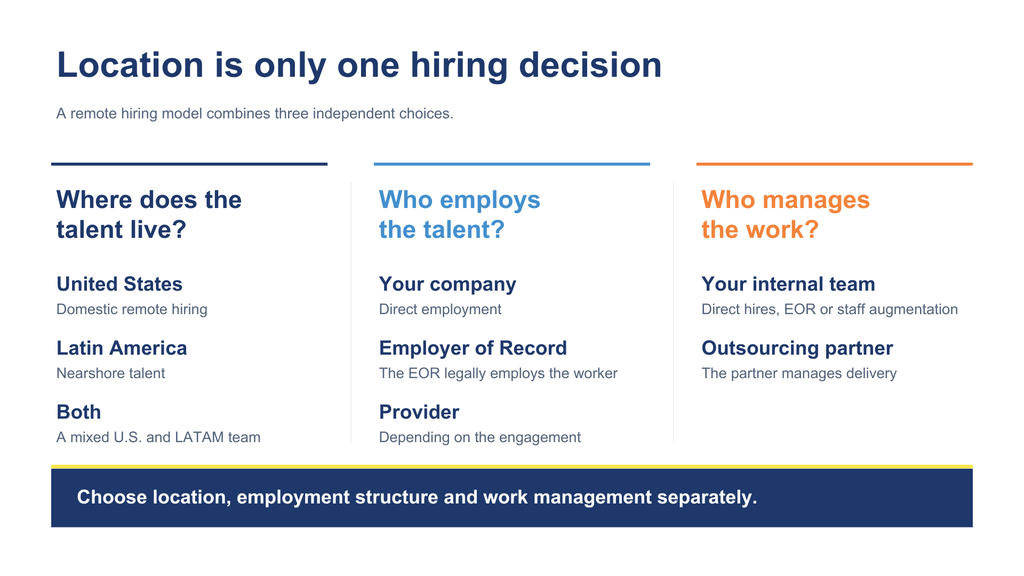
If you want LATAM employees within your own organization, direct hiring or an EOR may be appropriate. If you want engineers integrated into your team without building the recruiting and employment infrastructure yourself, nearshore staff augmentation is another option.
And if you don’t want to manage additional engineers at all, traditional outsourcing may be a better fit.
Separate three decisions: where the talent lives, who employs them and who manages the work.
What common mistakes should you avoid?
Three mistakes come up repeatedly: comparing unlike costs, choosing a country before defining the role and treating geography as the hiring strategy.
A senior AI engineer, React developer and QA professional shouldn’t share one generic LATAM hiring benchmark. And a remote role shouldn’t automatically be U.S.-only or LATAM-only.
Start with the person you need. Then decide which markets give you the strongest options for that role and budget.
FAQ
Is it cheaper to hire developers in LATAM than in the U.S.?
Often, yes, but the size of the difference depends on the role, seniority, country and employment model.
The U.S. Bureau of Labor Statistics reports a $135,980 median annual wage for software developers as of May 2025.
Plugg’s role-specific LATAM hiring ranges can be considerably lower, but we’d compare like-for-like candidates and total hiring costs rather than applying one savings percentage to every role.
How much can companies save by hiring LATAM developers?
There isn’t one percentage we’d promise for every hire.
Plugg has seen substantial savings in individual cases. Its San Francisco Series B case study describes a fully remote U.S. engineering role costing more than $200,000 annually, compared with approximately 40% of that previous cost for senior LATAM talent.
That’s a case study, not a guarantee that every company will achieve the same result.
Are LATAM developers as experienced as U.S. developers?
Location doesn’t determine seniority or technical ability.
LATAM markets include junior developers, senior engineers, technical leads and highly specialized talent.
Plugg’s own engagements include senior full-stack developers in Argentina and a senior React Native developer in Bolivia who remained with his U.S. client for more than three years.
Do LATAM developers work U.S. hours?
LATAM generally provides substantial U.S. workday overlap, although the exact amount depends on the developer’s country and the U.S. team’s time zone.
That overlap can allow engineers to participate in the same standups, planning meetings, code reviews and day-to-day conversations as their U.S. colleagues.
Which LATAM countries are best for hiring remote developers?
There isn’t one country we’d choose for every technical role.
Plugg’s recruiting experience shows that the answer changes with specialization. Brazil is Plugg’s top recommendation for data engineering and AI/ML, with Argentina also a strong market. For Cloud/DevOps, Plugg’s recruiting team recommends Brazil and Argentina.
For other searches, budget can change the answer. Plugg’s Bolivia React Native placement is a good example of widening the search beyond more established markets when the client’s budget couldn’t compete for the talent it wanted.
Should I hire LATAM developers directly or use staff augmentation?
It depends on how much recruiting, employment and administrative infrastructure you want to manage.
Direct hiring can make sense if you’re prepared to employ and support people in the countries where you’re hiring.
Staff augmentation can be useful when you want nearshore engineers working within your existing organization while a provider handles much of the recruiting and administrative work.
Why hire nearshore developers through Plugg?
Plugg doesn’t start with “Which LATAM country is cheapest?” It starts with the role.
That has produced very different recommendations for different clients.
When a fast-growing technology company that had raised more than $70 million needed senior engineers during a competitive hiring market, Plugg recommended Argentina and built a four-person senior full-stack team.
When a San Francisco SaaS startup couldn’t compete for the React Native talent it needed within budget, Plugg widened the search beyond more established LATAM markets and found its developer in Bolivia. He remained with the company for more than three years.
And when another San Francisco startup had been spending more than $200,000 annually on a fully remote U.S. engineering role, Plugg helped it hire senior LATAM talent for a comparable remote role at approximately 40% of the previous cost.
Those companies had different problems. One needed access to senior talent. One needed to make a difficult search work within budget. One needed to change the economics of an existing remote role.
That’s the value of opening the search beyond the U.S.: you have more hiring markets available to solve for talent, specialization and budget.