
Short answer: For most U.S. companies making multiple software hires, we’d start with Mexico.
But Argentina makes the decision more interesting than you might expect.
Plugg has hundreds of contractor starts in Mexico in our 2021–2026 rate history, giving us considerably more hiring experience there than in Argentina. Mexico also offers closer alignment across U.S. time zones.
Argentina’s advantage is English. It has the stronger English-proficiency signal, including among IT test takers. And if you’re expecting Argentina to make up for Mexico’s advantages by being cheaper, our data says otherwise: our historical average is over $35 per hour billed in Argentina compared with over $30 in Mexico.
Our recommendation: Start with Mexico when you’re building a team. For a specific hire, search both and let the candidates challenge that assumption.
Who this is for
This guide is for CTOs, engineering leaders and founders deciding whether to focus a nearshore software developer search in Argentina or Mexico.
It’s most useful if you’re making your first LATAM hires, planning to scale an engineering team or comparing the two countries based on talent, cost, communication and U.S. workday overlap.
Argentina vs. Mexico for software developers at a glance
Argentina and Mexico both offer substantial technology talent and meaningful overlap with U.S. working hours. The biggest differences for hiring are Plugg’s depth of experience in each market, observed rates, time-zone alignment and English proficiency.
| Factor | Mexico | Argentina |
| Talent-market evidence | ~390,000 people in the broader software developer, analyst and multimedia occupation in Q1 2026* | ~146,000 registered private-sector jobs in computer activities in 2023† |
| U.S. workday overlap | Multiple U.S.-aligned time zones; strongest overall overlap | Strongest for Eastern and Central teams |
| Plugg hiring history | Hundreds of contractor starts | Dozens of contractor starts |
| Average Plugg bill rate | Over $30 an hour | Over $35 an hour |
| EF score among IT test takers | 559 | 589 |
| Our take | Stronger default for scaling and broader U.S. time-zone alignment | Strong alternative when English communication is a priority |
*Mexico’s figure comes from Data México’s occupational category for software developers, analysts and multimedia developers.
†Argentina’s figure measures registered private-sector employment in computer activities, based on Argentine government sector data. These figures come from different datasets and should not be directly compared as developer headcounts.
Which country has the deeper software developer talent pool?
Mexico gives us stronger evidence of hiring depth, but the available public data doesn’t support a clean developer-for-developer comparison with Argentina.
Data México counted approximately 390,000 people working as software developers, analysts and multimedia developers in Q1 2026. The largest concentrations were in Mexico City (92,600), the State of Mexico (77,700) and Jalisco (35,700).
Argentina measures its technology workforce differently. Government data reports approximately 146,000 registered private-sector jobs in computer activities in 2023, rather than a directly comparable count of software developers.
Plugg’s own hiring history gives us another signal: 163 contractor starts in Mexico compared with 17 in Argentina. That doesn’t measure the total talent pool, but it does mean we have substantially more hiring experience in Mexico.
For a company planning several hires or expecting the team to grow, Mexico is the market we’d investigate first.
Is it cheaper to hire software developers in Argentina or Mexico?
In Plugg’s hiring history, Mexico has had the lower average client bill rate, but we wouldn’t choose the country on price alone.
Across Plugg’s 2021–2026 rate history, hundreds of contractor starts in Mexico averaged over $30 per hour billed, compared with over $35 per hour across dozens of starts in Argentina.
The samples include different roles, seniority levels and technical requirements, so we wouldn’t treat those averages as a direct price comparison between equivalent developers.
If you’re considering Argentina because you expect it to be cheaper than Mexico, our data doesn’t support that assumption. Define the role and seniority first, then compare qualified candidates and actual rates.
Which country is better for the software skills you need?
We wouldn’t choose Argentina or Mexico based on a country-level reputation for a particular technology. For most roles, the specific candidate pool matters more than the country.
Mexico’s documented technology workforce gives companies a large market to search, while Argentina reports approximately 146,000 registered private-sector jobs in computer activities. But national workforce data can’t tell you whether the senior full-stack engineer, DevOps specialist or data engineer you need is available when you start hiring.
For common engineering roles, we’d consider both markets. For a specialized role, we’d define the technical and communication requirements first and widen the search across LATAM if necessary.
Which country offers better U.S. time-zone alignment?
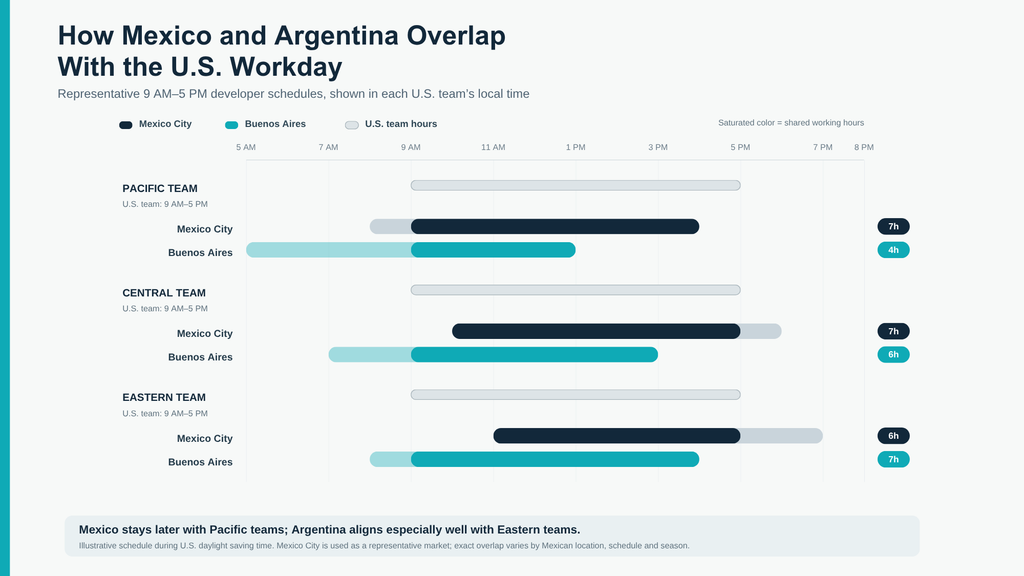
Mexico offers better time-zone alignment overall, especially for companies on the U.S. West Coast. For Eastern and Central teams, Argentina still provides plenty of workday overlap.
Argentina operates on UTC-3 year-round, with no daylight saving time. That generally puts developers one to two hours ahead of New York, two to three hours ahead of Chicago and four to five hours ahead of Los Angeles, depending on U.S. daylight saving time.
Mexico spans multiple time zones that align closely with the U.S. Mexico eliminated seasonal clock changes across most of the country, while specified areas along the northern border continue to follow a seasonal schedule.
In practice, an Argentine developer can still join U.S. standups, planning sessions and code reviews during the same workday. The difference becomes more important when a Pacific team needs someone available late in its afternoon.
For East Coast teams, we wouldn’t choose Mexico over Argentina because of time zone alone. For West Coast teams that need substantial late-day overlap, Mexico has the clearer advantage.
Which country has better English proficiency for software teams?
Argentina has the stronger English-proficiency signal, both nationally and among EF test takers working in IT.
In the 2025 EF English Proficiency Index, Argentina scored 575 and ranked 26th globally, compared with Mexico at 440 and 103rd.
The gap is smaller among EF test takers working in IT, but Argentina still leads: 589 compared with 559 in Mexico.
We’ve seen that advantage show up in actual hiring. When Plugg built a four-person senior full-stack team in Argentina for a Series A company, the client needed engineers who could participate actively in standups and contribute ideas. The developers Plugg placed stood out for their English fluency and willingness to speak up.
EF’s data comes from people who took its English assessments, so it doesn’t mean every Argentine developer will communicate better than every Mexican developer.
If English communication carries unusual weight in the role, we’d give Argentina an edge. But we’d still assess communication at the candidate level rather than using a country score as a hiring shortcut.
What are the pros, cons and risks of hiring in Argentina vs. Mexico?
Mexico is our stronger default for scaling and U.S. time-zone flexibility. Argentina’s clearest advantage is English proficiency.
| Mexico | Argentina | |
| Pros | More Plugg hiring history; stronger evidence of hiring depth; closer alignment across U.S. time zones | Stronger English-proficiency data; established software industry; Plugg experience building senior engineering teams |
| Cons | Weaker national English-proficiency results; a larger documented market doesn’t guarantee the right specialist | Higher average bill rate in Plugg’s historical data; less convenient overlap for some Pacific teams; smaller Plugg hiring sample |
| Risks | Assuming a deeper market means every role will be easier or cheaper to fill | Assuming strong national English results guarantee candidate-level communication or that Argentina will be cheaper |
These differences can help determine where to concentrate a search. They don’t replace evaluating the individual candidate.
When should you choose Argentina or Mexico?
Choose Mexico when you’re making several hires, expect the team to grow or need close alignment across U.S. time zones. Plugg has substantially more hiring experience there, and it’s our stronger default for building a larger nearshore team.
Choose Argentina when English communication is especially important or when the market produces the stronger candidate for a specific role. We’ve successfully built senior engineering teams there, including developers hired specifically for their ability to contribute ideas and integrate closely with U.S. teams.
Don’t choose Argentina because you assume it will be cheaper. Plugg’s historical average bill rate has actually been slightly higher there.
If you’re building a team, we’d start with Mexico. If you’re filling a specific role, we’d search both and let the candidate pool challenge that assumption.
What are the alternatives to choosing Argentina or Mexico first?
You don’t necessarily need to choose a country before you start recruiting.
If you don’t have a business reason to concentrate hiring in one market, define the hiring bar first and search both.
For one Series B company with a highly specific technical stack, Plugg already knew senior developers in both Argentina and Mexico who matched the requirements. We introduced candidates within two days, and the company hired two engineers.
If neither market produces the right candidate, expand the search across LATAM rather than lowering the hiring bar to stay within one country.
Geography can narrow the search without becoming the hiring bar.
What mistakes should you avoid when choosing between Argentina and Mexico?
The biggest mistake is deciding which country to hire from before defining what the engineer needs to accomplish.
Start with the role, seniority, technical requirements, communication expectations, working hours and budget. Then use country-level data to decide where to search.
Don’t optimize for the lowest hourly rate. Mexico’s historical average is lower, but rate alone doesn’t determine whether someone is the better hire.
And don’t treat country-level advantages as candidate-level guarantees. Argentina’s stronger English scores don’t mean every Argentine developer will communicate better. Mexico’s deeper Plugg hiring history doesn’t mean the best candidate for your role will be there.
Why hire developers in Argentina or Mexico through Plugg?
Plugg’s leadership also brings firsthand experience in both markets. Before founding Plugg, Brian Samson owned a FinTech based in Argentina, where he scaled a team to 85 people in Buenos Aires. Plugg President Ruben Santana spent more than two years in Monterrey, where he built and led a team of more than 25 technology recruiters serving U.S. companies.
That experience means we don’t need to force every search into the same country.
We start with your technical requirements, seniority, budget, communication expectations and working hours, then recruit where the strongest candidates are.
Plugg has made 500+ successful placements across Latin America. We deliver a vetted, interview-ready shortlist in an average of three days, with the first hire onboarded in 14 days or less, from kickoff call to day one.
We also handle interview coordination, payroll, compliance and hardware, with ongoing support after the developer joins your team.
If Mexico produces the stronger candidates, we’ll tell you. If the right developer is in Argentina, we’ll tell you that too. The goal is to find the strongest engineer for the role, not steer you toward a predetermined country.
Frequently asked questions
Is Argentina or Mexico better for hiring software developers?
For most U.S. companies making multiple hires, we’d start with Mexico. Mexico gives us stronger evidence of hiring depth and flexible U.S. time-zone alignment.
Argentina is a strong alternative, particularly when English communication is a priority or when you’re hiring for a specific role rather than building a larger team.
Is it cheaper to hire software developers in Argentina or Mexico?
Mexico has been less expensive in Plugg’s historical data, but we wouldn’t choose between the two countries based on that difference alone.
Across Plugg’s 2021–2026 rate history, hundreds of contractor starts in Mexico averaged over $30 per hour billed, compared with over $35 per hour across dozens of starts in Argentina.
Actual rates vary by role, seniority and technical requirements.
Does Argentina have an advantage over Mexico for English proficiency?
Yes. Argentina has the stronger English-proficiency signal in the available data.
In the 2025 EF English Proficiency Index, Argentina scored 575 compared with Mexico’s 440. Among EF test takers working in IT, Argentina scored 589 compared with 559 in Mexico.
We’d still evaluate communication during interviews rather than assume proficiency based on nationality.
Is Argentina in a good time zone for U.S. software teams?
Yes, particularly for Eastern and Central teams. Argentina operates on UTC-3 year-round, providing substantial overlap with the U.S. workday.
For Pacific teams that need developers available late in the U.S. afternoon, Mexico generally offers better alignment.
Can I recruit software developers in both Argentina and Mexico?
Yes, and in many cases that’s what we’d recommend. If you don’t have a business reason to restrict the search to one country, define the role first and compare qualified candidates from both markets.
For difficult or specialized roles, expand the search across LATAM rather than lowering your hiring bar to stay within one country.
How quickly can Plugg find developers in Argentina or Mexico?
Plugg delivers a vetted, interview-ready shortlist in an average of three days. Our first hires are typically onboarded in 14 days or less, from kickoff call to day one.
Timing for an individual role can vary based on the technical requirements, seniority and hiring process.
Argentina vs. Mexico: Where should you hire software developers?
If you have to prioritize one market, we’d start with Mexico. It’s our stronger default for companies making multiple hires, building a larger engineering team or needing close alignment across U.S. time zones.
But we wouldn’t exclude Argentina.
It has the stronger English-proficiency signal, and Plugg has successfully built senior engineering teams there for U.S. companies.
If you’re hiring for a specific role rather than choosing a long-term hiring market, there’s an even simpler answer: search both and hire the strongest candidate.
Mexico is our stronger default. Argentina is a market we’d be reluctant to exclude.
Tell us what you’re hiring for, and Plugg can show you qualified candidates and real rates from Argentina, Mexico and the broader LATAM market.