
Search for the cost of hiring a backend developer in Latin America and you’ll find numbers all over the map.
One source might suggest you can hire an experienced developer for $3,000 a month. Another puts senior or specialized talent above $8,000.
So how can both numbers be right?
Based on Plugg’s current pricing data, a mid-level Java developer typically costs around $2,000 to $4,000 per month, while a senior Java developer costs approximately $4,000 to $6,000 per month. We use Java here as a benchmark because Plugg has strong current pricing data for Java backend roles. Pricing is subject to change based on labor supply and demand for a specific technology.
“Backend developer” covers an enormous range of work. Someone building APIs for an established application isn’t the same hire as an engineer designing distributed systems, managing cloud infrastructure, or making architecture decisions that will shape a product for years.
Geography adds another variable.
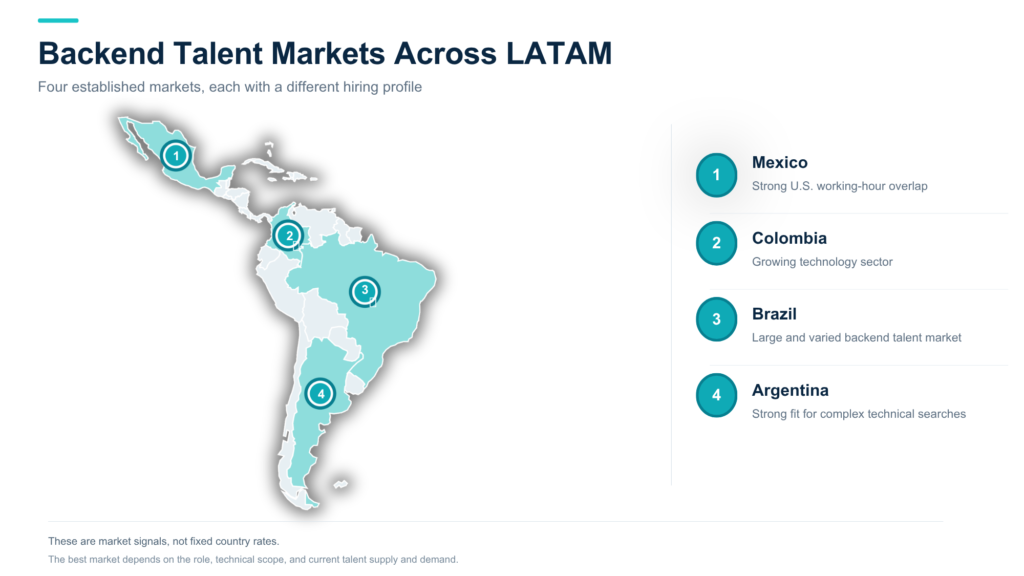
Mexico, Brazil, Colombia, and Argentina all have established technical talent markets, but the available skills, depth of talent, competition, and typical compensation aren’t identical.
So rather than looking for one LATAM-wide salary number, it makes more sense to look at what you’re actually hiring for, where you’re hiring, and what pushes a backend role toward the top or bottom of the market.
What exactly are you hiring when you hire a backend developer?
Backend developers build and maintain the systems working behind an application’s interface. That can include server-side logic, APIs, databases, integrations, authentication, security, and application performance.
The scope of that work can vary considerably.
One backend developer might spend most of their time building APIs, managing database functionality, and integrating third-party services. Another might be responsible for distributed systems, cloud architecture, high-volume transactions, deployment infrastructure, or decisions that affect an entire platform.
As the scope and technical ownership increase, so does the level of developer you need.
So, what does a backend developer cost in LATAM?
The $2,000 to $4,000 monthly range for mid-level Java developers and $4,000 to $6,000 for senior Java developers gives companies a useful starting point. But the technology, seniority, and scope of the role can move a backend hire above or below those benchmarks.
More specialized technical talent can cost considerably more. In Plugg’s LATAM tech talent salary discussion from the Nearshore Cafe Podcast, founder Brian Samson puts senior AI engineers, data engineers, and data scientists in Brazil at roughly $7,000 to $9,000 per month.
The hiring market matters too. Based on Plugg’s experience, Mexico tends to sit around the middle of the regional pricing spectrum, while Brazil and Argentina can run higher for technical talent and Colombia somewhat lower.
These aren’t fixed country rates. Current labor supply and demand for a particular technology, along with the experience and technical ownership required, can change what you’ll ultimately pay.
Why can two backend developers cost so differently?
The technical requirements behind the title can change the market considerably.
Seniority and ownership
A mid-level developer who can independently build features and APIs has a different hiring profile from a senior engineer expected to make architecture decisions, mentor other developers, or take ownership of critical systems.
If your existing team already has strong technical leadership, you may not need senior-level experience in every backend hire. If the person is expected to operate autonomously or lead technical decisions, you’ll need to budget for a different level of talent.
Architecture and scale
Building standard APIs is one thing. Designing systems that need to handle large transaction volumes, multiple services, complex integrations, or rapid growth requires a different level of experience.
Roles involving distributed systems, microservices, high-volume transactions, or platform-wide architecture decisions are more likely to require senior developers with experience solving those problems at scale.
Cloud and infrastructure experience
Backend responsibilities can also overlap with cloud and infrastructure work. Experience with AWS, Azure, GCP, CI/CD, containers, observability, and infrastructure automation can broaden the role considerably.
If you expect a backend developer to own deployment pipelines or cloud infrastructure in addition to application development, that needs to be reflected in both the job description and the budget.
Data, AI, and other specialized skills
Specialization can push costs higher aga8in.
The smaller the talent pool and the more specialized the technical requirements, the more likely the role is to move beyond standard backend benchmarks. That is particularly relevant when backend responsibilities begin to overlap with areas such as data engineering or AI.
That doesn’t mean adding one specialized skill automatically pushes a developer into a higher salary bracket. But it can change both the available talent pool and the budget required to compete for it.
How do backend talent pools differ across LATAM markets?
Salary isn’t the only difference between LATAM markets. The available technologies, depth of the talent pool, and competition for specialized skills also vary.
Mexico sits around the middle of the region’s pricing spectrum based on Plugg’s experience hiring across LATAM. For companies in the U.S., it also offers significant working-hour overlap, which can be useful for backend roles that require close collaboration with product, engineering, or infrastructure teams.
Brazil has a large and varied backend developer market. The 2026 Código Fonte survey includes 4,920 professionals working in backend development. Java was the most commonly reported language among those respondents, followed by C#, Python, TypeScript, PHP, JavaScript, and Go. Spring Boot and .NET were the two most commonly reported frameworks and tools. Brian also points to Brazil as a market worth considering for more difficult technical searches, including senior data engineering.
Colombia has a substantial and growing technology sector. According to Invest in Bogotá’s 2025 IT talent report, Bogotá Region attracted 60% of the new and expansion foreign direct investment projects in software and IT that entered Colombia over the previous six years. A separate 2025–2030 study from Colombia’s Ministry of Information and Communications Technologies and FEDESOFT identifies growing demand for skills including Big Data and analytics, AI, cloud computing, cybersecurity, DevOps, and full-stack development.
Argentina tends to sit toward the higher end of LATAM technical hiring costs in Plugg’s experience. But on the Nearshore Cafe Podcast, Brian also recommends Argentina for complex technical searches where problem-solving and overall return on investment matter more than simply finding the lowest salary.
The best market depends on the backend developer you’re trying to hire. A general Java search and a senior cloud or data engineering search may lead you toward different talent pools, even within the same region.
What should you budget for a backend developer in LATAM?
Start with the scope of the role.
For a mid-level Java developer, Plugg’s experience suggests roughly $2,000 to $4,000 per month as a useful benchmark. For a senior Java developer, that moves to around $4,000 to $6,000. Highly specialized technical talent can move beyond those ranges, with some senior AI and data roles reaching $7,000 to $9,000 per month.
From there, consider what you’re actually asking the developer to own. Architecture experience, cloud expertise, scale, leadership responsibilities, specialized technologies, English proficiency, and the country you’re recruiting in can all affect the final cost.
A precise job description will give you a much better salary benchmark than “backend developer” alone.
Plugg recruits backend, full-stack, and specialized technical talent across Latin America. See how Plugg approaches technical hiring.