Short Answer: For software engineering, we’d start in Costa Rica. Nicaragua is particularly compelling for non-technical roles such as virtual assistants, call-center teams and operations.
Costa Rica has the more mature technology ecosystem, with validation from other technology companies that have built engineering teams there. Nicaragua offers greater cost-arbitrage potential, but Plugg’s strongest experience there has been outside software engineering.
This comparison is for U.S. founders, CTOs and engineering leaders deciding whether Nicaragua or Costa Rica is the better place to search for nearshore software talent.
Both countries offer Central American proximity and substantial U.S. workday overlap. But they are not interchangeable hiring markets.
Costa Rica has the stronger documented technology ecosystem and international-services footprint. Nicaragua may be more attractive from a cost perspective, but there is less public evidence about the depth of its software-engineering market.
The practical decision is whether you need a deeper technical market or whether economics carry more weight in the search.
Factor | Costa Rica | Nicaragua |
Starting point | Stronger evidence for software-engineering searches | Worth considering when cost is a major priority |
Technology ecosystem | More established and export-oriented | Smaller and less documented |
Specialized technical talent | Better documented ecosystem | Less documented software-engineering depth |
Cost | No verified Plugg developer comparison | Potential cost advantage, but no verified developer rate comparison |
English | Stronger EF result among IT test takers | Lower IT-specific EF result |
U.S. collaboration | Strong overlap | Strong overlap |
Best fit | Specialized engineering and companies prioritizing talent depth | Cost-sensitive searches where the required talent is available |
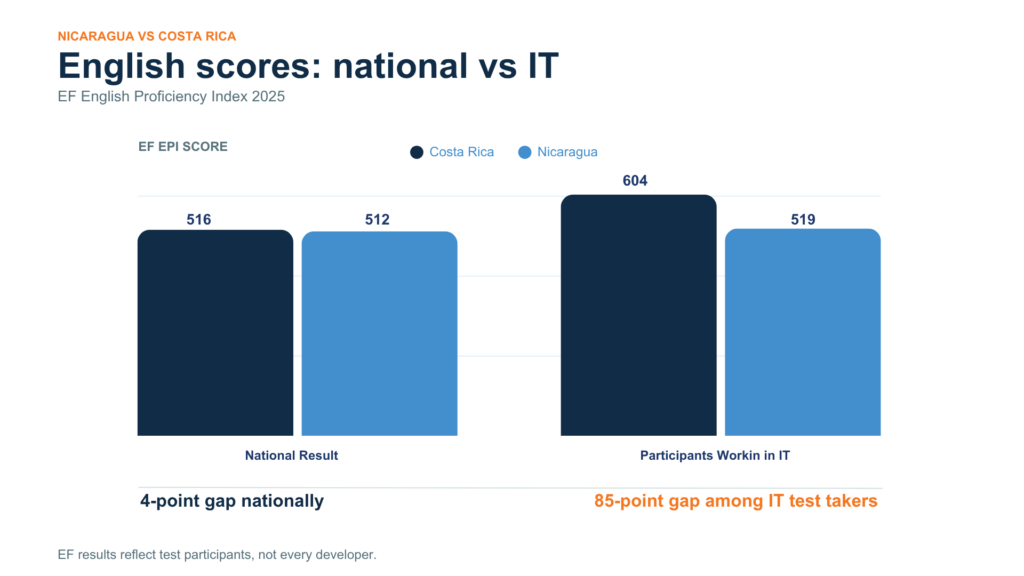
The English data is particularly interesting. At the national level, the two countries look similar. In the 2025 EF English Proficiency Index, Costa Rica scored 516 and Nicaragua 512. Among EF test takers working in IT, however, Costa Rica scored 604, compared with 519 in Nicaragua.
EF’s results reflect people who took its English tests rather than the entire technology workforce, so we wouldn’t treat those scores as representative of every developer.
We’d still assess communication at the candidate level rather than hire based on a country score.
Nicaragua may offer a cost advantage, but we don’t currently have enough verified Plugg software-engineering data to publish a defensible country-to-country rate range.
That’s an important limitation.
Costa Rica has a more mature technology and international-services sector, which can put greater competition around experienced technical talent.
Plugg does have firsthand operating evidence that Nicaragua can offer attractive economics. In one engagement, a Midwest FinTech company replaced a high-cost, high-attrition Missouri call-center operation with a six-person team in Managua and achieved roughly 50% monthly cost savings.
Read Plugg’s Nicaragua FinTech case study
That was a BPO engagement, not a software-development placement.
We would not turn a 50% BPO saving into a software-developer rate claim.
Until Plugg has verified developer benchmarks for both countries, we’d compare actual qualified candidates rather than choose Nicaragua based on an assumed country discount.
Costa Rica has strong evidence of an established, internationally oriented ICT sector.
A 2025 PROCOMER study of 86 Costa Rican ICT companies found:
The United States was the leading export market for the companies surveyed.
PROCOMER: Costa Rica ICT Sector 2025
For a U.S. company hiring software engineers, those numbers give us much more direct evidence of an established software and international-services ecosystem.
Plugg has also heard firsthand how that ecosystem can support significant team growth. On the Nearshore Cafe Podcast, IT staffing entrepreneur Doug Firestone described evaluating several Latin American markets based on English, technology capabilities, education and cost before choosing Costa Rica. His operation ultimately grew from 10 people to 225 at its peak and included technical teams supporting major U.S. clients. Firestone credited Costa Rica’s “quality people, great education, great English and also great infrastructure.”
The United States is the leading export market for Costa Rica’s ICT companies.
That doesn’t mean every Costa Rican developer has worked on a U.S. engineering team. It does show that the country’s technology sector has significant exposure to international clients.
The PROCOMER study found that 92% of surveyed ICT companies reported English proficiency among employees.
EF provides another useful data point. Among its 2025 test takers working in IT, Costa Rica scored 604, compared with 519 in Nicaragua.
For U.S. engineering teams, communication matters because developers may need to participate in standups, architecture discussions, code reviews and product conversations rather than simply read technical documentation.
Costa Rica also hosts more than 350 multinational companies across more than 18 specialized areas, exporting services to more than 45 countries.
PROCOMER specifically identifies capabilities including custom software development, engineering-team scaling, AI, advanced analytics and cloud migration.
PROCOMER: Costa Rica technology ecosystem
If the role requires deeper technical experience, Costa Rica is the more evidence-supported starting point.
Costa Rica’s more mature technology market is an advantage, but established talent markets are not always the least expensive.
We don’t currently have enough verified Plugg developer-rate data to quantify the difference between these two countries.
If the role doesn’t require unusual specialization, paying for access to a deeper ecosystem may not create enough additional value.
Even Costa Rica’s ICT sector reports constraints around specialized talent.
PROCOMER’s 2025 research identifies access to specialized talent as one of the challenges facing technology companies seeking to expand internationally.
So Costa Rica’s mature technology reputation shouldn’t be interpreted as meaning every difficult role will be easy to fill.
Nicaragua’s strongest opportunity may be outside highly specialized technical hiring. Plugg has seen the market work particularly well for virtual assistants, call-center teams and operations roles, where the country’s lower costs can create significant arbitrage opportunities.
In its FinTech engagement, Plugg built and equipped a six-person team and reported approximately 50% monthly cost savings compared with the client’s previous Missouri operation.
Again, that is operating evidence, not a software-developer rate benchmark.
Nicaragua shouldn’t be treated as a market with no technical economy.
World Bank data shows the country exported approximately $280 million in ICT services in 2023, equal to roughly 18% of total service exports.
World Bank/WITS: Nicaragua trade profile
That category includes telecommunications, computer and information services, so it tells us that ICT services are economically meaningful without telling us how many software developers are available for a particular search.
Nicaragua scored 512 nationally on the 2025 EF English Proficiency Index. Among EF test takers working in IT, the country scored 519.
Those results trail Costa Rica’s IT-specific score, but they don’t tell the whole story. Nicaragua also has an established BPO workforce with experience communicating directly with U.S. companies.
Anna Rodriguez, a Nicaragua-based operations professional working with a Plugg client, described that experience on the Nearshore Cafe Podcast:
“We have a lot of talented people in Nicaragua with strong English skills. Many also have BPO experience, so they understand the U.S. business mindset and how to work effectively with U.S. teams.” Editor’s note: This quote has been lightly edited for clarity and readability.
That experience isn’t specific to software engineering, but it does reinforce why country-level English scores shouldn’t determine the search. Evaluate actual communication during the interview.
Plugg’s Nicaragua experience is not limited to looking at market statistics.
On the Nearshore Cafe Podcast, CourtMoney CEO Joe Helleny discusses the company’s successful Nicaragua operation and says the experience led it to explore Latin American talent for software development as well.
Nearshore Cafe Podcast: Building a 24/7 Nearshore Call Center in Central America
That doesn’t prove Nicaragua has a deep developer market. It does show that a successful operating experience there increased one client’s confidence in using LATAM for additional technical functions.
This is the biggest trade-off.
Costa Rica has much stronger public evidence around custom software, technology exports and multinational technical services.
Nicaragua has ICT-sector activity, but we don’t currently have comparable developer-specific data showing the same depth of software-engineering talent.
That doesn’t mean a strong developer can’t be found there.
It means a narrower or less documented market gives the hiring team less certainty when the requirements become highly specific.
The biggest risk is choosing the country before defining the hire.
If you choose Nicaragua solely because you expect lower rates, you may discover that the available candidate pool doesn’t contain enough people with the seniority or stack you need.
If you automatically choose Costa Rica because it has the stronger technology reputation, you may pay more when a qualified candidate exists elsewhere.
There’s also a risk in treating country-level statistics as candidate characteristics.
An English score doesn’t tell you how well a particular engineer communicates. ICT exports don’t tell you whether someone can architect your application. A country’s reputation doesn’t establish the quality of a specific candidate.
Country data should help determine where to search first. Candidate quality should determine whom you hire.
You don’t have to force the search to remain in Central America.
If Costa Rica and Nicaragua aren’t producing the right candidates, expand the geography.
Plugg recruits across Latin America, and different countries can be stronger for different technical roles and budget levels.
That flexibility matters because the best market for one role may not be the best market for another.
Start with the countries most likely to fit the role, but don’t let the original geography become more important than the hiring bar.
Choosing Nicaragua purely because it looks cheaper. A lower rate doesn’t create value if the required talent isn’t available.
Assuming Costa Rica is automatically the right choice. A deeper technology ecosystem doesn’t mean every role needs to be hired there.
Treating national English scores as hiring decisions. Evaluate communication during the interview.
Searching only one country. Expand the geography if the candidate pool isn’t producing what you need.
Comparing generic country averages instead of equivalent candidates. A senior engineer in a lower-cost country can still cost more than a less experienced developer in a more expensive market.
Based on the available market evidence, we’d start with Costa Rica for most specialized software-engineering searches.
Costa Rica has the deeper documented technology ecosystem, including substantial custom-software and international-services activity.
Nicaragua becomes more interesting when cost is a major priority and qualified candidates are available.
Nicaragua may be more cost-competitive, but we don’t yet have enough verified Plugg software-engineering data to publish a defensible rate comparison.
That’s one of the points we’d have Brian validate before publication.
Costa Rica has the stronger technology-specific evidence.
National EF scores are close: Costa Rica scored 516 and Nicaragua 512 in 2025. But among EF test takers working in IT, Costa Rica scored 604, compared with 519 in Nicaragua.
Those results aren’t representative of every developer, so we’d still evaluate English and communication during the interview.
Costa Rica has the stronger documented technology ecosystem.
PROCOMER’s current research shows substantial custom-software activity, technology exports, English capability and an established multinational-services sector.
Nicaragua has a meaningful ICT-services economy, but public software-engineering data is much thinner.
Yes, although the published example is not software engineering.
Plugg built a six-person call-center operation in Managua for a Midwest FinTech company, including recruiting, hardware and setup. The engagement produced roughly 50% monthly cost savings compared with the client’s previous Missouri operation.
Because that was a BPO engagement, we wouldn’t use its savings figure as a software-developer benchmark.
Usually not.
Start with the markets that best fit the role, but expand across LATAM if the candidate pool isn’t producing the technical skills, seniority or economics you need.
Plugg’s advantage isn’t simply knowing which country has the lowest headline cost. It’s knowing when the search should stay in a market and when it should move.
Costa Rica has the stronger documented technology ecosystem of these two countries.
Nicaragua is a market where Plugg has direct operating experience. For its FinTech client, Plugg didn’t simply recruit six people in Managua. It sourced hardware, configured the environment, tested it against the client’s requirements and onboarded the team.
Plugg also has visibility across Latin America rather than being tied to one country. If a particular role calls for a deeper or more specialized candidate pool, the search can move.
The comparison should help decide where to search first, not predetermine where the hire has to come from.
For software engineering, we’d start the search in Costa Rica. For non-technical roles, particularly virtual assistants, call-center teams and operations, Nicaragua becomes much more compelling, especially when cost is a major consideration.