Short answer: Plugg averages about three days to put vetted LATAM developers in front of clients and 14 days or less from kickoff to day one.
Some roles take longer. A senior developer with a common stack is a very different search from a specialized DevOps, AI or data engineering hire. Budget, geography and the client’s interview process can also add time.
Our recommendation: plan on about two weeks for a well-defined software engineering role. For specialized hires, give the search more time rather than lowering the bar.
See Plugg’s current hiring benchmarks
This guide is for U.S. founders, CTOs and engineering leaders who need to know how quickly they can realistically add software developers in Latin America.
Maybe a roadmap is slipping because you’re short an engineer. Maybe funding has created pressure to build the team quickly. Or perhaps you’ve spent months trying to fill a U.S. role and want to know whether expanding the search to LATAM will actually make hiring faster.
For a typical Plugg search, think about the process in two stages:
Stage | Plugg benchmark |
Vetted, interview-ready shortlist | 3 days on average |
Kickoff to first hire’s day one | 14 days or less |
These are Plugg’s current operating benchmarks, not estimates pulled from a general recruiting survey.
The process includes defining the role, sourcing and vetting candidates, client interviews, candidate selection, the offer and onboarding.
Once the shortlist arrives, the client’s interview process becomes one of the biggest variables in the remaining timeline.
If the hiring team can interview candidates quickly and make decisions without unnecessary rounds, a fast recruiting pipeline can stay fast. If candidates wait a week between interviews, the recruiting market isn’t necessarily the bottleneck.
Sometimes.
When Cloud Cath needed a senior DevOps engineer for a complex medical technology product, Plugg introduced the company to Juan, a senior engineer from Argentina, within four days of the need. Cloud Cath CTO Eric Yu later described him as a key member of the team.
Read the Cloud Cath DevOps case study
That’s one placement, not a promise that every specialized search will produce a candidate in four days. But it shows that a niche technical requirement doesn’t automatically mean months of recruiting.
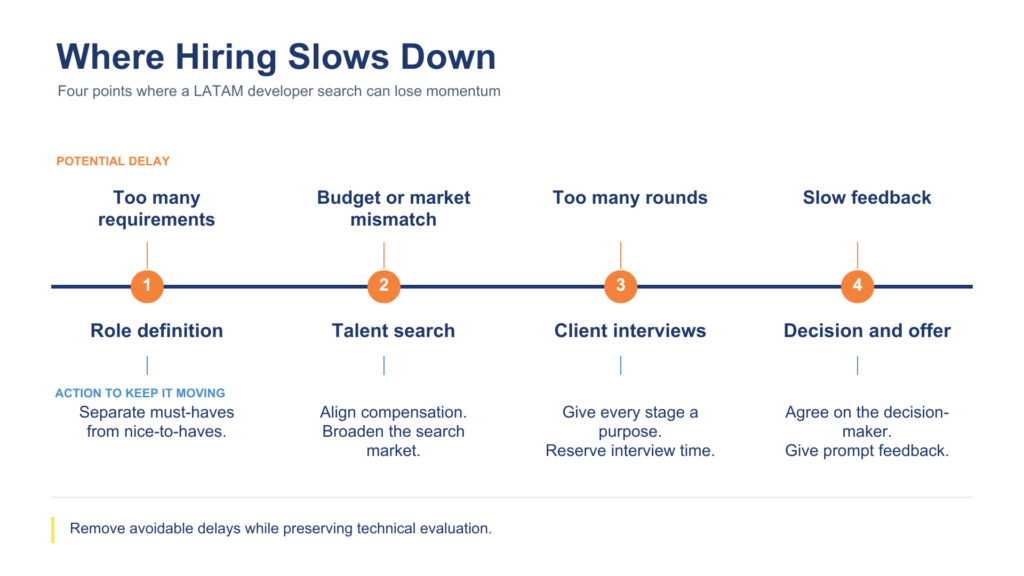
Yes. A search can take longer when the budget doesn’t match the seniority and specialization you’re asking for.
Hiring in two weeks doesn’t require paying a “speed premium.” But it does require a realistic budget for the role.
A search can also take longer when too many requirements are combined into one position. Plugg addresses these variables at kickoff by providing market-rate guidance by role and seniority.
See Plugg’s software engineering hiring process
It’s much easier to hire quickly when the candidate you’re looking for exists at the rate you’re prepared to pay.
Plugg averages about three days to deliver a vetted, interview-ready shortlist.
That doesn’t mean hiring someone in three days. It means getting qualified candidates into your interview process without spending the first several weeks sourcing them.
Speed shouldn’t come from throwing more resumes at the hiring manager. The useful benchmark is how quickly qualified candidates reach the interview stage.
A fast recruiting process can also make it easier to build beyond the first developer.
The initial search establishes the hiring bar, interview process and compensation expectations. Those decisions can then carry into subsequent roles rather than starting from scratch every time.
A fast recruiting pipeline creates little value if nobody has time to interview the candidates.
Before kickoff, decide who needs to participate, what each interview evaluates and who makes the final hiring decision.
A general full-stack search offers a different candidate pool from a role requiring an uncommon combination of technologies, industry experience and seniority.
For roles with particularly limited talent supply, Plugg says the search can take up to 30 days, although these cases are rare.
The standard timeline shouldn’t become an artificial deadline for a niche role.
Strong candidates may be considering more than one opportunity.
Plugg currently reports a 93% offer-to-acceptance rate and works to align candidate expectations before an offer is extended.
See Plugg’s current hiring metrics
The client still needs to provide feedback and make decisions while candidates are engaged in the process.
A search gets harder when one person is expected to cover too much.
If you’re looking for someone who is simultaneously an expert in front-end development, backend architecture, cloud infrastructure, AI and team leadership, the problem may be the role rather than the talent market.
Separate must-haves from nice-to-haves before recruiting begins.
Some talent pools are narrower than others.
The more specific the required combination of technologies, domain expertise and seniority, the fewer qualified candidates a recruiter has to work with.
For niche roles, allow more time rather than weakening the requirements that actually matter.
If you want senior-level ownership at a mid-level budget, recruiting can stall.
That doesn’t necessarily mean LATAM is too expensive. It means the compensation and candidate profile need to match.
Not every technical talent pool is equally deep in every LATAM country.
If a well-defined search isn’t producing candidates, we’d reconsider the geography before reconsidering the hiring bar. An AI engineer, for example, may be much harder to find if the search is limited to Belize rather than a larger talent market such as Brazil. Plugg uses its recruiting experience across Latin America to advise clients on which countries and cities are likely to offer the strongest talent supply for a particular role and scaling plan.
One San Francisco SaaS startup needed a senior React Native developer but struggled to compete for the talent it wanted within its budget. Plugg widened the geographic search and ultimately found the developer in Bolivia. He remained with the company for more than three years.
Don’t keep a difficult search confined to one country simply because that’s where you originally planned to hire.
Read the Bolivia React Native case study
A three-day shortlist doesn’t help much if the company’s interview process takes three weeks.
Know what each stage is evaluating and remove interviews that don’t contribute meaningfully to the decision.
Candidates don’t necessarily stop interviewing elsewhere because one company is interested.
If someone performs well, decide what happens next quickly.
The biggest risk is confusing fast recruiting with rushed hiring.
They aren’t the same thing.
A recruiting partner can compress sourcing, screening, scheduling and onboarding. The company still needs enough technical vetting to determine whether the developer can actually do the job.
Hiring based on immediate availability rather than fit can undermine the reason for speeding up the search in the first place.
There’s also a risk in treating Plugg’s 14-day benchmark as a universal deadline. A specialized infrastructure engineer, AI/ML engineer or highly specific technical lead may require a different search.
Treat 14 days as a planning benchmark, not a reason to hire the wrong person.
If you literally need engineering capacity tomorrow, traditional project outsourcing or an existing consultant may be faster than recruiting someone into your team.
That can make sense when the immediate priority is getting work delivered rather than adding another contributor to your engineering organization.
But if the goal is to add someone to your team, we’d generally avoid changing the hiring model just to save a few days.
Two weeks spent finding the right developer can be a better trade than months managing the wrong one.
The biggest delays are usually avoidable:
Plugg currently averages about three days to deliver a vetted, interview-ready shortlist and 14 days or less from kickoff to the first hire’s day one.
For roles with particularly limited talent supply, the search can take up to 30 days, although Plugg says those cases are rare. Geography can also affect the timeline if the search is limited to a market with a smaller talent pool for the required skills.
Plugg currently reports an average of about three days to deliver a vetted, interview-ready shortlist.
That means candidates are ready for the client’s interview process. It doesn’t mean a hiring decision has already been made.
Sometimes.
Cloud Cath needed a senior DevOps engineer for a complex medical technology product. Plugg introduced the company to Juan, a senior engineer from Argentina, within four days of the need.
That’s a specific placement rather than a guarantee that every specialized search will move that quickly.
Not necessarily. Multiple searches can run at the same time.
When a technology solutions company needed to shift engineering capacity away from Eastern Europe during the war in Ukraine, Plugg made 20 engineering hires in Mexico within three months. Within six months, it had made more than 40 senior engineering hires.
Read the engineering team transition case study
That’s a different hiring problem from filling one developer seat, but it shows how the process can scale beyond an individual search.
At minimum, define:
The clearer those decisions are at kickoff, the easier it is to keep the process moving once candidates arrive.
No.
Faster sourcing is useful. Faster scheduling and decision-making are useful. Lowering the hiring bar to hit an arbitrary deadline isn’t.
The objective is to remove unnecessary delays while preserving the vetting required to make a good hire.
Plugg currently averages three days to deliver a vetted, interview-ready shortlist and 14 days or less from kickoff to the first hire’s day one, with a 93% offer-to-acceptance rate.
But speed starts before sourcing. Plugg works with clients to define the role, set a realistic budget and hiring bar, identify the right LATAM markets and keep candidates moving through the interview process.
Plugg can also handle operational steps around the hire, including onboarding, payroll, compliance support and hardware.
Learn how Plugg hires nearshore software engineers
Our recommendation: come to kickoff with a clear role, realistic budget and decision-ready interview process. Plugg can compress the recruiting timeline. The client still needs to be ready to hire.