
Short answer: Argentina isn’t the cheapest LATAM market to hire software developers, but it can be one of the strongest choices when technical experience, communication and independent ownership matter.
Historical hiring data from Plugg and its president, Brian Samson, puts Argentina contractor rates at more than USD 35 per hour billed. For a four-person engineering team with a mix of seniority levels, budget approximately USD 22,000 per month.
Argentina is particularly attractive for Cloud/DevOps, AI/ML and React talent. Brian previously built a team of more than 85 developers in Buenos Aires, giving Plugg firsthand insight into the country’s engineering market.
What should you budget for software developers in Argentina?
Seniority, technical requirements and the amount of ownership expected can move the number considerably when you hire developers in Argentina.
Here are three useful Argentina planning benchmarks:
| Benchmark | Argentina data |
| Historical average across dozens of contractor starts | Over $35/hour billed |
| Senior React developer | $40-$44/hour |
| Representative four-person mixed-seniority engineering team | ~$22,000/month |
The representative four-person team works out to a weighted average of approximately $33 per hour and assumes one lead, one senior developer, one mid-level developer and one junior developer.
The sources behind these benchmarks are slightly different. The historical contractor rate data includes both Plugg history and Brian’s earlier Argentina experience. The $40-$44/hour senior React benchmark comes from Brian’s pre-Plugg experience building engineering teams in Argentina. The four-person team is Brian’s representative planning model.
These aren’t fixed Argentina rate cards. An all-senior team would cost more, while a team that can rely on existing U.S.-based technical leadership may cost less.
See Plugg’s guide to building an Agile team in Argentina
Plugg’s broader LATAM benchmarks provide additional context. On the Nearshore Cafe Podcast, Brian estimates mid-level Java developers across LATAM at roughly $2,000 – $4,000 per month, senior Java developers at $4,000 – $6,000 and full-stack developers at roughly $4,000 – $8,000.
But Brian places Argentina toward the higher end of LATAM technical pricing.
Don’t take a generic LATAM developer rate and assume that’s what the engineer you want in Argentina will cost.
Why should you hire developers in Argentina?
Argentina isn’t simply a general-purpose nearshore market. There are specific searches where we’d move it higher on the list when you hire LATAM developers.
Cloud and DevOps
Based on Plugg’s recruiting experience, Brazil and Argentina are the strongest LATAM markets for Cloud/DevOps talent.
For infrastructure roles that require technical depth and close collaboration with a U.S. engineering organization, we’d include Argentina early in the search.
See Plugg’s LATAM DevOps and cloud market analysis
React
Brian has particularly deep experience with React talent in Argentina.
Before Plugg, he co-founded a company where he built a team of more than 85 software developers in Palermo, Buenos Aires, many of them React developers.
Based on that experience, Brian uses approximately $40-$44 per hour for a senior React developer in Argentina as a planning benchmark.
That figure comes from Brian’s pre-Plugg Argentina experience rather than Plugg placement data, but it gives us a useful role-specific reference point for an experienced engineer in this market.
AI and machine learning
Plugg’s recruiting experience also puts Argentina among the stronger LATAM markets for AI/ML talent, behind Brazil but ahead of many other markets.
For a difficult AI or data search, we’d care less about finding the cheapest country and more about starting where the relevant talent is concentrated. That’s when the decision to hire developers in Argentina could make your life much easier.
Match the market to the role rather than forcing every search into the lowest-cost country.
Why would you pay more for an Argentine developer?
Because the lowest hourly rate isn’t necessarily the lowest-cost engineering decision.
Brian’s argument for hiring developers in Argentina isn’t based on cheap labor. It’s based on the value strong engineers can create.
On the Nearshore Cafe Podcast, Brian uses the example of a company paying roughly $120,000 per year for exceptional talent in Argentina instead of $300,000 in San Francisco. If that engineer generates millions of dollars in business value, the Argentina hire can still represent significant arbitrage without optimizing for the cheapest possible developer.
Listen to the Nearshore Cafe Podcast
That’s how we’d think about Argentina: pay less than you might for equivalent U.S. talent, but don’t expect bargain-market rates for the strongest engineers.
When else does Argentina make sense?
You need someone who can own the work
Argentina becomes more compelling as the job moves beyond simply executing tickets.
Plugg has seen this firsthand.
A Series A company that had raised more than $70 million needed senior engineers who could contribute ideas from day one. Plugg built a team of four senior full-stack developers in Argentina who joined daily stand-ups and worked directly in the client’s existing Slack, Zoom and Jira workflows.
The client wasn’t looking for a separate offshore delivery team. It needed engineers who could operate as part of its existing engineering organization.
Read the Argentina full-stack case study
If ownership is part of the job, budget for it.
Communication matters
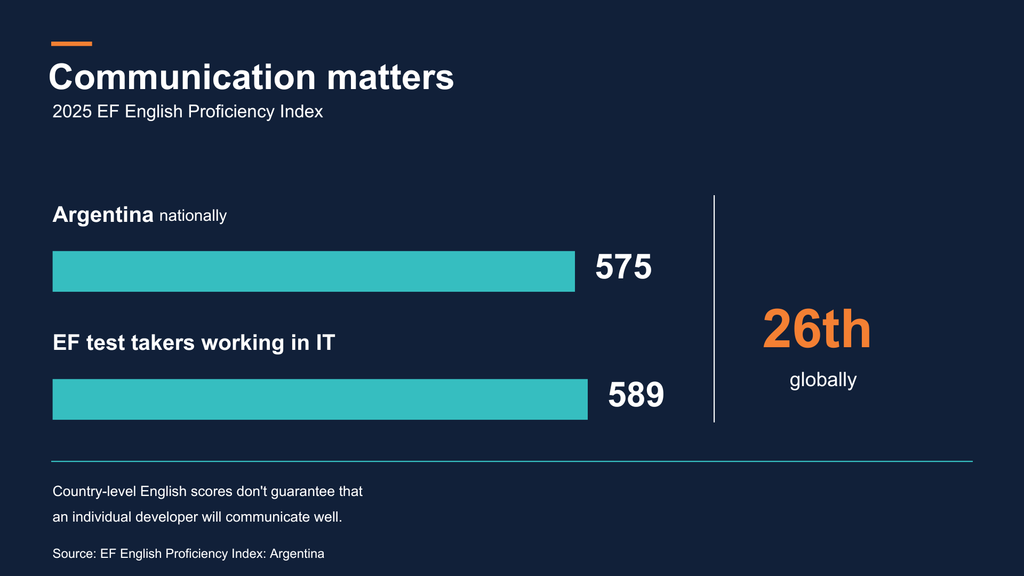
Argentina has one of the stronger English-proficiency signals among the LATAM markets Plugg recruits from.
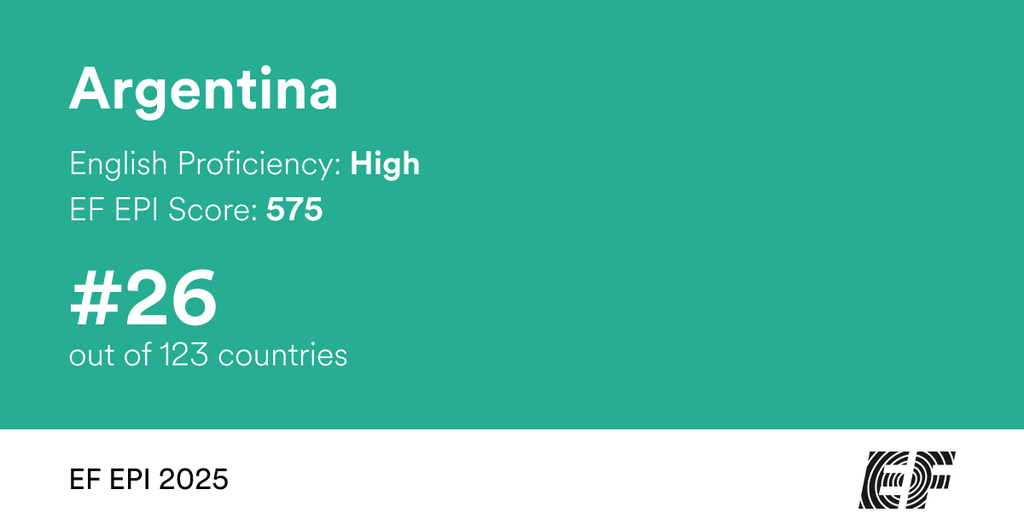
In the 2025 EF English Proficiency Index, Argentina scored 575 nationally and ranked 26th globally. Among EF test takers working in IT, the score was 589.
See Argentina’s EF English Proficiency Index results
Plugg has also seen that advantage in actual hiring. In the four-person senior full-stack team, the developers stood out not only for their English fluency but for their willingness to speak up and contribute ideas.
Country-level English scores don’t guarantee that an individual developer will communicate well. We’d still assess that during interviews.
But if the engineer needs to participate actively in planning, challenge assumptions and communicate directly with U.S. leadership, Argentina belongs high on the shortlist.
Your team needs real-time collaboration
Argentina operates on UTC−3 year-round, without daylight-saving clock changes.
That provides substantial working-hour overlap with U.S. teams, particularly those on Eastern and Central Time.
In Plugg’s experience, time-zone alignment can matter more than squeezing out a lower hourly rate when the role requires frequent collaboration.
For Pacific teams that need developers available late in the U.S. afternoon, other LATAM markets may provide more convenient overlap.
What does an Argentina team actually cost?
Individual developer rates only tell part of the story.
For a CTO building a team, the more useful question may be: What will the group I actually need cost?
Brian’s representative example of a full nearshore development team in Argentina looks like this:
- One lead
- One senior developer
- One mid-level developer
- One junior developer
- Approximately $22,000 per month total
- Approximately $33/hour weighted average
That doesn’t mean every four-person team in Argentina costs $22,000.
The seniority mix matters.
If the team needs four senior engineers capable of working independently, expect the budget to move higher. If U.S.-based technical leadership can support more mid-level talent, the team may cost less.
Define what the team needs to own first. Then decide where you’re paying for seniority.
See Plugg’s guide to building an Agile team in Argentina
Don’t use local Argentine salary averages as your nearshore rate card
Local salary data can be useful for understanding Argentina’s domestic labor market. It’s much less useful for pricing the experienced engineers U.S. companies typically recruit.
Senior Argentine developers with strong English and experience working with U.S. or international companies aren’t necessarily competing only for local jobs.
They’re competing for international opportunities.
That means the compensation required to hire them can look very different from a broad Argentine salary average.
Argentina’s compensation market has its own dynamics, and broad salary averages don’t always reflect what experienced engineers working with U.S. companies expect to earn.
As Argentine technical recruiter Matt Steinberg explained on the Nearshore Cafe Podcast, “Learn your markets, learn your trade, learn what really has been taking place in Argentina.”
For U.S. companies, that means benchmarking against the engineers they’re actually competing to hire, rather than relying on general domestic salary figures.
Listen to Nearshoring in Argentina Under Milei
Benchmark against the talent market you’re actually hiring in, not an Argentina-wide salary average.
What can throw off an Argentina hiring budget?
Assuming LATAM means cheap. Argentina sits toward the higher-cost end of the LATAM markets Plugg works in.
Comparing developers who aren’t equivalent. A developer who executes assigned work and a senior engineer who can make architecture decisions, challenge requirements and work directly with U.S. leadership aren’t cheaper and more expensive versions of the same hire.
Using domestic salaries to budget international talent. Strong English and experience working with international companies can put an Argentine engineer in a different compensation market.
Building an unnecessarily senior team. An all-senior team can become expensive quickly. Put seniority where the team needs technical ownership and use mid-level talent where leadership already exists.
Optimizing for rate instead of output. Saving on the hourly rate doesn’t help if the developer needs substantially more oversight or can’t handle the work.
Forgetting the costs around the hire. Recruiting, vetting, payroll, compliance, equipment, onboarding and ongoing support all contribute to the actual cost of building an international team.
When should you look beyond Argentina?
When Argentina’s strengths aren’t important to the role.
If you’re hiring a relatively common mid-level developer and cost is the dominant consideration, we’d compare candidates across LATAM.
Historical rate data also shows the cost of hiring developers in Argentina is above some other highly competitive LATAM markets.
See Plugg’s Argentina vs. Mexico comparison
But we wouldn’t choose another country based on rate alone.
For Cloud/DevOps, AI/ML, React or senior roles where communication and independent ownership carry more weight, Argentina can justify the higher cost.
Don’t pay more simply to hire in Argentina. Pay more when the role gives you a reason to.
FAQ About hiring developers in Argentina
How much does a software developer in Argentina cost in 2027?
Historical rate data across dozens of Argentina contractor starts averages over $35 per hour billed.
For a more role-specific benchmark, Brian Samson uses approximately 40–44 per hour for senior React developers, based on his pre-Plugg experience building engineering teams in Buenos Aires.
For team planning, Brian estimates approximately $22,000 per month for a representative four-person engineering team consisting of one lead, one senior developer, one mid-level developer and one junior developer.
Actual costs vary with seniority, technical specialization, communication requirements and the amount of ownership attached to the role.
All dollar figures are in USD.
Is Argentina one of the cheapest countries in Latin America for developers?
No.
Plugg generally sees Argentina toward the higher end of LATAM technical pricing.
We’d choose Argentina when the role benefits from the country’s talent strengths, rather than because we’re looking for the lowest possible rate.
What software development roles is Argentina strongest for?
Based on Plugg’s recruiting experience, Argentina is particularly strong for Cloud/DevOps and AI/ML talent.
Brian also has extensive pre-Plugg experience building React teams in Buenos Aires, including a team of more than 85 software developers.
For a general software role where those strengths aren’t important, we’d compare qualified candidates across LATAM.
Does Argentina have good English-speaking software developers?
Argentina has a strong English-proficiency signal.
In the 2025 EF English Proficiency Index, Argentina scored 575 nationally, while EF test takers working in IT scored 589.
See Argentina’s EF English Proficiency Index results
Plugg has also built senior engineering teams in Argentina where English fluency and the ability to contribute actively in U.S. team discussions were important hiring requirements.
Is Argentina in a good time zone for U.S. software teams?
Yes, particularly for Eastern and Central teams.
Argentina operates on UTC−3 year-round, providing substantial overlap with the U.S. workday.
For Pacific teams that need developers available late in their afternoon, other LATAM markets may provide more convenient overlap.
Should I hire in Argentina or search across Latin America?
For a common technical profile where cost is the dominant concern, we’d compare candidates across LATAM.
For Cloud/DevOps, AI/ML, React or a senior role where communication, problem-solving and independent ownership carry more weight, we’d be more likely to include Argentina early.
Does a U.S. company need an Argentine entity to hire a developer there?
No.
U.S. companies can use legitimate contractor arrangements, an Employer of Record or a nearshore staffing partner without establishing their own Argentine entity.
The appropriate model depends on the employment relationship and who will handle payroll, compliance, equipment, onboarding and ongoing administration.
Have an Argentina role you’re trying to price?
Argentina isn’t the market we’d recommend when the brief is simply “find us the cheapest developer.”
But for Cloud/DevOps, AI/ML, React and senior roles where communication and technical ownership matter, the economics can look very different.
Tell us the stack, seniority and what the engineer needs to own. Plugg can benchmark the role against Argentina and the broader LATAM market, then focus the search where the strongest return on your hiring budget sits.
Tell us the role. We’ll show you what it should cost and whether Argentina is where we’d search first.