Short answer: You don’t need to open a company in Latin America just to hire someone there. You can hire through contractors, an Employer of Record (EOR) or a nearshore staffing partner without setting up your own local entity.
So don’t start with the entity. Start with the talent. Once you’ve built a substantial, long-term team in one country, then it may make sense to build the local infrastructure.
Our recommendation: build the team first. Build the entity when the team justifies it.
This guide is for U.S. founders, CTOs and engineering leaders who want to hire developers in Latin America but don’t have a legal entity, meaning their own locally registered company, in the country where they’ve found talent.
You might be hiring your first developer in Argentina, building a small engineering team in Mexico, or searching across several LATAM markets without yet knowing where the best candidates will be.
That last scenario matters. Opening an entity before you’ve determined where the talent is can lock the hiring strategy to one country unnecessarily.
Plugg has seen searches land in different markets depending on the role, budget and candidate pool. Its published engagements include senior teams in Argentina, a difficult React Native search solved in Bolivia and large-scale engineering hiring in Mexico.
Choose the talent market first. Then choose the employment structure that works there.
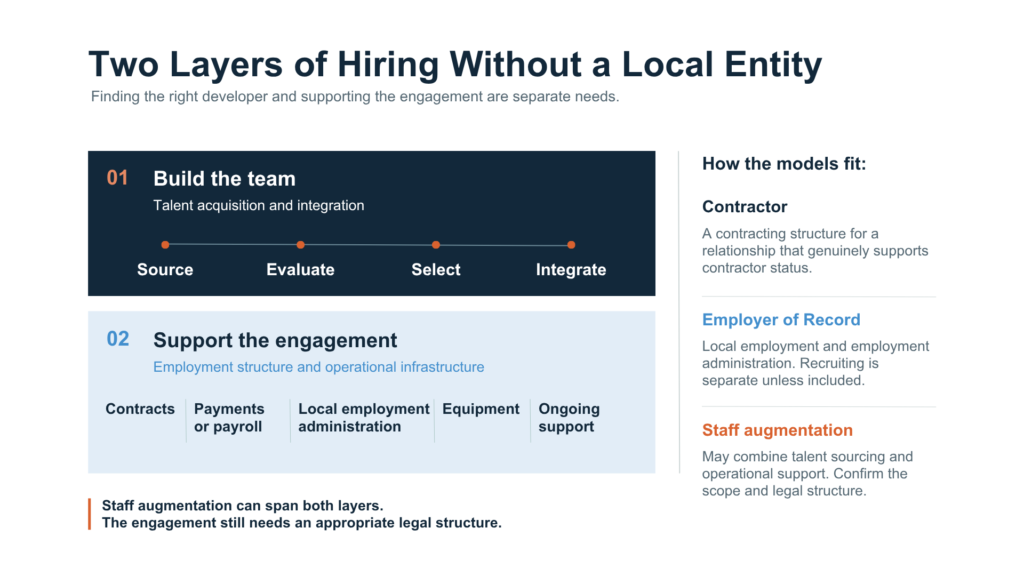
The important distinction is that contractor and EOR describe employment structures, while staff augmentation describes how external talent is added to your team.
Model | Best fit |
Independent contractor | The relationship legitimately supports contractor status |
Employer of Record (EOR) | You’ve found the person and want a third party to legally employ them locally |
Staff augmentation | You need both the talent and the operational infrastructure around the engagement |
A company can potentially contract directly with a LATAM developer without employing that person through a local subsidiary.
This can offer flexibility, but calling someone a contractor doesn’t automatically make the relationship compliant. The appropriate classification depends on local law and how the relationship operates in practice.
Contractor arrangements are therefore best used when the working relationship genuinely supports contractor status, rather than simply because contracting appears easier than employment.
An Employer of Record (EOR) is a third party that legally employs the developer locally on your behalf.
The worker is employed through the EOR while performing work for your company. The EOR typically handles local employment administration such as payroll, employment agreements, statutory contributions and benefits.
This can make sense when you’ve already found the developer you want and want that person employed locally without setting up your own entity.
This model is already common in markets such as Colombia. On the Nearshore Cafe Podcast, Brian Samson and a Colombia-based operator discuss U.S. companies using local employment partners that handle contracts, benefits and social-security obligations so the client doesn’t need to establish its own Colombian entity.
Staff augmentation goes a step beyond employment infrastructure because it can also solve the recruiting problem.
A staffing partner sources and supports the talent and may also provide payroll, contracts, compliance and operational infrastructure around the engagement. The engineer still works within the client’s organization.
Plugg, for example, provides staff augmentation alongside payroll processing, local legal/compliance support, onboarding, hardware procurement and ongoing engagement management. Its current site explicitly states that its payroll processing requires no local entity from the client.
Staff augmentation describes how the talent is added to your team. It doesn’t, by itself, define the worker’s legal classification.
For companies that haven’t yet found the candidates, that distinction matters: staff augmentation can solve both the talent problem and much of the operational infrastructure problem at the same time.
There isn’t one cheapest model. A direct contractor arrangement may have fewer administrative layers, while an EOR or staff augmentation partner charges for infrastructure the client would otherwise need to manage itself.
With a direct contractor, you’re generally negotiating compensation with the individual while taking responsibility for establishing an appropriate contract and payment process.
With an EOR, you’re paying for the developer’s compensation plus the EOR’s employment and administrative services.
With staff augmentation, the rate may cover the developer plus recruiting, payroll, compliance, onboarding, equipment and ongoing support.
Plugg’s current service model bundles much of that infrastructure, including sourcing, hardware, payroll and compliance.
That makes headline-fee comparisons misleading.
A contractor rate, EOR fee and staff augmentation rate aren’t prices for exactly the same thing.
We’d compare the total cost of getting a qualified developer hired, paid, equipped and supported rather than choosing a model solely because one visible fee is lower.
Hiring one developer in a country doesn’t necessarily mean you need a corporate presence there.
Using a third-party structure lets you learn whether the market works for your company before making a larger infrastructure commitment.
That’s particularly useful when you’re recruiting across several LATAM countries rather than building around one predetermined location.
Suppose your company establishes an entity in Mexico and later discovers that the strongest candidates for a specialized role are in Brazil or Argentina.
Your corporate structure can start influencing the recruiting strategy.
Without that constraint, you can define the role first and search the markets most likely to produce the right person.
Plugg has taken that approach in its own recruiting. In one engagement, it recommended Argentina for a company seeking senior full-stack engineers and ultimately built a four-person team there.
In another, a San Francisco SaaS company couldn’t make the economics of its senior React Native search work in more established markets. Plugg widened the search and found the developer in Bolivia, where he remained with the company for more than three years.
A company may eventually hire a data engineer in Brazil, a React developer in Argentina and another specialist elsewhere in LATAM.
Creating a separate entity every time recruiting crosses a border would add substantial operational complexity.
Using partner infrastructure can let the hiring footprint follow the talent instead.
Payroll, contracts, equipment and local compliance aren’t usually the reasons a CTO wants to expand into Latin America.
Plugg’s current model handles payroll processing, local legal/compliance support, onboarding, hardware procurement and ongoing engagement management across the countries where it operates.
That lets engineering leadership stay focused on who to hire and what they’ll work on rather than building cross-border employment infrastructure internally.
Hiring without your own local entity still leaves employment and administrative responsibilities to manage. The question is who handles them.
A direct contractor arrangement gives the company flexibility, but the company still needs an appropriate contract, payment process, IP protections and a relationship that fits the chosen classification.
An EOR handles local employment administration, but you still need to recruit, select, manage and integrate the developer unless you’re using another provider for those functions.
Staff augmentation can combine recruiting and operational support, but you’re paying a partner to provide that infrastructure rather than building it yourself.
And if you eventually build a large, permanent operation in one country, there may come a point where owning the local infrastructure deserves serious consideration.
The relevant question isn’t whether having an entity is good or bad. It’s whether your activity in one market has become substantial and permanent enough to justify it.
Don’t treat “contractor” as shorthand for “easy international hire.”
Classification depends on applicable rules and the reality of the relationship, not simply the wording in the agreement.
If you want an employee-like relationship, use an employment or staffing structure designed to support it rather than assuming a contractor agreement solves the problem.
It doesn’t.
Mexico, Brazil, Argentina, Colombia and other LATAM countries have different labor, tax and employment requirements.
A structure that works for one hire in one country shouldn’t automatically be copied into another.
Developers may have access to source code, customer information, credentials and proprietary systems.
Contracts should address ownership and confidentiality, and technical access should follow appropriate security controls regardless of where the developer lives.
Using an EOR or staffing provider can remove substantial administrative burden, but international hiring can still raise tax and corporate questions depending on how a company operates in a country.
“No local entity required” does not mean there can never be broader tax or legal considerations.
Companies building significant operations in one market should get advice appropriate to their circumstances.
“EOR,” “staff augmentation,” “recruiting” and “payroll” aren’t interchangeable services.
Before selecting a provider, establish exactly who handles recruiting, contracts, payroll, local compliance, equipment, benefits where applicable, performance issues and offboarding.
The main alternative is establishing your own local entity and employing developers yourself.
That can eventually make sense for a company building a substantial, long-term operation in one country.
It gives the business more direct control over local employment infrastructure, benefits and operations, but also means taking responsibility for maintaining that infrastructure.
You can also keep the team entirely U.S.-based, although that gives up access to LATAM talent and its different labor-market economics.
Or you can outsource a project rather than hire developers into your own team. That’s a different decision: instead of solving the employment problem, you’re transferring more responsibility for delivering the work to another organization.
First decide whether you want to build a team or buy an outcome. If you want the team, then decide who should employ and support it.
Don’t establish an entity simply because you’ve decided to hire one or two people in a country. First determine whether a third-party structure can support what you’re trying to build.
Don’t classify someone as a contractor solely because it’s convenient. The working relationship needs to support that structure.
Don’t choose a country because you’ve already built infrastructure there. Define the role first and determine where the relevant talent is available.
Don’t assume an EOR will recruit the developer for you. An EOR solves employment infrastructure. A recruiter solves talent acquisition. A staff augmentation provider may combine both, but confirm what’s actually included.
And don’t compare provider fees without comparing the services behind them.
Choose the model based on what you need handled, not simply which option has the smallest visible fee.
Not necessarily.
U.S. companies can potentially use legitimate contractor arrangements, local employment through an EOR, or a staff augmentation provider rather than establishing their own entity.
Plugg explicitly provides payroll processing with tax compliance and no local entity required.
Potentially, but contractor classification should reflect the actual working relationship and applicable local requirements.
A contract calling someone an independent contractor isn’t by itself enough to determine whether that classification is appropriate.
An EOR is primarily an employment structure. Staff augmentation is a way of adding external talent to your team.
An EOR legally employs the worker locally and handles employment administration.
A staff augmentation provider may source the talent and also handle payroll, contracts, compliance and support, but the terms describe different parts of the engagement.
Yes, depending on the structure and providers you use.
That’s one of the practical benefits of hiring through third-party infrastructure: your recruiting strategy doesn’t necessarily need to be confined to a country where you’ve already established a company.
There isn’t one headcount threshold that applies to every company.
The decision can depend on team size, expected duration, country, cost, employment model and the broader business activity you expect to conduct there.
If you’re building a substantial permanent operation in one country, an entity may eventually deserve consideration.
For a handful of developers spread across LATAM, we’d generally investigate alternatives first.
Yes.
One Plugg client wanted senior engineers who would join its existing workflows rather than operate as a separate outsourced development shop. Plugg built a four-person senior full-stack team in Argentina whose developers used Slack, Zoom and Jira and participated in daily standups.
That depends on the model.
A company may pay an independent contractor directly, an EOR may run payroll for an employee it legally employs, or a staffing provider may manage payroll as part of its service.
Plugg states that it provides payroll processing with full tax compliance and no local entity required.
Plugg is designed to remove much of the infrastructure problem from LATAM hiring.
Instead of assembling separate recruiting, payroll, compliance and IT vendors, clients can use Plugg to source and vet talent while Plugg provides the operational infrastructure around the engagement. Its current offering includes staff augmentation, payroll processing, local legal/compliance support, onboarding, hardware procurement and ongoing engagement management.
Plugg currently reports 500+ successful placements and an average of three days to deliver a vetted, interview-ready shortlist.
That model has also supported larger team builds.
When a technology solutions company needed to shift engineering capacity away from Eastern Europe during the war in Ukraine, Plugg advised on LATAM markets, budget, talent availability, hardware and hiring strategy. It made 20 engineering hires in Mexico within three months and more than 40 senior engineering hires within six months.
Read the engineering team transition case study
Plugg has also built smaller, deeply integrated teams, including a four-person senior full-stack team in Argentina that worked within the client’s existing communication tools and daily standups.
You shouldn’t need to become an expert in setting up companies across Latin America just to find out whether LATAM hiring works for your engineering organization. Build the team first. Build local corporate infrastructure when there’s a business case for it.
Learn more about Plugg’s nearshore technical talent services